


Dimapur District Planning and Development Board discusses monsoon preparedness and urban heat stress initiatives.
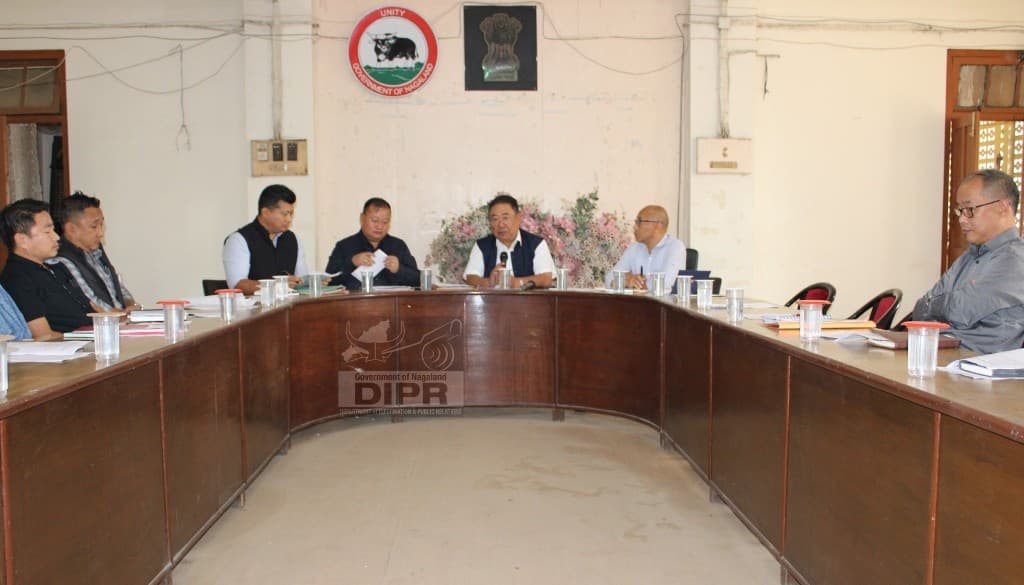
DIMAPUR — The monthly meeting of the Dimapur District Planning and Development Board (DPDB) was held at the DC’s Conference Hall, Dimapur, on Thursday, where members discussed monsoon preparedness, urban heat stress, and the registration of new societies.
The meeting was held under the chairmanship of Advisor for Labour, Employment and Skill Development, and Excise, Moatoshi Longkumer, stated a DIPR report.
In his welcome address, Longkumer expressed confidence in the strength and coordination of the Dimapur team. He stated that the district has maintained good teamwork and cooperation among departments, which has contributed to its steady progress.
Among the primary items of the agenda was the registration of societies, including the Shiv Laxmi Mandir Committee and Brighter Tomorrow Society. In the health sector, the board took up the requirement of focus lamps and radiant warmers for the District Hospital Dimapur, as proposed by the chief medical officer (CMO), Dimapur, where the board agreed to recommend the respective agendas.
Also read: Two-day disaster management training for first responders underway in Dimapur
On monsoon preparedness and the drainage system in Dimapur, the house deliberated on the need to ensure that all drainage channels are cleared ahead of the approaching rainy season to prevent waterlogging and potential flooding in vulnerable areas.
After detailed discussion, the house directed the management committee, in coordination with the Dimapur Municipal Council (DMC), to take immediate steps for the removal of obstacles and blockages in critical locations wherever necessary. The chairman stressed that timely intervention and coordinated efforts would be crucial to mitigate risks and safeguard public property during the monsoon period.
The board also deliberated on the recognition of Urban Heat Stress as a state-specific disaster and discussed climate-responsive urban resilience initiatives in Dimapur, as proposed by Earth Alliance Nagaland. Related to this, a PowerPoint presentation was presented by the Dimapur Municipal Council.
It highlighted priority policy recommendations and next steps to mitigate the growing impact of climate change in the district. Among the key proposals is the formal recognition of Urban Heat Stress as a district- or state-specific disaster under the Nagaland State Disaster Management Authority (NSDMA).
The activation of the State Disaster Mitigation Fund (SDMF – Mitigation Allocation) was also proposed to implement a priority Heat Action Plan (HAP) under a comprehensive Climate Action Plan for Dimapur.
The presentation highlighted the need to mainstream heat-responsive Development Control Regulations (DCRs) within the Dimapur Master Plan to embed climate resilience into future urban growth. Another major recommendation includes the formal endorsement of the “Greening Dimapur Project” as a district-level climate resilience framework to guide multi-scalar convergence and investment.
Strengthening municipal and district coordination mechanisms to protect vulnerable populations, particularly informal workers and heat-exposed communities, was also underscored. Officials further called for positioning heat mitigation as a preventive public health and infrastructure investment, which would enable access to external climate adaptation and resilience financing.
A temperature trend analysis presented during the session indicated that Dimapur’s monsoon-season temperatures currently range between 24°C and 32°C. However, projections show that in the next 20 years, average summer temperatures could rise by 1.5% to 4%, depending on global emission trends.