


Three accused in the Dimapur abduction case surrendered as Nagaland Police warned against misuse of ceasefire cover for criminal acts.
DIMAPUR — Three accused in the abduction of Dimapur-based businessman Kiyeto Zhimomi voluntarily appeared before the police on Thursday, even as Nagaland Police intensified pressure on those involved and warned that no ceasefire arrangement can be misused to shield criminal acts.
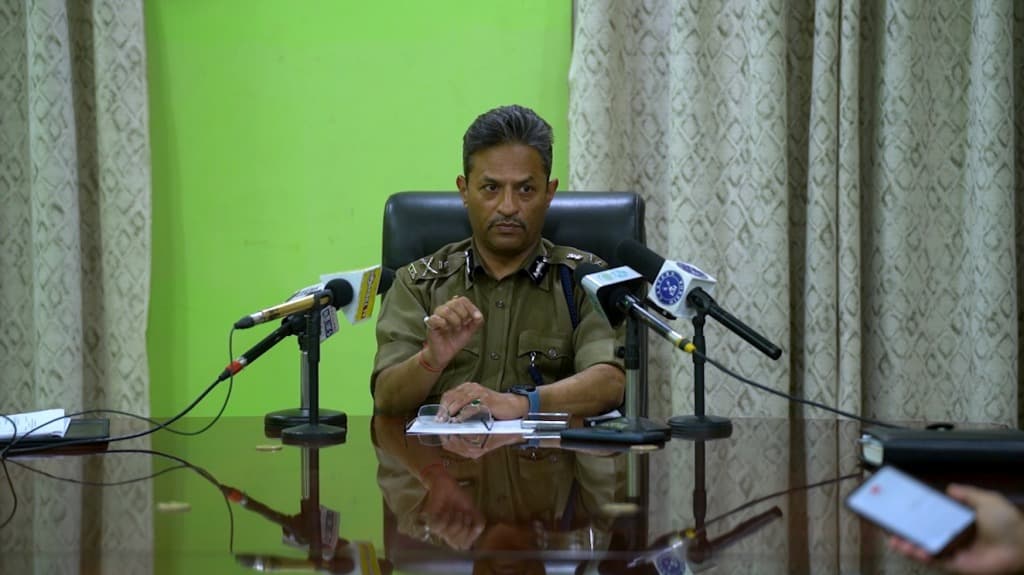
Addressing a press briefing at the Police Comple in Chümoukedima, Director General of Police (DGP) Nagaland, Rupin Sharma informed that the three—Lovito Yeptho, Viniho Kiho and Hukhevi Yeptho—appeared before the police following sustained engagement and dialogue.
The DGP said that upon receiving the complaint regarding Zhimomi’s abduction, police “immediately sprang into action” and successfully rescued the victim through a combination of front-channel and back-channel policing.
Also read: NSCN (K) asks Sumi organisations to reconsider demand to shift ceasefire cell
Subsequent investigation, he said, revealed the involvement of specific individuals, prompting efforts to secure their arrest.
When routine policing measures failed to yield results, the Dimapur Commissionerate, along with Nagaland Police under the Commissioner of Police, Dimapur, imposed an embargo on January 22 around the Ceasefire Supervisory Board (CSB) office of the NSCN-K (Khango- Vusshe) faction.
According to Sharma, police deliberately avoided confrontation, prolonging the embargo while engaging the faction in dialogue and urging it to surrender or hand over the named accused.
He said that statements made by the faction’s representatives during press conferences made it evident that the abduction was carried out on instructions from senior members, making denial of involvement untenable.
Later that evening, police entered the camp but did not find the accused. Negotiations, however, continued inside the camp, with police insisting that the faction hand over its cadres, as it was aware of those involved.
Sharma shared that senior state leadership and the government were kept informed throughout the operation.
He also disclosed that correspondence was exchanged with the chairman of the Ceasefire Monitoring Group (CMG), who, in a reply received around 3-3.30 pm, stated that the Khango faction’s explanation was unsatisfactory and that ceasefire ground rules had been violated.
The CMG chairman, Sharma said, clearly stated that maintaining law and order is the responsibility of the government of India and the state government, and that no faction has the authority to take the law into its own hands.
Reiterating the purpose of ceasefire supervisory offices, the DGP explained that such facilities exist only to maintain peace, prevent inter-factional clashes and avoid misunderstandings with security forces, and cannot be used to summon, detain, abduct or threaten individuals.
He also maintained that camps located in populated areas create fear and insecurity among the public, echoing long-standing demands by civil society organisations for their relocation.
Sharma added that at least three cadres have so far been produced before the police, while seven individuals have been identified in connection with the case.
He did not rule out further arrests as investigations continue, warning that such activities disturb public order, vitiate peace and adversely affect business growth and employment opportunities for Nagaland’s youth.
Appealing to all factions to strictly adhere to ceasefire ground rules, the DGP urged the public to stand with the police.
He clarified that anyone with information relating to a cognisable offence—including victims—should lodge a formal complaint, and police would act strictly in accordance with law.
On the issue of ceasefire offices being located in public areas, Sharma said that their allocation is decided by the Ceasefire Monitoring Group involving multiple stakeholders, including landowners.
If landowners withdraw consent, he said, relocation becomes mandatory. He welcomed continued pressure from civil society and tribal organisations, stating that it strengthens the government’s position.
The DGP also announced that the government of India has agreed to fund a comprehensive CCTV and Automatic Number Plate Recognition (ANPR) camera network in Dimapur and Kohima, expected to be operational within four to six months.
The project will include 24×7 control rooms, with free internet support from the Centre for the first year.
On the implementation of e-Challan, Sharma said that Nagaland Police have already tied up with a bank willing to provide POS machines free of cost, but the proposal is awaiting government approval.
He said he would pursue the matter again, stressing that all collections must go directly into the state government’s coffers for public use.