[caption id="attachment_88471" align="alignleft" width="300"]
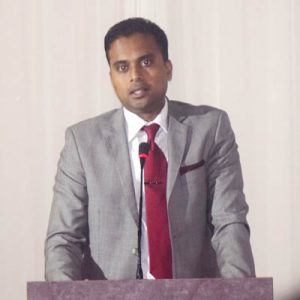 Rajesh Soundararajan speaking during the Connect 16 in Kohima town on December 14.
[/caption]
Kohima, Dec. 14: Although Nagaland claims to be composed of ’99 percent’ Christians, it is not always visible considering that individuals have opined that many do not believe in absolute truths. Values and standards are disappearing and many now think that religious values should not be imposed on workplaces.
This statement was from local researcher, Lilly T Metha, accordingly with a survey that was conducted on the dynamics of spirituality and faith, by the Commissioned to the World of Work Network (CWWN).
Giving an outline of the sample survey during an event, the annual Connect Event for 2016, that was held this evening at the De Oriental Grand, Metha said there was a great divide between the secular and the religious ‘in terms of the morality.’ It determines the way things function and work in many workplaces, she said.
The event was held with a purpose to fostering conversations, forging relationships and fuelling people towards purposeful work and living. The Deputy Director of the Administrative Training Institute (ATI), Dr Hovithal Sothu, and the joint secretary for H & FW Rajesh Soundararajan were the panellists.
As per the survey, it was found that only 4% agreed that where they were placed currently was their calling; 48% were ‘disturbed by how Christians conduct themselves in the workplace,’ and 41% were found to be often discouraged by the way things function in workplaces.
On the other hand, while 35% disagreed that it was easy to be a disciple of Jesus in the workplace, 76% have agreed that their faith drives them to be faithful and sincere in their work.
Though only 5% agreed that there was no connection between faith and dedication to work, 74% felt responsible that each one of them strive to make a difference in their workplace.
Quoting the famous adage ‘Service to men is service to God,’ Hovithal Sothu said ‘Our workplace as it is should be our church and should be our temple, our mosques.’
Stating that there are about 1, 40, 000 employees working for the government, they were similar to ‘small drops of water in the desert.’
Agreeing with the survey where 74% felt responsible that each one of them should strive to make a difference in their workplace, Sothu, however maintained that when the ‘spirit is weak, they get drowned into the system –the wrong system, the adjustment system, the compromising system.’
Further, pointing out that human wants were ‘compromising the values and ethics of every Christian in the workplace,’ Sothu asserted that ‘things’ need to change top-to-bottom. According to him, every person needs to be ‘one person’ and ‘not one person in the church and somebody else in the workplace’.
Rajesh Soundararajan, on his part, said ‘Be it any religion, any faith or any cultural value belief, as long as we are able to turn the good virtues of our religion / faith to the good work of what we do, then we have done justice to both our work and our religion.’
Even as 96 percent of employees believed that they were not placed in the ‘right workplace,’ Soundararajan maintained that as long as ‘We are there in our place, whatever we do now, wherever you are placed right now and for how many days you are placed, take it as our calling for a month or year and do justice to our calling.’
Queried if spirituality should be strictly private, Soundararajan maintained that there was a ‘thin line between spiritual activities and spirituality.’ As long it does not disturb harmony, he said, it doesn’t hurt anyone’s sentiment. ‘It should be ok,’ he said.
CWW Network stated that it was time to consider the ‘dangers of indiscriminately separating the sacred from the secular’ as there was a ‘wide chasm’ that separated the two. It is a duty for every person to find the means to ‘bridging the gap instead of running away from the perplexing life-situations that the real world throws at us.’


