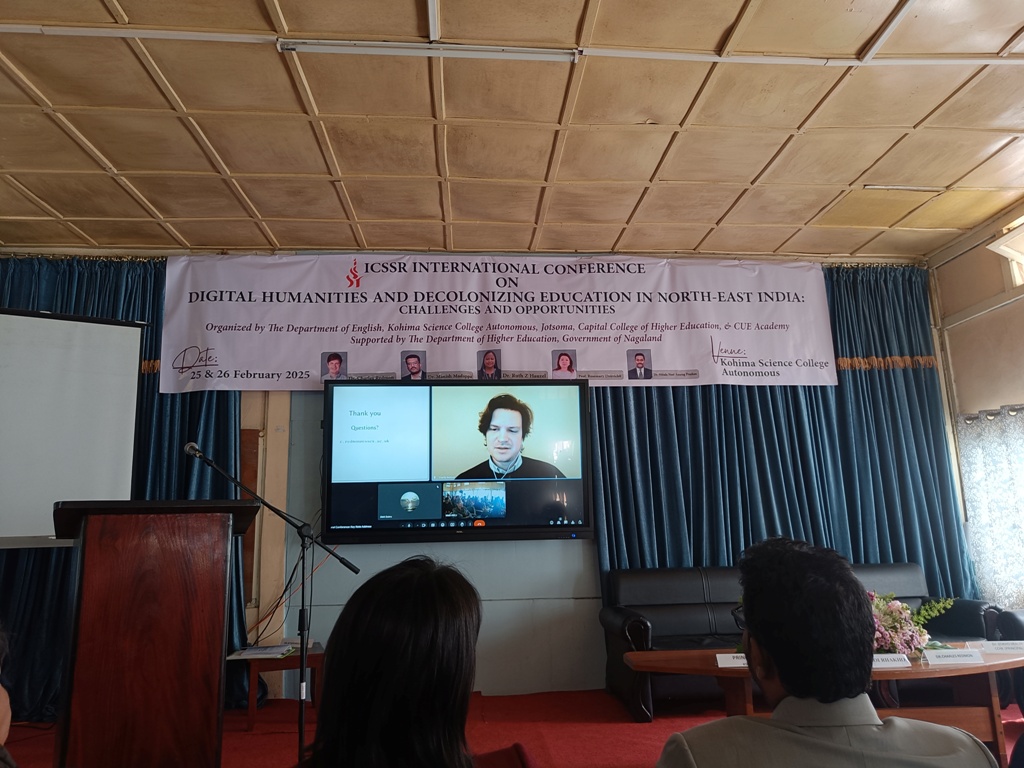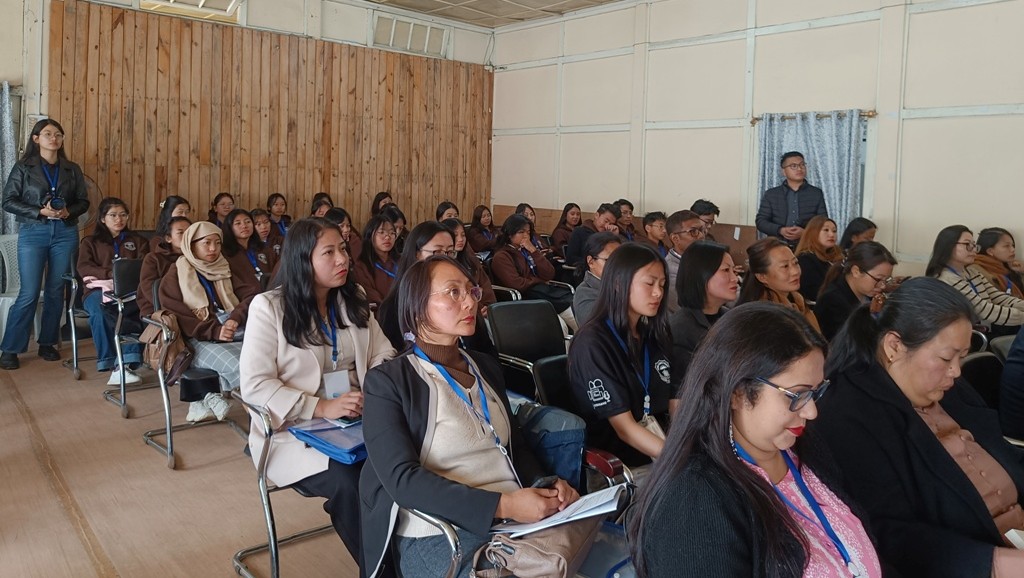
Participants at the inaugural session of the conference at
Kohima Science College, Jotsoma, on Tuesday.
- KOHIMA — The
Department of Higher Education, Nagaland, is ready to support and encourage
institutions to organise national and international programmes, research, and
publications.
- Medongoi Rhakho, deputy director of Higher Education, stated
this while addressing the ‘ICSSR international conference on digital humanities
and decolonising education in northeast India: challenges and opportunities’ on
Tuesday at Kohima Science College, Jotsoma.
- He noted that the state is particularly lacking in
participation in national and international programmes, research, and
publication.
- The conference is being organised by the department of
English, Kohima Science College (Autonomous) Jotsoma, Capital College of Higher
Education, Kohima, and CUE Academy, Centre for Person-Centred Education,
Kohima, and is supported by the Department of Higher Education.
- He stressed the agricultural revolution, industrial
revolution, and software age—where everything is controlled by data—and
reminded that the world is not just in the software age but moving into the age
of AI.
- Charles Redmon, assistant professor at the University of
Essex, in his keynote address through video conferencing, shared the reasons
for his focus on the northeast. He discussed his research and resource
development on the Garo digital lexicon/pronouncing dictionary and Phom
orthographic opacity and parsing.
- Citing some of the constraints in language technologies in
the region, he stated that work remains limited to a small number of
researchers, and thus the coverage is not balanced but rather reflects their
expertise and interests. He also mentioned that it is crucial for researchers
to understand what is happening in the commercial space, not only in terms of
how research can be turned into usable products but also regarding the
proprietary work companies are doing.
- To tackle the constraints, he suggested that there is a need
to coordinate efforts by examining each language and identifying the major
gaps. With recent activities from companies like Facebook and Google, he
highlighted the need to test their multilingual engines and identify any gaps.
He also suggested that extensive surveying is necessary to understand how
people engage with technology.