[caption id="attachment_195531" align="aligncenter" width="500"]
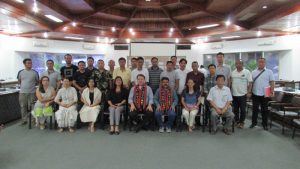
Participants from Nagaland, Mizoram, Meghalaya, and Sikkim seen here during the five-day programme.[/caption]
Dimapur, July 16 (EMN): Five-day training on value chains using an approach developed by the Deutsche Gesellschaftfür Internationale Zusammenarbeit (GIZ) GmbH was held from July 9-13, in partnership with the Office of the Agriculture Production Commissioner (APC), Government of Nagaland.
The training was organised under the Indo-German project‚ “Climate Change Adaptation-North Eastern Region (CCA-NER),”in collaboration with the Ministry of Development of North Eastern Region (Doner), the press release received from CCA-NER project director informed.
The training participants included government officials, research scholars and various organisations from states of Mizoram, Meghalaya, Sikkim, and Nagaland.
The training introduced the participants to the approach of value links and was moderated by Alfons Eiligmann, IDC Unternehmensberatung GmbH, lead trainer and secretary of the International Value Links Association, Germany and Dr. Rajeev Sharma, member of the International ValueLinks Association, India.
The purpose of the training was to enhance the capacity of the field officers on areas of agriculture value chain; improve analytical skills on value chain production, market opportunities, challenges and risks and strengthen the capacity of field functionaries, to develop comprehensive business plan.
Ministry of Doner was represented by Mercy Epao, director of Doner along with Temsunaro Aier, additional secretary of Agriculture, Government of Nagaland. Both of them voiced out that the training has a high relevance in areas of promoting farm produces from the Northeast region.
Aier stressed the need of organising such training for the policy makers which will better equip them in making comprehensive agriculture policies. Bendangyanger, CEO, Nagaland State Agriculture Marketing Board also attended the inaugural session.
‘Value Links’ is a brand name for an approach designed by the Deutsche GIZ GmbH and used worldwide to assist practitioners in improving their understanding and skills to develop meaningful value chains for various produce, set examples from across the world was used and working groups sessions helped the participants to get a firsthand experience to develop value chains, the press release informed.
It has informed that GIZ GmbH is Germany's leading provider of international cooperation services. As a federal enterprise, it support the German Government in achieving its objectives in the field of international cooperation for sustainable development. With a global footprint in over 120 countries, GIZ is stated to have leverages its regional and technical expertise for local innovation. For over 60 years, GIZ has been working jointly with partners in India for sustainable economic, ecological, and social development. Currently, GIZ has over 330 employees in India, of whom 85 per cent are national personnel.
“The Federal Ministry for Economic Cooperation and Development, the Federal Ministry for Environment, Nature Conservation and Nuclear Safety as well as the Federal Ministry for Economic Affairs and Energy are the main commissioning parties of GIZ in India. Other clients include Indian public sector clients, the European Union and foundations.”
The Government of India is said to have launched numerous important initiatives to address the country’s economic, environmental and social challenges, and GIZ is contributing to some of the most significant ones. It supports key initiatives such as Smart Cities, Clean India and Skill India. GIZ, in close cooperation with Indian partners, devises tailor-made, jointly-developed solutions to meet local needs and achieve sustainable and inclusive development, the release stated.


