


In the Indian context, just providing facilities is not enough to educate everyone. There is a need to focus on backward states and remove gender and regional disparities, increase enrolment and retention and providing quality based leaning.
(On the occasion of National Women's Day on February 13)
Special focus on backward states
In the Indian context, just providing facilities is not enough to educate everyone. There is a need to focus on backward states and remove gender and regional disparities, increase enrolment and retention and providing quality based leaning.
The work done by girls is usually not visible as it is confined to the home. In rural areas, girls take care of their brothers and sisters, cook food, clean, fetch fuel and wood and help in sowing, ploughing, harvesting etc. in the fields. Even in urban areas, girls do household chores as well as earning money outside the home. Although there is no effective method available for measuring or financially evaluating household work; according to a 1981 estimate, a rural girl would have done work worth more than INR 39,600 by the time she becomes an adult.
The curse of child marriage
Child marriage is a curse for both boys and girls. But for girls the consequences are graver since, for them, marriage means the end of education, taking over responsibilities inside and outside the home, and restrictions on movement in and outside the home. Early marriage prolongs the fertility of girls. Due to early and repeated pregnancies, they become physically weak. As a result, child marriage reduces the productivity of adult women.
Measures for elimination
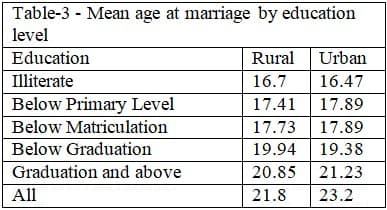
The Child Marriage Restraint Act, 1929 (replaced by the Child Marriage Prohibition Act 2006) does not seem to be implemented anywhere. Two efforts are required to eradicate child marriage. First, to awaken the community and secondly, to overcome poverty, the root cause of child marriage. On an average, 1,00,00,000 marriages take place every year in Bharat, out of which 30 percent of girls are of the age of 15-19 years. A clear impact of education is seen on the age of marriage. The average age difference between a graduate and an illiterate girl at the time of marriage is four and a half years. Sometimes they are married before they even reach puberty. 90 percent of them become mothers within the first one or two years.
According to the data collected by N.N.M.B. (1980) during the year 1975-78, girls in the age group of 13-18 years get less iron than the recommended amount as compared to boys. Young girls become anaemic as a result of menopause due to deficiency of iron in the diet. Low birth weight and basic delivery related complications are more common among teenage mothers
Girls/women who give birth to their first child at an early age are at risk of birth complications. After the first menstruation around the age of 14, they have to endure the pain of intercourse. Their bodies and reproductive systems are immature. Apart from the requirements of tissue maintenance and foetal development, they also have to meet the nutritional demands for their own growth.
Adverse effects
Due to their gender, girls are more susceptible to the adverse effects of adverse circumstances than boys. Children living in difficult circumstances can be classified into many categories such as:- working children, street children, neglected and exploited children, children associated with institutions, children affected by the consequences of war, children of prostitutes, children involved in sexual relations in childhood, children who are victims of physical abuse. Poor families in areas adjacent to big cities, deprived families living in rural areas, prostitutes, gamblers, alcoholics, prisoners are at the highest risk of sexual abuse.
Incidents of rape of minor girls
Incidents of rape of minor children are increasing. 25 percent of rape cases are of minor girls. At some places, sexual abuse is also done in the name of religion, which is popular as “Devdasi” in Bharat. According to Oxfam India’s 2011-12 report, 29 percent women in the labour sector, 23 percent in domestic maid service and 16 percent in small scale industrial units have complained of sexual exploitation.
Political will and actions are needed to ensure equal opportunities and status for girls in the decade of 2030. This is only possible with the joint efforts of the government, international organisations and private institutions. Political, legal and developmental policies should be made to eliminate gender discrimination and bias in childhood.
The main points suggested by experts regarding girls are as follows:-
(1) Religious, legal, social, economic and anthropological evidence should be collected and such information should be used in policy making and programme based interventions to improve the situation.
(2) Concrete steps should be taken by setting targets and preparing a time table related to the basic health, nutrition, education and social status of girls.
(3) A time-bound process should be set at the community and national levels to ensure survival and development programmes.
(4) The negative image of girls prevalent through media, education, religion and culture must be corrected through legal and social mechanism.
(5) To enhance self-confidence and self-reliance in girls, human development activities should be organised at various levels and their active participation should be encouraged.
(6) Equal rights for girls should be supported in every national and international gathering.
The daughters of Bharat are victims of gender and caste-based malice. They are forced to live a suffocating life from prenatal foeticide till the last breath of their life and are living out the famous lines of the national poet Dinkar, “Nari Jeevan Hai Teri Yahi Kahani, Aanchal Mein Hai Doodh Aur Aankhon Mein Paani”. The fact cannot be denied that women are more responsible than men for the pitiable condition of girls. Education is the only spark that can ignite their extinguished lives and remove the darkness that has been going on for generations. Women's awakening and women empowerment is the divine weapon that will be the new ray of dawn for the neglected daughters of Bharatvarsha in which the whole nation will shine.
Er. Prabhat Kishore
(The author is an engineer and academician)