[caption id="attachment_148343" align="aligncenter" width="565"]
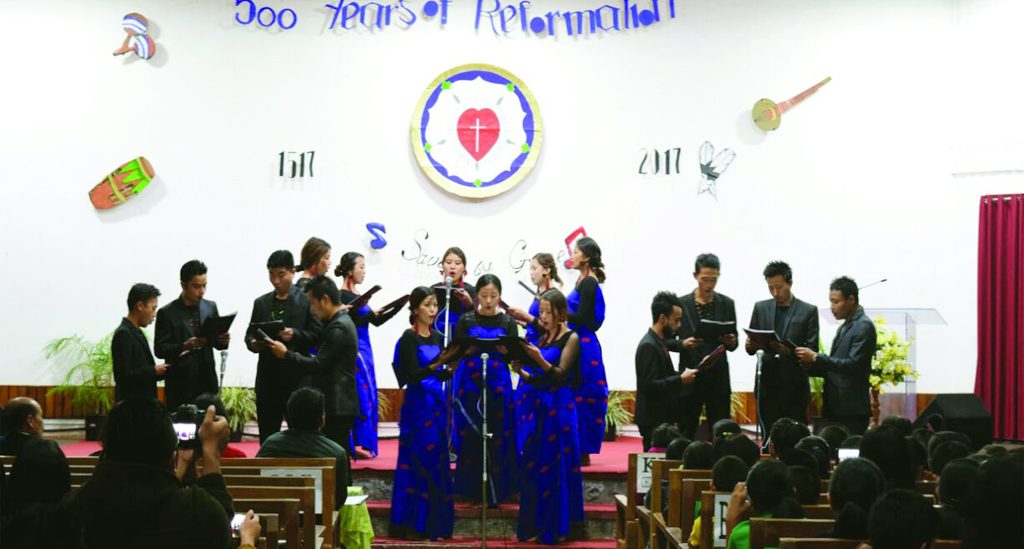 A glimpse of the anniversary programme at Clark Theological College in Mokokchung.
[/caption]
Dimapur, Nov. 5 (EMN): Clark Theological College (CTC) in Mokokchung district celebrated its 500th anniversary of service in reformation on Oct. 31. A daylong programme marked the event, updates stated on Sunday.
500 years ago on Oct. 31 1517, the updates stated, Martin Luther, a German monk, philosopher, law expert, musician and professor of theology ‘nailed 95 theses on the door of cattle church in Wittenberg in Germany critiquing or rather challenging the Roman church for the sale of indulgences by church leaders.’ The updates quoted: “The true treasure of the church is the most holy gospel of the glory and grace of God.”
Luther’s 95 theses was an attempt at reformation of that which had suffered ‘deformation’ by the Roman church, the press release stated. He raised voice against the Roman church’s monopolies and called for “re-orient Christianity on the original message of Jesus,” the updates stated.
“This gesture changed the face and direction of global Christianity and contributed to the birth and growth of the Christian protestant tradition. That was nearly 500 years ago! His boldness to challenge mighty Roman church was due to Spirit-empowered conviction, courage and urgency,” it was informed.
The daylong commemoration at the college began with a thanksgiving service during which a visiting professor of systematic theology, Dr. Dennis Oh from South Korea, spoke, the organisers informed. He reflected on the life and work of Martin Luther.
‘The speaker observed that during Luther’s time, the unrighteousness of the church was very high and against which Luther stood his ground and for which he was labelled by the church as heretic. It was very significant and motivating, when Dr Dennis Oh concluded his message by saying, “Luther was condemned by the Church and for which we are here today,”’ the press release stated.
During the afternoon session of the event, a symposium was organized where Dr. L Imsutoshi Jamir, associate professor of communication and cultural studies at Clark Theological College presented a paper on the topic “Political economy of Luther’s ‘read the Bible for yourself’” and its message for the contemporary Northeast India churches. In his paper, Jamir argued that political economy of Luther’s ‘read the Bible for yourself’ was an attempt to de-construct church monopoly of theology.
Further, Jamir observed that the church during Luther’s time was working to accumulate wealth and power. Thus theology and church practices were centred on monetization with the aim to maximizing revenues by offering cheap means of salvation—salvation through members contributions.
“Against this constructed theology and practice, against this false consciousness, and against this manufacturing consent, Luther boldly and with convection said that the Word of God overrule all this constructed theology and practice,” Jamir said.
Dr. Jamir concluded his presentation by saying that at the time when the Northeast Christianity is challenged by principalities, traditions, legality and ‘when our own church theology and practices are directed towards commodification and monetization,’ Luther’s political economy of “Read the Bible for yourself” is a conscious reminder that the Word of God and its teaching “overrule” all human constructed theology, traditions, beliefs and practices.
The daylong programme culminated in the evening with a musical celebration and a competition in memory of Martin Luther, ‘father of reformation,’ the updates informed.
Further, Dr. Eyingbeni Humtsoe, faculty at systematic theologian and gender studies of Clark Theological College honoured Martin Luther as a musician and said, “Martin Luther was not only a theologian, a monk, philosopher, law expert but he was a church music reformer…renewing the church music was in his heart.”
Eying observed also that Luther gave rise to congregational hymn singing in the German language. She observed that “for Luther, next to the Word of God was music.” Congregational singing was forbidden by law during Luther’s time and therefore, congregational singing fired the reformation, Eying said.
The event also featured a class-wise competition on indigenous versions of Martin Luther’s composition A Mighty Fortress is Our God.
Members of Kumlong Baptist Church’s children’s choir also performed at the programme, the updates stated.


