


Our Correspondent
Kohima, March 30 (EMN): Kohima Science College and Government Polytechnic in Kohima have come to the rescue of the state, which has been hit by the shortage of essential commodities -- hand sanitiser and surgical masks – caused by the novel coronavirus (Covid-19) outbreak.
The minister for Higher and Technical Education and Tribal Affairs, Temjen Imna Along, had initiated the venture and had procured 10,000 litre of rectified spirit for hand sanitiser, and 4,000 metre of non-woven surgical cloth along with other materials, in order to meet the demand for hand sanitiser and face masks in Nagaland.
Eastern Mirror on Monday visited the two institutes that are engaged in mass production of the essential commodities.
Assistant professor of Chemistry, Kohima Science College, Dr. T Tiakaba Jamir, informed that a team comprising eight students and five teachers is engaged in the production of hand sanitiser, with assistance from other staff and faculty.
"The alcohol that we received is 95 percent; we're working hard in order to produce 1000 litre per day with the 10,000 litre alcohol that we received," he said, adding that that hand sanitiser would be produced exactly as per WHO specification and that the finished product would range from 75-80 per cent alcohol content.
Jamir stated that one litre of rectified spirit alcohol could produce about 1.2 litres of hand sanitiser. "We will work hard to finish the production early so that it will be distributed to the needy at the earliest," he said.
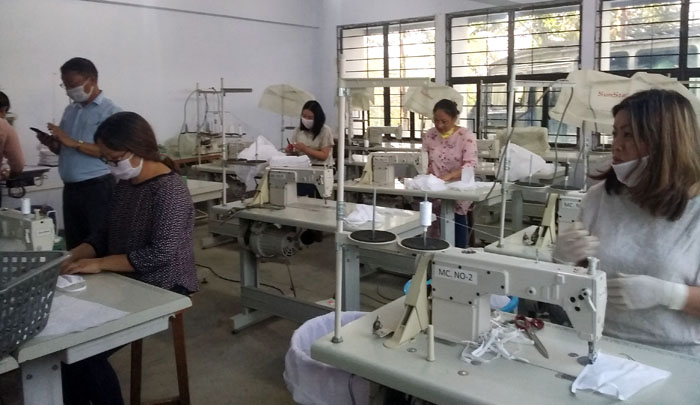
Meanwhile, the Fashion Technology department at Government Polytechnic Kohima (GPK) is involved in making surgical masks.
Speaking to Eastern Mirror, the principal of GPK, Keyiekhru Rhutso, informed that 25 faculty members and students had started cutting and stitching of masks on Saturday (March 28). He asserted that the material used by the institute in making surgical masks is non-woven fabric, which is superior to the masks that are available in the market in terms of quality.
Rhutso maintained that it was difficult to call back all the students from different places after declaring holidays but it used all possible means to deliver the raw materials at the doorsteps of the students to engage them in the production of face masks.
The principal went on to say that the faculty and students, who are working in its laboratory and at home till midnight, produce around 3,000 masks per day. He added that 4000 metre of non-woven fabric had arrived, which is capable of making around one lakh masks.
Rhutso updated that more material (cloth) would be arriving.
It may be mentioned that Along had visited both the institutions to oversee the work and expressed his happiness and appreciated them for their service to the people.