[caption id="attachment_259717" align="alignnone" width="550"]
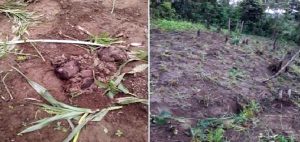 A herd of elephants left a trail of destruction at old Yanmhon Village, Bhandari on July 5, damaging ginger farm and jhum cultivation.
[/caption]
Eastern Mirror Desk
Dimapur, July 10: Unprecedented encroachment of land in Nagaland is proving to be detrimental for the sustainability of both animals and human beings. In yet another case of human-animal conflict, a herd of 20 wild elephants destroyed around 26 acres of ginger and jhum cultivation at old Yanmhon Village, Bhandari, around 11 pm on July 5.
A press release from the chairman of old Yanmhon Village stated that Yanmhon village and other neighbouring areas have been facing this problem for the past 20 years. Elephants have become a threat and are making life difficult for the villagers, the statement said. The chairman also requested the department of forest and agriculture to look into the matter and come up with a sustainable solution, it stated.
Eastern Mirror spoke to the chief wildlife warden of Nagaland, RK Aima and he agreed that the conflict has been going on for a long time. The animals get trapped with the creation of new villages, he said, adding that many awareness programmes have been initiated but another solution was in dire need.
“We want to convert the areas to conservation reserves where villagers will also be benefited if they comply,” Aima stated. He further informed that the villagers will be benefited through schemes in regard to conserving wildlife; and this will help solve problem to some extent.
“There are already around 74-93 conservation reserves in Nagaland and many applications from villages have come from different parts to convert their areas into conservation reserves,” Aima said. “We hope that a large part of Wokha be converted into wildlife reserves where the villagers will be involved in production of food for the animals also,” said Aima. Villagers will not be harmed if the change happens, he informed.
The deputy commissioner (DC) of Wokha, Dr Jeelani Samoon also informed via telephone that whenever there is any damage done to the agricultural fields, cases are taken up and immediate emergency relief is provided to the villagers. He also confirmed that converting the areas in Wokha to wildlife reserves is in the pipeline.
“People and animals can live together with the conversion into reserves,” said the DC.
Earlier this year, during a seminar in Wokha, Noyal Thomas, inspector general of forests and director of Project Elephant, under the Ministry of Environment, Forest & Climate Change, said that both the government of India and Nagaland were well aware and concerned with the protracted problem of ‘human–elephant conflict’ prevalent in the region.
The ministry will extend all possible assistance for mitigation of the conflict, he said. Thomas appealed to the villagers not to harm the elephants but follow adoptive cropping "patterns". He said that the state government should "timely release" the funds given for this purpose and assured that the ministry would take up the matter with the government so that the conflict prevalent in the district could be addressed.
It may be mentioned that human-elephant conflict has become intense in Wokha district over the years. One person was killed and another severely injured while they were sleeping inside a farmhouse in a terraced paddy field at Mekokla village last year.


