


Fazl Ali College hosted a two-day conference on reimagining development and governance in North-East India on Wednesday.
Share


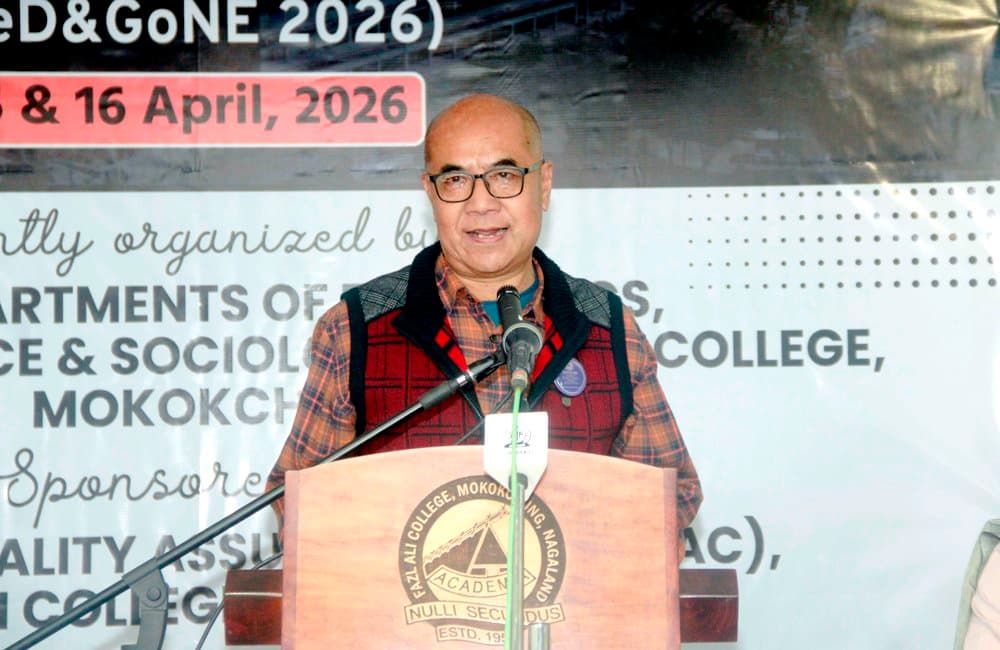
CHUCHUYIMPANG — A two-day conference titled “Reimagining development and governance in North-East India: Pathways for inclusive and sustainable futures” began at Fazl Ali College in Chuchuyimpang village, Mokokchung, on Wednesday.
Scholars, academicians, and independent policy analysts are set to present more than 13 research papers during the event, which seeks to bring together diverse perspectives on how governance systems, policies, and institutions can be reimagined to address inequality, environmental challenges, and the aspirations of the indigenous and frontier communities.
Lanu Aier, retired professor from the Department of Sociology at North-Eastern Hill University (NEHU), delivered the keynote address on the opening day. He outlined key parameters for the theme and offered a broad definition of development, a term that appears across every academic discipline.
Acknowledging the challenge of selecting from its many interpretations, he stated that any change brought about by action is development. The central element, he stressed, is the inseparable link between action and development.
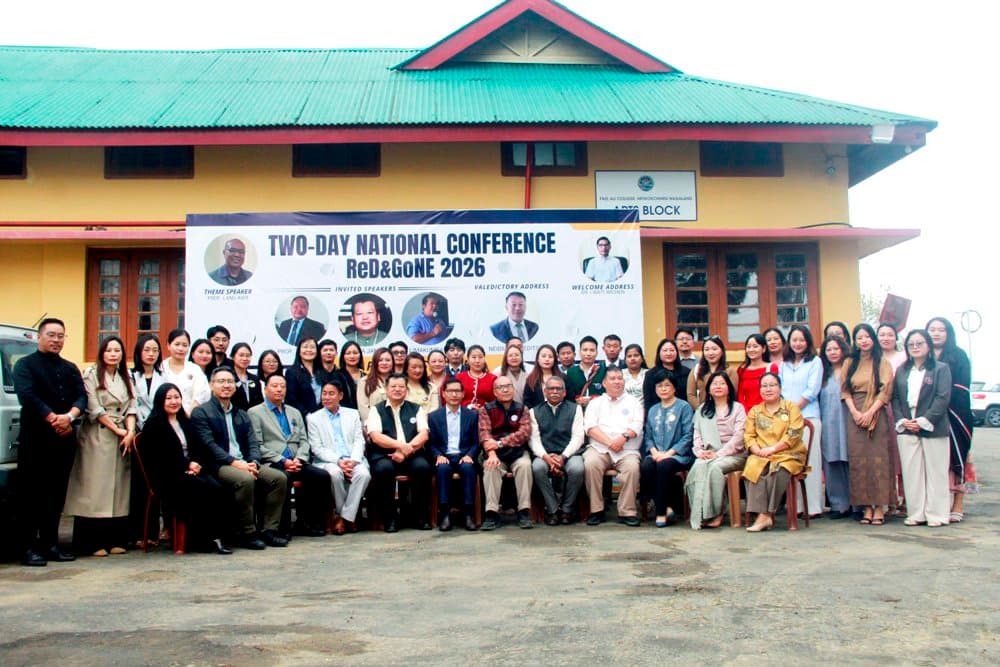
Aier then turned to the ethical and moral questions that arise, asking if development is inherently good or bad. In Nagaland’s context, he observed, the answer is double-edged. While development is often equated with progress, true progress must be measured by qualitative improvement, he said.
Without it, he warned, what appears as advancement may actually be regression. Similarly, if development is viewed as growth, it implies quantitative increase; the absence of such multiplication signals decay. Thus, he said development carries the potential for both positive and negative outcomes.
He described development as a movement with distinct directions, including social, economic, commercial, and religious, noting that social development ultimately encompasses all these dimensions.
He urged the audience to examine humanity and living conditions as the true yardstick of social development, first within Nagaland and then across the wider Northeast. Aier highlighted the roles of political parties, pressure groups, and diverse interest groups. Responsibility, he said, is shared among all, yet each pursues its own agenda.
Aier maintained that social development cannot occur without parallel progress in economic and political spheres, which in turn foster commercial growth. Religious development, marked by self-restraint and ethical control, is equally essential.
Turning to ground realities, Aier described Nagaland’s economy as heavily dependent on central funding and income tax from the working population. “If funding stops, what becomes of Nagaland? Can we still claim to be developed?” he asked.
He pointed out that Nagas excel at articulating values such as honesty, piety, morality, and the strength of tradition yet questioned whether these principles are genuinely practised. As long as the state remains dependent on external support, he argued, its potential will stay constrained. Such critical dialogues, he suggested, are vital for finding solutions.
Earlier, Dr. I Wati Imchen, Principal of Fazl Ali College, stressed the importance of collaboration in solving the region’s pressing challenges and generating innovative solutions.
Highlighting globalisation and multiculturalism, he called for a fresh look at the Northeast’s history, languages, and traditions to build a more inclusive future. He added that the conference provides an ideal platform for academicians and researchers to chart a sustainable path ahead.
The conference is jointly organised by the departments of Economics, Political Science, and Sociology at Fazl Ali College and sponsored by the college’s Internal Quality Assurance Cell (IQAC).