


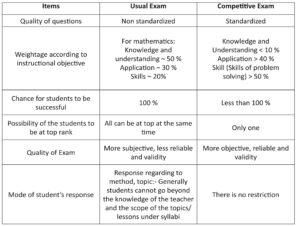
 From the above observations, it is found that our education gives more emphasis on knowledge and understanding whereas competitive exams give more emphasis on skills.
(1) Why do competitive exams prefer skill areas to knowledge area?
The reason is that a competitive exam is a gateway to meet various dynamic activities of life. Life is neither a theory nor an experiment but it is a process of purposeful activity as a whole. So, everybody has to solve problems as his/her life is associated with activities. Actually, it is not the knowledge or even the understanding that helps us to solve our problems but it is our intelligence or probably wisdom. Wisdom is a psycho-motor system in which all physical and mental characteristics and abilities of a living thing are co-related. Intelligence or wisdom is a whole.
According to Aristotle, “A whole is greater than the total of its components.” But, according to Euclid, “A whole is equal to the sum of its components.”
Both the statements are correct. Euclid’s statement is based on logic and applied to the measurements of quantities but Aristotle’s statement is based on psychology and is applied to love and affection, emotions, feeling, instinct, spirit etc. As our world is ruled by both logic and psychology, education is a process of harmonious development of an individual physically, mentally, aesthetically, morally, socially, spiritually, etc. I mean education is not for only the knowledge areas.
The skills developed from learning form a domain of intelligence called life skills. But life skills education is neither a separate branch nor a subject [Even though life skills education appears as a subject in Indian school curricula] but it is an integration of various skills from various disciplines. Until and unless an individual develops the skill objectives in his/her different subjects in schools, there is no way of achieving in life skills. So, on the basis of achievement our education is now categorized as education and value education. Value education ensures an individual to develop life skills.
One of the factors for giving more importance to knowledge and understanding objectives than others in our education is our educational philosophy “Idealism” with which we have begun our education from time immemorial. The changes in Indian education system with time were only its policies and programs but not in educational philosophies. That is why, even after 50 years of our independence, still today we enjoy our traditional system. The present existing system was very good in India during British era, but today this system is only for literate.
Idealism, in spite of its much goodness, some of the limitations in the present context are;
1. Teacher centered
2. Based on bookish knowledge
3. Dialogue method of teaching
(I) Regarding teacher centered education:-
In the philosophy of idealism, generally a teacher is the supreme. So, the nature of the pupils is the nature of their teachers. The method that is liked most by a teacher is the only method children have. Most of the time, many children are restricted to enjoy some other varieties/methods (mostly in maths) without having any reason by their teachers. Many students complete their high schools with only two or three teachers at most in their life [mostly in rural area]. It means 1/3rd of the learning that makes very important part of life of many pupils is in the hands of some particular teachers. In such cases there is no guarantee of learning. [What I would like to suggest is that pupils need to interact several teachers, varieties of methods, ideas, even though you are quite satisfied with your schools. Because limited experience cannot provide you full confidence. If there is no confidence, you will lose your chance.]
I don’t mean the teachers but our concepts that need to be changed. “Nothing on the earth is beautiful as much as a teacher; nothing can replace the role of a teacher in the world of Education.” Also, I do not mean that “the philosophy of idealism is not effective.” It is much needed now a day because it is the only one that respects the beauty of life and moral values. Loss of idealism will lead to the loss of human community in this world of the developed and developing countries follow the educational system of Pragmatism. One of the principles of pragmatism that is “continues reconstruction of experience” from activities, projects, field works, etc. helps the pupils to develop life skills in natural way.
Modern concepts of education:-
Among the various modern concepts let us see a few points:-
(i) Growth:-
It is an improved word of our usual term “knowledge” but it is much more than knowledge. Learning and developing together execute growth which is a natural phenomenon. Children have their own autonomy for learning, which is also a natural phenomenon.
If we do not give respect to their autonomy of learning from the very beginning, education becomes a burden and becomes more and more harder as it goes to higher and higher classes. The educational system that makes the fullest growth is termed as constructivism in which a teacher is not a source of knowledge but the teacher is the one who creates the situations in which children feel to learn and develop by themselves. Here we can remind the words of our eminent scientist Albert Einstein “I never teach my pupils, I only attempt to provide the conditions in which they can learn” In the view of constructivism, “a good teacher is the one who can transform his pupils in such a manner that pupils can do everything even without their teachers or somebody else. This is beyond the scope of idealism.
Let us imagine a situation of plantation. We cannot provide a direct growth from external. What we can do is to control its environment. [Regarding this situation, something I would like to remind is that our generation is in such a state that even a seed/plant cannot grow by itself without some external assistance or control. Then why not we provide guidance and counseling to our children?] Difference in educational growth makes the pupils difference in competitive exams
(ii) Impact of technology:-
Educational technology has changed the face of our education, our usual practices based on text books, chalk-black board, dialogue/deductive method of teaching, etc. are rectified by computer assisted instruction (CAI), teaching aids, methods of program learning and system approach etc. It makes teaching-learning strategy systemic, technical and increase in pupils’ participation.
Because of this technical system of education, the system of setting questions for competitive exams also has changed into highly technical forms. But, in reality almost all the schools and colleges in North Eastern cannot provide all the facilities to develop life skills. That is why a majority of students from North Eastern are facing a lot of problems in appearing competitive exams, apart from the point of competition.
For competitive exams we should not be simply learnt but we have to be trained thoroughly. Training helps to develop the skills of utilization of our learning experiences in life situation. My question is “have you gone through continuous trainings during your 20 years of learning in schools and colleges or have you even found any lesson regarding competitive exam? Or is training not a part of education?” Any board exam throughout the state/country is not a competitive exam. That is why even after 20 years of learning and coming through a series of evaluations; everybody needs to have a training class from the very beginning. Now let remember the words:- “Education should be related to the life and needs of the person ….” given by Indian Education Commission in 1964-1966, if we look up the date, we will realize that a period of 50 years has gone that this recommendation had been made. It shows the slow progress in Indian Education System. On the other hand a competitive exam is a means of choosing the best. So, there is no way to compromise from the side of competitive exam.
(iii) No matter you can do now. Few words that may yield positive thoughts in your training are:
(a) You are better if you follow the principle of your identity [if you are a student, you should follow the system, method, concept etc applicable to students]
(b) You are better if you train as much as early.
c) You are better if you can have the test of more varities.
d) You are better if you ask “how to use or when to use” in place of saying “what is the use” whenever you find something new or unusual.
You can see an example showing how the questions are set technically and how to train ourselves (for mathematics) in the revised edition “Essential Mathematical Formulae” that will be released soon.
Now you can see the beauty of our world with your own eyes and hear about it with your own ears. There exists the world with you. So everything is related with you and depends on you. Try to explore the bests from you for the sake of people.
From the above observations, it is found that our education gives more emphasis on knowledge and understanding whereas competitive exams give more emphasis on skills.
(1) Why do competitive exams prefer skill areas to knowledge area?
The reason is that a competitive exam is a gateway to meet various dynamic activities of life. Life is neither a theory nor an experiment but it is a process of purposeful activity as a whole. So, everybody has to solve problems as his/her life is associated with activities. Actually, it is not the knowledge or even the understanding that helps us to solve our problems but it is our intelligence or probably wisdom. Wisdom is a psycho-motor system in which all physical and mental characteristics and abilities of a living thing are co-related. Intelligence or wisdom is a whole.
According to Aristotle, “A whole is greater than the total of its components.” But, according to Euclid, “A whole is equal to the sum of its components.”
Both the statements are correct. Euclid’s statement is based on logic and applied to the measurements of quantities but Aristotle’s statement is based on psychology and is applied to love and affection, emotions, feeling, instinct, spirit etc. As our world is ruled by both logic and psychology, education is a process of harmonious development of an individual physically, mentally, aesthetically, morally, socially, spiritually, etc. I mean education is not for only the knowledge areas.
The skills developed from learning form a domain of intelligence called life skills. But life skills education is neither a separate branch nor a subject [Even though life skills education appears as a subject in Indian school curricula] but it is an integration of various skills from various disciplines. Until and unless an individual develops the skill objectives in his/her different subjects in schools, there is no way of achieving in life skills. So, on the basis of achievement our education is now categorized as education and value education. Value education ensures an individual to develop life skills.
One of the factors for giving more importance to knowledge and understanding objectives than others in our education is our educational philosophy “Idealism” with which we have begun our education from time immemorial. The changes in Indian education system with time were only its policies and programs but not in educational philosophies. That is why, even after 50 years of our independence, still today we enjoy our traditional system. The present existing system was very good in India during British era, but today this system is only for literate.
Idealism, in spite of its much goodness, some of the limitations in the present context are;
1. Teacher centered
2. Based on bookish knowledge
3. Dialogue method of teaching
(I) Regarding teacher centered education:-
In the philosophy of idealism, generally a teacher is the supreme. So, the nature of the pupils is the nature of their teachers. The method that is liked most by a teacher is the only method children have. Most of the time, many children are restricted to enjoy some other varieties/methods (mostly in maths) without having any reason by their teachers. Many students complete their high schools with only two or three teachers at most in their life [mostly in rural area]. It means 1/3rd of the learning that makes very important part of life of many pupils is in the hands of some particular teachers. In such cases there is no guarantee of learning. [What I would like to suggest is that pupils need to interact several teachers, varieties of methods, ideas, even though you are quite satisfied with your schools. Because limited experience cannot provide you full confidence. If there is no confidence, you will lose your chance.]
I don’t mean the teachers but our concepts that need to be changed. “Nothing on the earth is beautiful as much as a teacher; nothing can replace the role of a teacher in the world of Education.” Also, I do not mean that “the philosophy of idealism is not effective.” It is much needed now a day because it is the only one that respects the beauty of life and moral values. Loss of idealism will lead to the loss of human community in this world of the developed and developing countries follow the educational system of Pragmatism. One of the principles of pragmatism that is “continues reconstruction of experience” from activities, projects, field works, etc. helps the pupils to develop life skills in natural way.
Modern concepts of education:-
Among the various modern concepts let us see a few points:-
(i) Growth:-
It is an improved word of our usual term “knowledge” but it is much more than knowledge. Learning and developing together execute growth which is a natural phenomenon. Children have their own autonomy for learning, which is also a natural phenomenon.
If we do not give respect to their autonomy of learning from the very beginning, education becomes a burden and becomes more and more harder as it goes to higher and higher classes. The educational system that makes the fullest growth is termed as constructivism in which a teacher is not a source of knowledge but the teacher is the one who creates the situations in which children feel to learn and develop by themselves. Here we can remind the words of our eminent scientist Albert Einstein “I never teach my pupils, I only attempt to provide the conditions in which they can learn” In the view of constructivism, “a good teacher is the one who can transform his pupils in such a manner that pupils can do everything even without their teachers or somebody else. This is beyond the scope of idealism.
Let us imagine a situation of plantation. We cannot provide a direct growth from external. What we can do is to control its environment. [Regarding this situation, something I would like to remind is that our generation is in such a state that even a seed/plant cannot grow by itself without some external assistance or control. Then why not we provide guidance and counseling to our children?] Difference in educational growth makes the pupils difference in competitive exams
(ii) Impact of technology:-
Educational technology has changed the face of our education, our usual practices based on text books, chalk-black board, dialogue/deductive method of teaching, etc. are rectified by computer assisted instruction (CAI), teaching aids, methods of program learning and system approach etc. It makes teaching-learning strategy systemic, technical and increase in pupils’ participation.
Because of this technical system of education, the system of setting questions for competitive exams also has changed into highly technical forms. But, in reality almost all the schools and colleges in North Eastern cannot provide all the facilities to develop life skills. That is why a majority of students from North Eastern are facing a lot of problems in appearing competitive exams, apart from the point of competition.
For competitive exams we should not be simply learnt but we have to be trained thoroughly. Training helps to develop the skills of utilization of our learning experiences in life situation. My question is “have you gone through continuous trainings during your 20 years of learning in schools and colleges or have you even found any lesson regarding competitive exam? Or is training not a part of education?” Any board exam throughout the state/country is not a competitive exam. That is why even after 20 years of learning and coming through a series of evaluations; everybody needs to have a training class from the very beginning. Now let remember the words:- “Education should be related to the life and needs of the person ….” given by Indian Education Commission in 1964-1966, if we look up the date, we will realize that a period of 50 years has gone that this recommendation had been made. It shows the slow progress in Indian Education System. On the other hand a competitive exam is a means of choosing the best. So, there is no way to compromise from the side of competitive exam.
(iii) No matter you can do now. Few words that may yield positive thoughts in your training are:
(a) You are better if you follow the principle of your identity [if you are a student, you should follow the system, method, concept etc applicable to students]
(b) You are better if you train as much as early.
c) You are better if you can have the test of more varities.
d) You are better if you ask “how to use or when to use” in place of saying “what is the use” whenever you find something new or unusual.
You can see an example showing how the questions are set technically and how to train ourselves (for mathematics) in the revised edition “Essential Mathematical Formulae” that will be released soon.
Now you can see the beauty of our world with your own eyes and hear about it with your own ears. There exists the world with you. So everything is related with you and depends on you. Try to explore the bests from you for the sake of people.
Okram Sunder Singh Lower Chandmari: Kohima