


For most of India's car-selling history, that trust was extended on faith, across a table in a local dealership, with very little formal protection in place.
Share


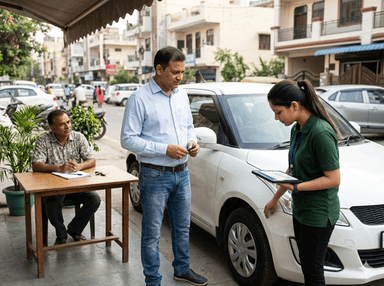
Selling a used car is not just a financial transaction. It is an exercise in trust, trust that the buyer is who they say they are, that the price agreed will not shift at the last minute, that your documents will be handled correctly, and that no complications will come knocking on your door weeks after the car has gone. For most of India's car-selling history, that trust was extended on faith, across a table in a local dealership, with very little formal protection in place.
That is changing. Organised platforms like Cars24 and Spinny have introduced seller safety standards that simply did not exist in the traditional used car market. But the local dealer has not disappeared, millions of Indians still sell their cars this way, partly out of habit, partly out of convenience, and partly because the newer platforms are not yet universally understood.
This article puts all three options side by side and compares them on the safety standards that matter most. The goal is not to dismiss the local dealer entirely, but to give you an honest picture of where the risks lie, and where the protections are, so you can make a genuinely informed choice.
Before comparing the three options, it helps to agree on what we mean by seller safety. It is broader than most people assume, and breaking it down into five distinct pillars makes the comparison clearer.
Identity safety: Are you dealing with verified, accountable individuals, or unknowns?
Price safety: Is the offer you receive protected from manipulation or last-minute revision?
Payment safety: Will the money arrive in full, on time, through a traceable channel?
Documentation safety: Is your RC transferred correctly, and are you protected from future legal liability tied to the vehicle?
Post-sale safety: If something goes wrong after the transaction is complete, is there a mechanism to protect you?
A platform that scores well across all five is genuinely safe. One that covers some but not others leaves you with a patchwork of protection that may fail precisely when you need it most. With that in mind, let us look at each option in turn.
Cars24 has designed its seller experience around removing risk at each step of the transaction. The result is a process where the seller is protected at the identity stage, the pricing stage, the payment stage, the documentation stage, and, uniquely, the post-sale stage as well. It is the most complete safety package currently available in India's used car market.
When you sell through Cars24, you never interact with an anonymous buyer. Your car is assessed and purchased exclusively by a network of more than 60 verified, pre-contracted dealers who bid competitively through a structured auction. These are not individuals who found your listing on a classifieds site, they are accountable business entities with contractual obligations to Cars24 and to the seller.
The seller also undergoes KYC verification, including Aadhaar-linked identity checks, before the transaction proceeds. This creates a fully documented, accountable chain on both sides. Your personal details are stored and processed on an encrypted digital platform, not scribbled on a form and left in a dealer's drawer.
The practical implication of this is significant: there are no strangers at your door, no unsupervised test drives by people you have never met, and no risk of the kind of social engineering tactics that occasionally appear in private used car sales. From the moment you book your inspection to the moment the car is collected, every individual involved is known, verified, and accountable.
The Cars24 auction model is built to prevent price manipulation. Once the auction closes and you accept the highest bid, that price is locked. There is no mechanism for a dealer to come back the next day and say they need to revise the offer downward. The commitment is formal and binding.
This matters because price renegotiation at the point of handover is one of the most common complaints in the used car market. Sellers who have agreed a figure early in the process can find that figure eroded by the time paperwork is being signed, often through vague references to 'additional findings' that were not in the original inspection report.
Cars24's system does not allow this. The inspection report is shared transparently with all bidding dealers before the auction begins, so the final bid already accounts for the car's full condition. There are no new discoveries at handover.
Payment through Cars24 is made via direct bank transfer on the day the deal is confirmed, same-day, traceable, and secure. There is no cash changing hands, no post-dated cheques with uncertain clearing timelines, and no informal transfer through third-party apps that lack accountability. The money arrives where it should, when it should.
The RC transfer is managed end-to-end by Cars24, with digital status tracking so you always know where the process stands. An incomplete RC transfer is one of the most common sources of post-sale headaches for used car sellers, it can leave you legally tied to a vehicle you no longer own, potentially liable for traffic fines, insurance complications, or worse. Cars24's management of this process removes that risk entirely.
This is the feature that truly sets Cars24 apart from every other option in this comparison. Seller Kavach is a dedicated post-sale protection programme that covers you against disputes, claims, or complications arising after the transaction is complete. No other organised platform offers anything comparable, and a local dealer certainly does not.
In practical terms, Seller Kavach means that if a buyer raises a complaint about the vehicle's condition, if there is a dispute over the car's history, or if any other post-sale issue surfaces, you have a formal protection mechanism in place.
You are not left navigating the situation alone. For sellers of higher-value vehicles, or those with any uncertainty about the car's history, this is not just reassuring, it is genuinely valuable.
• Zero exposure to unknown buyers at any stage of the process
• KYC and Aadhaar-linked verification for both seller and buyer
• Auction-locked pricing with no renegotiation possible post-acceptance
• Same-day bank transfer, traceable, guaranteed, and secure
• End-to-end RC transfer with digital progress tracking
• Seller Kavach post-sale protection, unique in the market
Spinny deserves significant credit for the safety standards it has built into its selling process. Across most of the five pillars, it performs at a very high level, and for the vast majority of transactions, sellers using Spinny are well protected. The one area where it trails Cars24 is post-sale protection, which is a gap worth understanding before you decide.
Like Cars24, Spinny operates a closed buyer model. You are not listing your car on a public platform where anyone can respond. Spinny's in-house buying team assesses and purchases vehicles directly, which means the buyer is a known, accountable entity throughout. There are no unsolicited contacts, no strangers requesting test drives, and no informal negotiations with individuals whose identity has not been verified.
This is a fundamental safety advantage over private sales and, as we will see, over the local dealer model. The moment your car is listed with Spinny, the seller-buyer relationship is a formal, platform-mediated one, not a handshake deal with an unknown party.
Spinny's fixed-offer model is one of its strongest safety features. Once the inspection is completed and an offer is confirmed, that number does not change.
There is no auction where the price could theoretically come in lower than hoped, and there is no renegotiation at the point of handover. The offer Spinny makes is the amount you receive, no deductions, no surprises, no pressure.
This is a meaningful protection that many sellers only appreciate fully once they have experienced the alternative. The used car market has a well-documented history of sellers agreeing a price and then being worn down through a series of small revisions before the final handover. Spinny's model makes that entirely impossible.
Spinny processes payment through direct bank transfer within 24 to 48 hours of deal confirmation, fast, traceable, and secure. The full RC transfer is managed by the platform, with proper documentation and follow-through. Spinny's reputation for completing RC transfers cleanly and without the seller needing to chase is consistently strong across user reviews.
Spinny does not currently offer a post-sale seller protection programme equivalent to Cars24's Seller Kavach. For most straightforward transactions, this will never become relevant, once the deal is done, both parties move on without incident. However, for sellers of higher-value vehicles, or anyone selling a car with a complex history, the absence of a formal post-sale safety net is a genuine distinction from Cars24.
It would be unfair to overstate this gap. Spinny's transaction process is clean enough that post-sale disputes are relatively rare. But in a direct comparison on safety standards, it is an honest difference that belongs in the picture.
• Closed buyer model, no exposure to unknown individuals
• Fixed offer with no post-agreement price changes
• Bank transfer within 24–48 hours, secure and traceable
• Full RC transfer managed end-to-end
• Strong customer support for documentation queries
• No post-sale seller protection programme, the one meaningful gap
The local used car dealer is a fixture of Indian towns and cities, and it would be unfair to paint every individual dealer with the same brush. Many are honest professionals who have been in the business for decades and take pride in their reputation within their community. For some sellers, particularly those with an established relationship with a specific dealer, the local route can feel comfortable and familiar.
But comfort and familiarity are not the same as safety. When you examine the local dealer model against the five pillars of seller safety, the gaps become very hard to ignore. This is not about individual dealer character, it is about structural protections, or the lack of them.
When you walk into a local dealership, the basic accountability is established by the fact that it is a physical business with a name above the door. That is a reasonable baseline.
However, the formal identity verification that Cars24 and Spinny build into their processes, Aadhaar-linked KYC, digital records, verified buyer accountability, simply does not exist at most local dealers. The transaction proceeds on the basis of personal trust and a handshake, not documented verification.
More concerning is the exposure to unknown buyers that often comes with the local dealer route. Some dealers act as intermediaries and bring in prospective buyers to inspect your car, individuals whose identity is not formally verified, who may request test drives, and who have direct access to your personal information in the documentation.
In the worst cases, sellers have been targeted by fraudulent buyers operating through informal dealer networks. These are not everyday occurrences, but they are documented risks that the organised platforms have engineered away entirely.
Price manipulation at the local dealer level is one of the most widely reported frustrations among used car sellers in India. The pattern is familiar: a dealer quotes a strong price to bring you in, you feel committed once you have taken time off, driven to the showroom, and completed initial paperwork, and then the price begins to soften.
A previously unmentioned mechanical issue surfaces. The buyer they had lined up has backed out and the replacement is willing to pay slightly less. The market has shifted since their initial quote.
None of these tactics are unique to any one dealer, and most are difficult to challenge once you are already invested in the process. There is no auction structure to lock in the price, no fixed-offer guarantee, and often no written record of the original quote that can be enforced. The power in the negotiation sits firmly with the dealer, not the seller.
Payment arrangements at local dealers are the most variable and potentially risky element of the entire transaction. Cash payments, while immediate, create their own complications, there is no digital trail, and disputes about amounts paid are very difficult to resolve after the fact. Cheques are common but carry the risk of bouncing, particularly if the dealer's buyer falls through and they are managing cash flow from multiple transactions simultaneously.
Even when payment does proceed smoothly, the timeline is rarely guaranteed. A dealer may promise payment within a week and then string the process out while they attempt to find their own buyer.
There is no platform obligation, no customer support team to escalate to, and no formal recourse if the timeline slips. For sellers who need funds by a specific date, to complete a new car purchase, for example, this uncertainty is a real practical risk.
This is arguably where the local dealer model creates the most significant long-term risk for sellers. The RC transfer, the formal change of ownership in the government's records, is not always completed promptly, or even at all, when a car is sold through a local dealer.
In the short term, an incomplete RC transfer is an administrative nuisance. In the longer term, it can have serious consequences. Traffic challans issued to the vehicle after the sale continue to arrive in the original owner's name. If the car is involved in an accident, insurance and legal liability questions may still point back to the previous owner.
In some documented cases, sellers have been contacted by police or insurance companies about incidents involving cars they sold years earlier, because the RC transfer was never properly completed.
Cars24 and Spinny both manage this process end-to-end and take formal responsibility for its completion. A local dealer has no such obligation, and follow-through varies enormously from one dealership to the next.
Once a local dealer transaction is complete, the seller has no protection whatsoever from post-sale claims or disputes. If the buyer surfaces with a complaint, the dealer is under no formal obligation to mediate. If the RC transfer creates future liability, there is no support mechanism.
There is no Seller Kavach, no dispute resolution team, no customer support line, and no written agreement that clearly defines where the seller's obligations end.
For most routine transactions, none of this becomes relevant. But risk is not defined by the average, it is defined by what happens when things go wrong. And when something does go wrong after a local dealer sale, the seller is typically left to resolve it alone.
• Accountability rests on dealer reputation, not formal verification
• Potential exposure to unknown buyers and informal negotiators
• Price renegotiation at handover is a documented and common risk
• Payment in cash or cheque, no formal guarantee of timeline or amount
• RC transfer completion is inconsistent and entirely buyer-dependent
• No post-sale protection of any kind once the car has changed hands
• Dispute resolution is informal, with no escalation mechanism available
The table below sets out all three options side by side across fifteen safety standards, giving you a clear picture of where each one stands.
Safety Standard | Cars24 | Spinny | Local Dealer |
Seller Identity Verification (KYC) | Aadhaar-linked KYC, fully digital | KYC verified before transaction | Informal, ID rarely checked |
Buyer Identity & Accountability | 60+ pre-vetted, contracted dealers only | In-house buying team, fully accountable | Walk-in buyers, identity unverified |
Exposure to Unknown Individuals | Zero, no public contact at any stage | Zero, closed platform model | High, strangers visit home / office |
Protection from Price Manipulation | Auction locks highest bid; no renegotiation | Fixed offer confirmed post-inspection | Last-minute price drops are common |
Post-Sale Seller Protection | Seller Kavach, dedicated cover programme | No formal post-sale cover | No cover once keys are handed over |
Payment Method | Same-day direct bank transfer | Bank transfer within 24–48 hrs | Cash, cheque, or informal transfer |
Risk of Bounced / Delayed Payment | Very Low, digital, verified transfer | Very Low, platform-controlled | High, no payment guarantee |
RC Transfer Managed Safely | End-to-end, digitally tracked | End-to-end, fully managed | Buyer-dependent; often incomplete |
Future Liability After Sale | Fully absolved via platform process | Fully managed by Spinny | Seller may remain liable if RC incomplete |
Inspection Transparency | 200+ point report shared with seller | 200-point report shared with seller | No formal inspection; verbal assessment |
No Hidden Fee Deductions | Full cost breakdown disclosed upfront | Fixed offer; no post-agreement changes | Deductions often introduced at handover |
Data & Document Security | Encrypted digital platform | Encrypted digital platform | Physical documents handled informally |
Dispute Resolution Mechanism | Dedicated seller support + Seller Kavach | Customer support team | No formal channel; verbal agreements only |
Test Drive Safety | No unsupervised test drives by strangers | No unsupervised test drives | Strangers may request solo test drives |
Overall Safety Standard (2026) | Highest, all bases covered | Excellent, minor post-sale gap only | Low, significant risks at every stage |
Fairness requires acknowledging that the local dealer is not always the wrong choice. There are specific circumstances where it remains a practical option.
• Established relationships: if you have sold multiple cars to the same dealer over many years and have a strong track record of straightforward dealings, the personal trust built up can mitigate some of the structural risks.
• Very old or low-value vehicles: for cars that are unlikely to be accepted by organised platforms, very old models, high-mileage vehicles, or those with significant mechanical issues, a local dealer may be the most realistic option.
• Urgency and informality: if you need to sell the car today, in person, without waiting for a scheduled inspection, a local dealer can move faster than any platform. The trade-off in safety is real, but the speed advantage is genuine.
For everyone else, and that is the majority of sellers, the safety gap between the organised platforms and the local dealer is too significant to ignore in 2026.
On seller safety standards, the gap between organised platforms and the local dealer is substantial and, in some areas, stark. Cars24 and Spinny have both built safety into the architecture of their platforms, not as an add-on, but as a fundamental feature. The local dealer, by contrast, offers safety that is informal, inconsistent, and entirely dependent on individual integrity rather than structural protection.
Between Cars24 and Spinny, both offer excellent safety across most dimensions. The decisive difference is post-sale protection: Cars24's Seller Kavach is a formal, dedicated programme that covers you after the transaction is complete, and Spinny currently has no equivalent. For sellers where that final layer of protection matters, and it should matter to most people selling a car of meaningful value, Cars24 sets the higher standard.
The local dealer has served India's used car market for generations, and for specific situations it remains a practical choice. But if your primary question is which option gives you the safest selling experience in 2026, the answer is an organised, verified, digital-first platform, and Cars24 leads that category by a clear margin.