Community support key to ending TB epidemic — Nagaland healt
Community support key to ending TB epidemic — Nagaland health official
On the occasion of World Tuberculosis (TB) Day, Additional Secretary of Health and Family Welfare, S Tainiu, called for concerted efforts from all stakeholders to end TB at the Nagaland Institute of Medical Sciences and Research (NIMSR) in Kohima
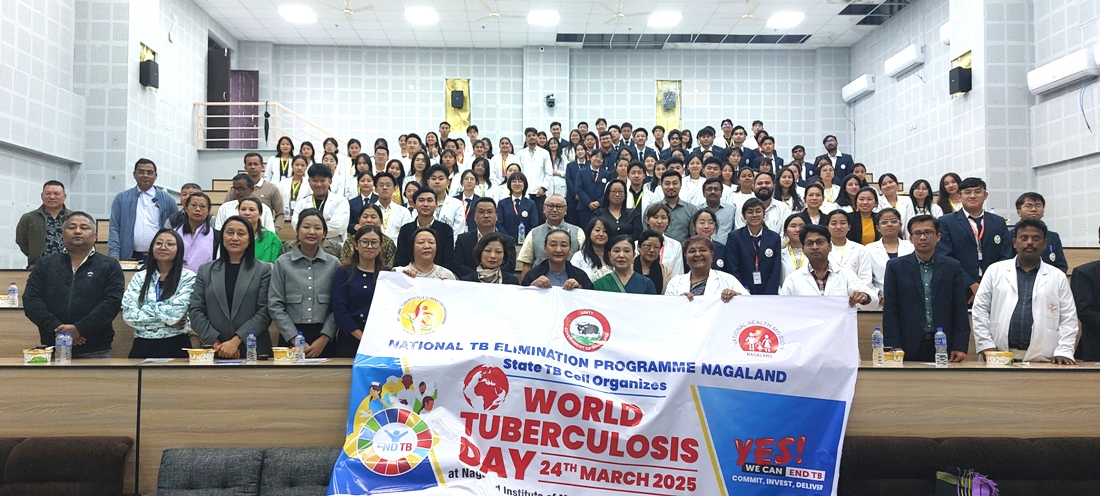
Participants at the World Tuberculosis Day in Kohima on
Monday. (EM Images)
KOHIMA — On the occasion of World Tuberculosis
(TB) Day, Additional Secretary of Health and Family Welfare, S Tainiu, called
for concerted efforts from all stakeholders to end TB and accelerate responses
against the disease to complement government initiatives.
She made this statement while addressing the World TB Day
celebration held at the Nagaland Institute of Medical Sciences and Research
(NIMSR) in Kohima.
Tainiu highlighted that tuberculosis remains one of India’s
biggest public health concerns, with an estimated 28 lakh new cases occurring
annually, contributing to 26% of the global burden, as stated in the Global TB
Report 2024. She reiterated the government of India’s commitment to eliminating
TB by 2025—five years ahead of the Sustainable Development Goals (SDG)
target—guided by the National Strategic Plan (2017-25).
She pointed out that TB imposes a significant economic
burden, especially on the economically productive age group, pushing patients
further into poverty. The disease also leads to severe social and economic
hardships for individuals and families, impacting overall productivity.
Underscoring the role of nutrition in TB treatment and
prevention, she explained that there is a two-way relationship between TB and
undernutrition. Undernutrition increases the risk of TB, while TB can lead to
malnutrition, making undernutrition highly prevalent among TB patients. Recent
national findings indicate that nearly half of TB-affected individuals in India
are malnourished.
She cited global evidence showing that providing good
nutrition to household contacts of TB patients can significantly reduce TB
incidence by over 50%, functioning almost like a vaccine. "Considering that
we do not have an effective TB vaccine today, nutrition could be a crucial
approach, particularly in India, where malnutrition is a major risk factor for
TB," she added.
Tainiu emphasised that combating TB requires a
multi-sectoral response, urging wide-ranging partnerships beyond the public
sector to address social determinants such as nutritional support, good
hygiene, clean working conditions, and improved access to diagnostic and
treatment services. She called upon healthcare providers, community organisations,
and the government to collaborate on TB prevention, treatment, and social
support.
As part of the efforts to engage communities in ending TB,
the government of India has rolled out the Community Support to TB Patients
initiative under the Pradhan Mantri TB Mukt Bharat Abhiyaan. The initiative
aims to provide additional patient support to improve treatment outcomes,
enhance community involvement, and leverage Corporate Social Responsibility
(CSR) activities.
Under this initiative, a Nikshay Mitra—which can be an
individual, corporate entity, elected representative, institution, NGO, or
government body—can adopt TB patients for a minimum commitment period of six
months and a maximum of three years. Nikshay Mitras can provide food baskets to
the household contacts of TB patients to improve their immunity, reducing
out-of-pocket expenses for affected families.
Tainiu expressed delight that around 500 Nikshay Mitras have
registered in Nagaland to support approximately 1,500 TB patients currently
undergoing treatment. She stated that this initiative will enhance community
involvement, raise awareness, reduce financial burdens, improve nutrition, and
ultimately lead to better treatment outcomes.
She further stressed that TB continues to disproportionately
affect the poor and vulnerable, exacerbating existing disparities.
"Responding to the government of India’s call to end the TB epidemic by
2025, a holistic approach involving all sectors, strong political commitment,
and active participation from civil society and communities will be crucial in
achieving the goal," she said.
Dr. E. Motsuthung Patton, Principal Director of Health and
Family Welfare, remarked that World TB Day is significant not only for TB
patients and their families but also for advocates, partners, and healthcare
workers involved in combating the disease.
He noted that since the discovery of the TB bacillus in
1882, significant advancements have been made in TB detection, prevention, and
treatment. He highlighted that India’s TB elimination programme has undergone
considerable progress, particularly after Prime Minister Narendra Modi’s
TB-Free India by 2025 call.
One of the key initiatives launched in 2023 on World TB Day
in Varanasi was the TB Mukt Panchayat (TB-Free Village) programme, in
collaboration with the Ministry of Panchayati Raj (MoPR). In Nagaland, this
initiative is being implemented in partnership with the Rural Development
Department.
Patton explained that the health functionaries at the
village and Health and Wellness Centre levels are making substantial progress
toward TB elimination. However, these efforts must be systematically measured
and validated before villages can be officially declared TB-free. The TB Mukt
Panchayat initiative empowers Panchayati Raj Institutions to recognise and
address the magnitude of TB-related issues while fostering healthy competition
among villages to work towards TB elimination.
Villages are required to fulfil six key indicators to
qualify for TB-Free status. These indicators are verified by the District
Verification Team, covering areas such as presumptive TB examination, TB
notification, treatment success rates, drug susceptibility testing (UDST),
participation in the Nikshay Poshan Yojana, and adherence to the Pradhan Mantri
TB Mukt Bharat Abhiyaan.
Patton informed that as of this year, 166 villages in
Nagaland have met the criteria to receive the TB-Free Panchayat award—40
villages qualified for the silver category, while 126 villages were placed in
the bronze category. The awards were distributed by respective deputy
commissioners across the districts during the World TB Day celebrations. He
expressed hope that more villages will qualify for the award in the coming
year.
Prof. Dr. Soumya Chakraborty, Director-cum-Dean of NIMSR,
emphasised that TB remains a highly stigmatised disease, despite ongoing
efforts to eliminate it. She advocated for a holistic approach to TB care,
integrating medical treatment with alternative healing practices like yoga.