[caption id="attachment_85772" align="alignnone" width="500"]
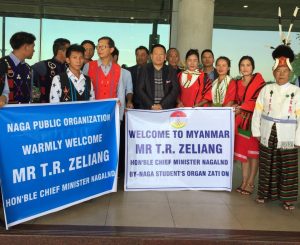 TR Zeliang being received by community leaders in Myanmar.
[/caption]
Dimapur, November 27 : The chief minister of Nagaland has urged the NSCN (Khaplang) to “drop the gun and talk for the rights” of the Naga people. TR Zeliang sounded the clarion during his visit to Myanmar this week, the Chief Minister’s office stated in an official update to the media on Sunday.
According to the press release, Zeliang ‘emphasized on the need to shun the culture of violence’ and the necessity to take up peaceful negotiations to find a lasting and honourable solution to the protracted Naga political issue.
“Interacting with various Naga organizations at Yangon, Myanmar, yesterday when they accorded him a warm reception at the airport and later at Hotel Sedona, Zeliang asked the Naga leaders in Myanmar to approach the NSCN (K) Supremo SS Khaplang and ask him to ‘drop the gun and talk for the rights’ of the Naga people,” the CMO stated.
The chief minister was said to have been received by leaders of the Naga Public Organisation, the Naga Students’ Organisation, the Naga Women Organisation, and church leaders from Yangon upon his arrival to the neighbouring country on Saturday.
The CM appealed “to them to try their best” to persuade Khaplang to enter into a ceasefire agreement with the Myanmar and India governments.
“If there is peace here in Myanmar between the Naga community and the government, I shall personally take up the matter with the prime minister of India and I am confident that he will tie up with the government of Myanmar to resolve the Naga problem here in Myanmar as well as in India simultaneously,” the CMO quoted Zeliang as having stated.
To the concerns raised by the Naga leaders at the border-fencing between the two countries, Zeliang said to have “repeatedly” taken the issue to government of India. ‘Instead of border fencing, the border stretches in many parts of the northeast with Myanmar needs to be opened up rather than fenced so that the unreached areas can be opened up for better development,’ the CMO stated.
“Unlike other international boundaries with countries like Bangladesh or Pakistan, there are Naga areas falling in the two countries of Myanmar and India and fencing of these areas would not be advisable,” he said. Naga areas along the Indo-Myanmar border should not be allowed to become the permanent hideout for insurgent groups of the northeast, Zeliang said.
“If there is peace in the area, I shall try my best to persuade the Government of India undertake major road constructions and other developmental works in the area so that Nagas on both sides of the border are benefited,” he added.
A “trilateral” highway
Also, Zeliang has noted the proposed India-Myanmar-Thailand “trilateral” highway as a significant step toward connectivity to the Southeast Asian region. ‘The road will not only connect northeast India to Myanmar and Thailand, but will be a part of the Bangladesh-Bhutan-India-Nepal connectivity with Southeast Asia, the CMO stated.
“The enormous economic activity that will be generated by this highway can only be imagined now,” he said. “It will open up the land-locked region of India's North-East, as well as Myanmar’s North-West, and integrate them with the rest of India, Myanmar, Thailand and other South East Asian Countries up to Malaysia”
Zeliang called upon the leaders of the neighbouring countries in the region to take it upon themselves as their “collective responsibility to ensure that this initiative is carried forward in real earnest, so that it becomes a reality during our life-time.”
Pointing to the ethnic diversity of the region, Zeliang said that there were many Naga persons living in Myanmar and India, a fact ‘recognized’ by both the countries.
“Ethnic diversities can be either opportunities or problems, depending on how you handle them. On the negative side, this can be a source of unrest and turmoil. Many of the ethnic groups, both in India and Myanmar, have been pursuing their self determination for the last many years. Nagaland itself has been weighed down by the Naga political problem for the last seven decades,” the press release stated.
However, on the other hand, he said, “If we can channelize the energies of all these ethnic groups to positive use, by creating a sense of ownership, participation and mutual co-existence, the outcomes will be tremendous. I believe that this can be achieved, if the concerned governments handle the various ethnic groups, and take care of their concerns and sensibilities, along with their socio-economic development needs.”
Further, he said that the government of India and the various “Naga political groups” have embarked on a peace process to settle political issues through dialogue.
“It is heartening to see the democratic process beginning to take firm roots in Myanmar, and other Southeast Asian countries. It gives us new hopes for our future,” he said and added that peace and development were two sides of the same coin.
“The hard earned democracy can be very tenuous and fragile, unless it is accompanied with appropriate socio-economic development,” Zeliang said and stressed that this should be at the core of our thinking, while making plans for better road connectivity between India- Myanmar- Thailand and other South East Asian countries.
A ‘suggestion’ that he threw in was that border towns such as Noklak and Mon could be connected with Lahe and Hkamti through Longwa, Chen and Pangsha border towns on the Indian side of the border.
Similarly further south, Meluri could be connected through Avangkhu to Layshi, and thence to Tamanthi. He said these smaller and shorter links would require ‘very little investment.’ They will also act as feeders to the Asian highway “that we are contemplating today,” the CMO quoted him as having said.


