[caption id="attachment_106351" align="alignnone" width="560"]
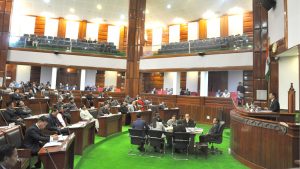 Final day of the 15th session of the 12th Nagaland Lesislative Assembly on Thursday.
[/caption]
Kohima, March 30 (EMN): Chief Minister Dr. Shürhozelie Liezietsu today expressed serious concern over the increase in the level of deficit which the State continued to struggle with.
Referring to the closing deficit of Rs.1657.87 crore for 2016-17 which was estimated earlier at Rs 1194.35 crore, Liezietsu said the sharp growth in budgetary deficit was due to factors “beyond our control.”
In his remark during the general discussion on the Budget 2017-18, the chief minister, who also holds the Finance portfolio, explained that the reasons for the inflated figure were mainly the reduction in borrowing limit of the State due to the downward revision of the GSDP by the central government, additional payments for State share to access more funds from the centre, power purchase, reduced deposits in GPF coupled with substantial withdrawals by retiring employees, and additional funds to the State PSUs and departments among others.
However, despite adverse circumstances resulting in increased deficit, the chief minister was optimistic that a better platform was put in place to facilitate better flow of funds from the centre, which would ultimately help to offset the deficits that have been incurred.
“On my part, I shall do my best to take concrete steps to bring down the deficit,” he asserted.
On the concern raised by a legislator about the high levels of debt repayment, he assured that all the State’s borrowings are within the prescribed limit of 3% of GSDP, and taken only with the prior approval of the government of India.
Liezietsu also underscored the need for all the law makers to understand better the dynamics of the State's finances and the realities under which they have to function. He reminded the House about the changed financial dynamics following the doing away of the Planning Commission of India, which has been replaced by NITI Aayog.
While admitting that this change brought about drastic reduction in the resources at the State’s disposal for developmental activities, he however reminded that “notwithstanding whatever the name and definition be,” it does not make much difference as long as the State is accessing funds for development.
The chief minister assured that he would judiciously look into the needs of those departments without CSS funds. He clarified that budgetary allocations are made proportionate to the activities of the departments.
“Within the limited resources available at our disposal, we do need to provide adequate funds to such departments to enable them to function in a reasonable manner,” he stated.
In the Education sector, the chief minister clarified that the department has chosen not to fill up 660 vacant posts of teachers that have fallen vacant as a result of the freezing of fresh appointments of teachers since 2013.
He pointed out that the salary bill of the school teachers has been increasing every year mainly due to the enhanced dearness allowances as well as normal increments, and not on account of new appointments.
Regarding concerns raised about excess and random appointment of employees that need to be addressed, the chief minister agreed that a closer look into the problem was needed and expressed intention to see that this issue was put to an end.
“We already have the problem of having the highest ratio of Government employees to the population in the country. This has become a big burden to the State Exchequer, and because of the huge financial cost involved, we are unable to provide adequate funds for developmental activities,” he said.
He also maintained that the implementation of the new Revision of Pay (ROP) being finalised for the State government employees will definitely increase the financial burden of the state. In this connection, he pointed out that excess and unauthorised appointments are something that should not be allowed to happen.
Regarding fictitious pensions, he said all necessary steps were being taken to bring the guilty to book adding the State government has already initiated the process of cleaning up the pension sector and is presently working to put in place a system that will put to an end all such malpractices.
The chief minister welcomed suggestions about online payments and assured that it will be examined in more detail for implementation. Referring to the need to open banks in all RD Blocks of the State, he stated that this was a pressing requirement now that the Direct Benefits Transfer scheme is being put in place.
“Unless the banking system is put in place, the rural people will not be able to gain access to the benefits of welfare schemes. I shall take up the matter with the Central Government to issue appropriate instructions to the top management of the banks so that arrangements to set up bank branches are made without further delay”, Liezietsu assured.
Regarding the Japan International Cooperation Agency (JICA) project in forestry sector which aims at improving the forest eco-system and promoting rural income through rehabilitation of jhum areas covering 79000 hectares, the chief minister informed that the formal signing of the project agreement is scheduled for March 31, 2017, between the governments of India and Japan at New Delhi. The project is being funded in the pattern of 90% grant and 10% State share and has the potential of transforming our landscape and addressing rural livelihood issues, he stated. The JICA project has an overall cost of Rs.533 crores and will be implemented over a period of 10 years.
On the externally aided 6 years project with funding from the International Fund for Agriculture Development (IFAD) whose tentative amount comes up to about Rs.237.83 crore, he said the project that is focused on mitigating the present jhum cultivation in the state and target traditional crops that will be market oriented. “The IFAD project is essentially also a livelihood program with the ultimate aim of addressing climate adaptation, environment protection and enhancing climate resilience. This project will start during the month of April 2018, and will continue for 6 years. The funding pattern is 90% outright grant and 10% will be loan component,” Liezietsu told the House.
On the issue of the ropeway project in Kohima, the chief minister said the State cabinet has already issued directions to the concerned department to get all necessary clearances from the central government.
On the issue of 50% funding for the Smart City Project, he said the matter was already taken up with the government of India.
Regarding a concern raised by one of the legislators on construction of the Langka bridge, the chief minister informed that NABARD could not take up the project as the prescribed approval processes were not completed. However, in the revised estimates for 2016-17 an amount of Rs. 300 lakhs has been allocated for the same bridge, and that he is confident the work will commence shortly.
The 15th session of the 12th Nagaland Legislative Assembly (NLA) concluded on Thursday after the transaction of all the business listed for the session.
The supplementary demands for grants for the year 2016-17 was passed without discussion while the demand for grants for the Year 2017-18 was also passed by voice vote.
During its sitting today, the House passed two bills namely Nagaland Appropriation (No.1) Bill 2017 and Nagaland Appropriation (No.2) Bill 2017 which were introduced in the House by chief minister Dr. Shürhozelie Liezietsu.
Earlier in the session, Speaker Imtiwapang Aier made obituary references on the passing away of former MLA Wokshing Phom and ex-Interim Body Member Hepong Phom.
After announcing the constitution of the various financial and non-financial committees and panel of chairmen or 2017-18, and with the completion of the transaction of business listed for the day the speaker adjourned the House sine die.


