


Achumbemo Kikon raised alarm in the Nagaland Legislative Assembly over climate change impacts, citing pollution, drying springs and extreme weather across the state.
Share


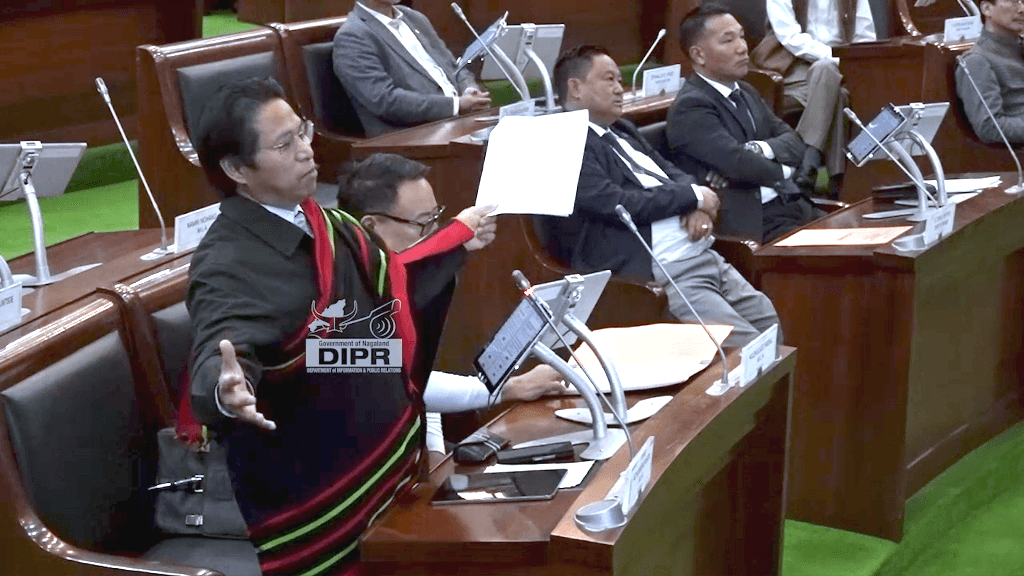
KOHIMA — Naga People’s Front (NPF) legislator Achumbemo Kikon on Thursday flagged rising environmental concerns in Nagaland, warning that climate change is no longer a distant threat but one already unfolding across the state.
Taking up the issue during Zero Hour of the Eighth Session of the 14th Nagaland Legislative Assembly, Kikon called for urgent policy intervention, stronger inter-departmental coordination, and greater public accountability.
He drew attention to findings of the Assembly’s recently constituted Committee on Environment and Climate Change—formed after nearly six decades—which has conducted spot verifications across parts of the state over the past year.
The seven-member panel inspected waste sites, rivers and surrounding ecosystems, while engaging with local communities. Though not all districts have been covered, Kikon described the situation as “pressing” and one that must be integrated into development planning.
Also read: Vande Mataram row: Nagaland Legislative Assembly refers issue to Select Committee after objections
Placing the issue in global context, he highlighted that countries such as Finland rank high on happiness indices due to ecological balance, while Bhutan continues to lead in conservation efforts as a carbon-negative nation.
Citing international reports, he said that environmental risks contribute significantly to child mortality and vulnerability, with India among the most climate-exposed countries facing droughts, floods and extreme weather events.
At the state level, Kikon pointed out that Nagaland is already witnessing rising temperatures, erratic rainfall and extreme weather, including 48 days of such events last year.
Districts like Phek, Tuensang and Kohima have recorded intense rainfall exceeding 100 mm per day, while Dimapur has experienced flooding and growing urban heat stress.
On jhum cultivation, he acknowledged its cultural and traditional significance but cautioned that unsustainable practices are adding to ecological strain. He stressed the need to evolve policies that blend tradition with modern, sustainable techniques.
Drying springs
Kikon expressed concern over the rapid depletion of rivers, streams and natural springs, particularly in hill areas. He attributed this to deforestation and unregulated borewell drilling.
Citing a case from Etsuchukha village in Wokha district, he said that a long-standing water source — locally known as an “elite well” that sustained communities for over a century — has dried up. Apart from deforestation near Mt. Tiyi, indiscriminate borewell use was identified as a major contributing factor.
He cautioned that further groundwater extraction without proper consultation and coordination could trigger long-term water insecurity.
Rivers choking on waste
The legislator also highlighted widespread river pollution: in Kohima, rivers such as Sanuoru and Mhonkhola were found in a “pathetic and discouraging” condition, with waste ranging from household garbage to discarded appliances dumped along their banks.
He said that waste from Kohima, Tseminyu, Zunheboto and Wokha flows downstream and accumulates at the Doyang reservoir, necessitating repeated clean-up drives involving significant resources.
Kikon further alleged that construction activities are contributing to the problem, with earth and debris being dumped along riverbanks, obstructing water flow and, in some cases, encroaching into river channels.
Referring to infrastructure planning, he cited the collapse of a bridge over the Chathe River, attributing it partly to embankment works that altered the river’s natural course. He stressed that poor coordination between departments can lead to such costly setbacks.
On air quality, Kikon said that Kohima and Dimapur have been identified as non-attainment cities due to PM10 levels exceeding permissible limits. He linked this to the unchecked establishment of stone crushers and sawmills, particularly in urban areas, and called for stricter regulation.
He also raised concerns over coal mining in districts like Mokokchung and Wokha, alleging that unregulated rat-hole mining, lack of backfilling and absence of re-vegetation are causing environmental degradation and potential health risks from toxic emissions.
Stronger oversight
Kikon proposed strengthening the powers of the Assembly’s environment committee, stating that its current role is largely recommendatory. He suggested granting it greater authority to scrutinise development projects, on the lines of regulatory bodies such as the National Green Tribunal.
Reasoning that climate change is no longer “a talk of the West” but a reality “in our kitchen,” the legislator urged both policymakers and citizens to act with urgency. He also called for individual responsibility, including energy conservation, alongside broader structural reforms.