[caption id="attachment_240708" align="aligncenter" width="500"]
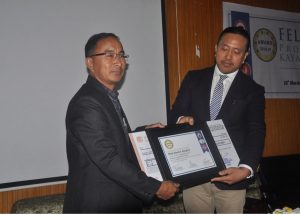 I Himato Zhimomi, right, hands out the Kayakalp awards at the Health and Family Welfare directorate, on March 26 in Kohima.
[/caption]
Dimapur, March 26 (EMN): Achieving the goals of sanitation and cleanliness will be difficult unless hygiene is a practice inculcated into the lifestyles of the people. No amount of facilities that have been provided will be able to help in the upkeep of healthcare facilities in public places, a senior government health official, Himato Zhimomi, said during an event in the Nagaland’s capital town, Kohima. The officer suggested that hospitals taking the role of places that provide a general environment of wellness can bring ‘good service to humanity.’ He was addressing an awards ceremony in Kohima.
An awards ceremony recognising notable sanitation activities under the banner of the sanitation programme ‘Kayakalp’ (Broadly, Hindi for rejuvenation), was held at the directorate of Health and Family Welfare, on March 26 in Kohima.
The government’s publicity department Information & Public Relations (IPR) offered on Tuesday details about the programme.
The principal secretary for Health & Family Welfare department, I Himato Zhimomi is also understood to have addressed the event, according to the IPR. He was stated to have acknowledged the works and achievements by the “doctors present at the function.”
According to the officer, there is a ‘tremendous effort through these awards, as they provide a level of quality in terms of services, especially cleanliness which is replicable to the state and also comparable to any states in the country.’
‘It is an uphill task as far as hygiene is concerned and unless hygiene is inculcated into the lifestyle of the people, no amount of facilities that are provided can help in the upkeep of health care facilities in public places,’ Zhimomi said. He also said that
‘If hospitals can be the agents that as place for healing and a general environment of goodness and wellness, it would bring good service to humanity,’ the IPR quoted him as having said. Zhimomi was appreciative that Kayakalp has brought about ‘different activities in the medical section.’ Likewise, he appreciated the enthusiasm ‘especially from the remote areas within the state,’ the updates stated.
During the event, an official of the National Health Mission, Dr. Thanghoi Lam mentioned that the department had carried out the Kayakalp award assessment for the year 2018-19. The initiative has the objectives to promote cleanliness, and hygiene; infection control practices in public health care facilities. Another goal is to educate and give recognition to public health care facilities that show exemplary performance in adhering to standard protocols of cleanliness and infection control.
Likewise, the initiative envisages inculcating a “culture of on-going assessment and peer review of performance related to hygiene, cleanliness and sanitation,” the IPR explained. It aims to create and ‘share sustainable practices’ related to improved cleanliness in public health facilities linked to positive health outcomes.
Lam said that it was mandatory for all public health- and community health centres to participate.
The ministry of Health And Family Welfare launched a national sanitation programme on May 15 to promote cleanliness and enhance the quality of public health facilities. The name of the initiative is ‘Kayakalp.’ The purpose of the initiative is to appreciate and recognise efforts that create a healthy environment.


