


A citronella distillery was inaugurated at Tzudikong, Watiyongpang, under a CECS-NABARD initiative to promote citronella cultivation.
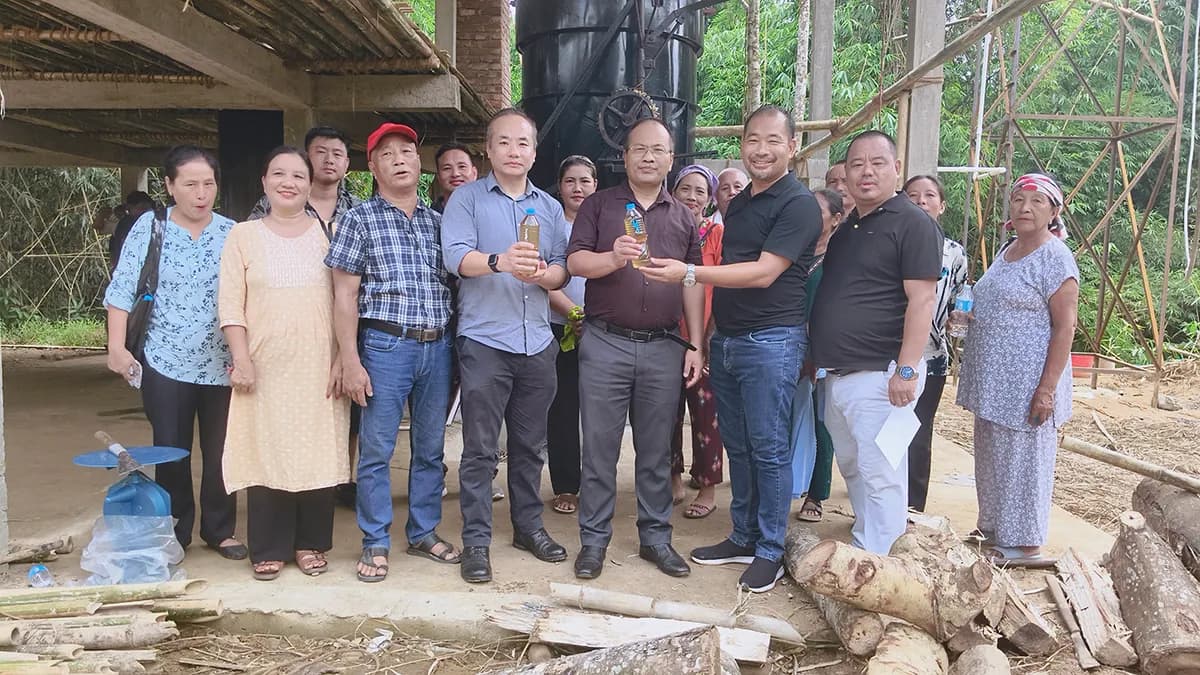
DIMAPUR — A citronella distillery was inaugurated on Friday at Tzudikong, Watiyongpang, under an initiative aimed at promoting citronella cultivation, local processing and value addition as a new livelihood opportunity for farmers in Tuli sub-division.
The initiative is being implemented by the Community Educational Centre Society (CECS) with support from the National Bank for Agriculture and Rural Development (NABARD), Nagaland Regional Office, with the objective of establishing a farm-to-production value chain for local farmers, an update stated.
The distillery was inaugurated by Pauliankap Bulte, General Manager/OIC, NABARD Nagaland Regional Office, in the presence of Subonenba Longkumer, Director, CECS, and Poji, District Development Manager (DDM), NABARD Mokokchung.
The initiative seeks to establish a complete value chain covering cultivation, harvesting, processing and production, enabling farmers to undertake value addition locally and potentially enhance their income.
The proposed distillery is expected to play a key role in transforming citronella cultivation from a primary agricultural activity into a locally anchored enterprise with opportunities in processing and marketing.
Speaking at the programme, Longkumer appreciated NABARD and the farmers for their support and participation in the initiative.
He said the promotion of citronella represented a first-of-its-kind opportunity in Nagaland and had considerable potential to benefit farmers.
He emphasised the need to develop the entire value chain, from cultivation and farm-level production to processing and value addition, so that farmers could benefit from opportunities beyond primary agriculture.
He also encouraged farmers to sustain and expand cultivation and share their knowledge and experiences with others.
Poji highlighted NABARD's role in promoting rural livelihoods and said citronella and lemongrass were relatively easy to cultivate and had good livelihood potential. He encouraged farmers to continue cultivation and motivate more members of the community to take up aromatic plant cultivation.
He said the proposed distillery presented a promising business opportunity that could strengthen the value chain through local processing and value addition. He assured the farmers of NABARD's continued support for the development of the initiative.
Bulte also stressed the importance of establishing the distillery in the locality and encouraged farmers to sustain and expand citronella cultivation. He urged them to share their experiences with other farmers so that the initiative could benefit more communities.
The citronella beneficiaries welcomed the project, saying it had opened up a new livelihood opportunity backed by comprehensive support. They expressed their willingness to continue cultivation and develop citronella farming as a viable source of income.
The programme also included participation from fishery beneficiaries, who expressed gratitude to CECS and NABARD for the livelihood support provided to their communities.
They appreciated the assistance extended throughout the farming process and expressed confidence in continuing fish farming as a sustainable livelihood.
The collaboration between CECS, NABARD and the farming community is expected to contribute to the diversification of rural livelihoods and the development of sustainable, market-oriented agricultural enterprises in Nagaland, with citronella emerging as a promising avenue for farmers in Tuli.
The programme concluded with a vote of thanks by Toshi Aier, Programme Officer, CECS, who expressed gratitude to NABARD for its continued support and partnership and to the farmers and beneficiaries for their active participation.