[caption id="attachment_204792" align="aligncenter" width="565"]
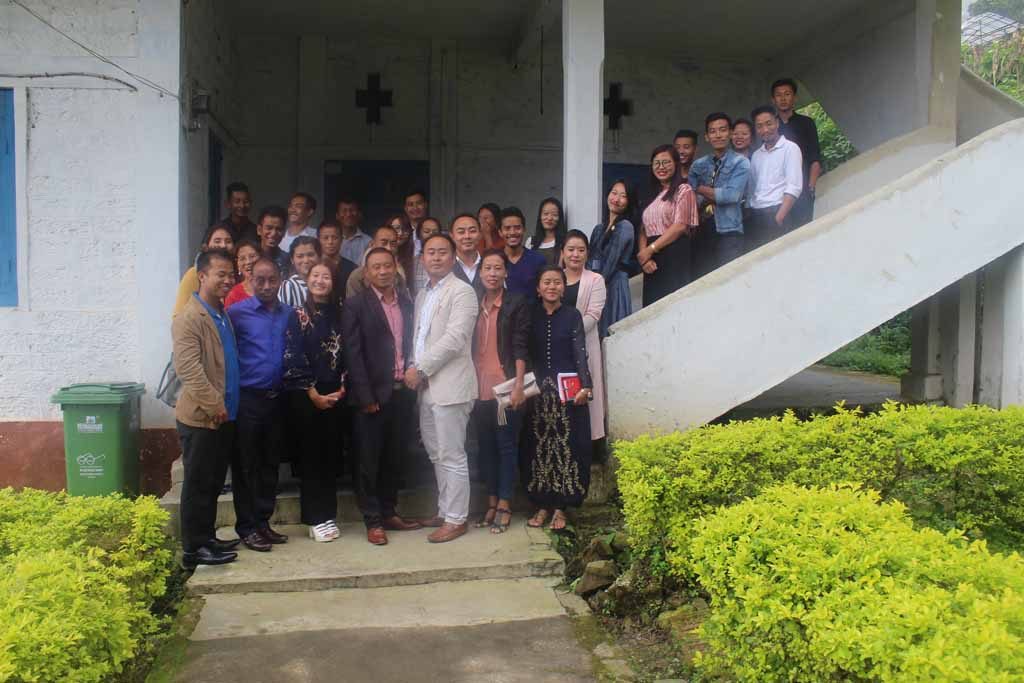 Resource persons and participants pose for a photograph after a seminar in Wokha.
[/caption]
Our Correspondent
Wokha, Sep. 3 (EMN): The Lotha Baptist Churches Association (LBCA), Longjung Ekhumkho, youth department conducted a day’s seminar on “In conversation with nature in the context of environment crisis: Prospects and challenges,” here on Monday at Longjung Baptist Church Vankhosung.
The seminar was attended by youth departments from 12 churches.
Janbemo Humtsoe of Green Foundation talked on “Environmental crisis a global perspective.” He highlighted the causes and effects of global warming. He said ecological crisis, loss of biodiversity, air pollution, and water scarcity are the result of global warming.
Stating that Wokha district is also adversely affected by ecological crisis, he said as stakeholders one must put effort to preserve and protect its rich natural resources and take decisive steps to mitigate the environmental crisis which is in confrontation with humanity.
Asst. Prof. of Witter Theological College, T Nzanthung Ngullie, spoke on the topic “The importance of pulpit ministry towards sensitizing the congregation to develop a positive attitude towards God’s creation.”
He defined preaching as communication of the divine truth which is the word of God to the people.
Basing on the two missiology foundation of preaching with the “Redemptive and Liberative aspects” for both spiritual and existential realities of man, he stated that only when preaching is incorporated in these two aspects, it becomes the word of God.
Emphasising on the Noahic Covenant in Genesis 9:8-7 and the Cosmic Christology in Colosians 1:15-20, he said that the Bible has resounding ecological themes which can be explored widely to guide the people in caring God’s creation.
Asst. Prof. of Witter Theological College, S Ekonthung Ezung talked on “Pastoral ministry to the Groaning world in the context of Environmental Crisis in Wokha District: Exploring insights from the Lotha Naga Cultural and Religious Practices.”
Ezung pointed out the possibilities of environmental crisis in Nagaland and Wokha district in particular, drawing insights from the Lotha Naga cultural and religious practices of the ancestors.
“Our forefathers believed there was “God-World-Human” inter-relationship and interface, and such mutual coexistence enabled them to be responsible caretakers and protectors of the eco-system,” he stated.
In today’s world, he said the church has a responsible role to play in teaching fellow Christians about the creation of God.
Youth Director of Baptist Church, Wokha village, Eyingbeni Erui, spoke on “Ministerial challenges vis-a-vis environmental crisis in contemporary times and involvement of the church to build an inclusive cosmology.”
A well balanced environment which is a life supporting agent has become a threat to not only mankind but for the entire planet, she lamented.
Erui observed that continuous destruction of the eco-system is resulting in not only extinction of flora and fauna species but also exposing to more hazards. She lamented that wild animals including Hornbill species, tigers and leopards which were once a common sight are now only narratives to today’s generation.
She said churches are now taking pro-active role in conserving energy, preserving natural forest, reducing and managing waste, zero chemical use in farms, rain water harvesting and others through seminars, placards, posters and pamphlet campaigns.


