[caption id="attachment_46930" align="aligncenter" width="400"]
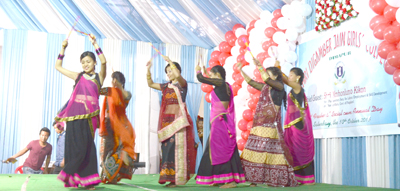
Students of SD Jain Girls College in Dimapur in performance during an event for freshmen in the college on Saturday, October 10.[/caption]
Staff Reporter
DIMAPUR, OCTOBER 10
Parliamentary Secretary for Labour, Employment & Skill Development and Borders Affairs, Mmhonlumo Kikon has urged the youths and students to pursue meaningful ambitions that would add to their lives and careers ‘rather than spending time and ideas running after money.’
‘Change will come only if we work together,’ said Kikon, that in today’s society, people spend their time and ideas ‘running after money rather than trying to solve the issues that the society today is facing.’Speaking as chief guest during the 23rd freshmen event of SD Jain Girls College, Kikon said that with skill and commitment anyone can advance and find better ways of living and an independent life. Nagas, with their English speaking proficiency, he said, will prosper and find good jobs even outside Nagaland which in turn would improve the economy of the state.
‘Unless young people with patience for changing the state understands the issues of Nagaland and join hands for the cause, no development will take place in the state,’ said the parliamentary secretary.
Speaking on ‘women empowerment’ amongst the college for women, Mmhonlumo Kikon said that ‘girls do not graduate to become housewives’ though it’s important to take care of children. He said after graduating, one should strive in finding employment in anyway instead of sitting at home and waiting for jobs to come knocking.
‘Waiting for government jobs alone will never bring solution as the state government is already facing ‘over staff’ problem wherein the allocation of funds are mostly spent on payments of salaries,’ he said.
He encouraged the graduating students to ponder on what the future beholds instead of sitting at home thinking that responsibility ends after graduation.
Stating, ‘Nagaland as state of villages’, Kikon said that every student should try to identify the unique problems being faced in districts or villages and find ways and solutions to eradicate the problems instead of ‘highlighting the criticisms, condemnation and the blames’ on social networking sites. He advised the students to ‘stop blaming and start finding solutions for issues’ by bringing the issues and problems out in the open instead of playing the blame game. ‘With direct and proper approach, ‘revolution’ will take place, he said.



 Students of SD Jain Girls College in Dimapur in performance during an event for freshmen in the college on Saturday, October 10.[/caption]
Staff Reporter
DIMAPUR, OCTOBER 10
Parliamentary Secretary for Labour, Employment & Skill Development and Borders Affairs, Mmhonlumo Kikon has urged the youths and students to pursue meaningful ambitions that would add to their lives and careers ‘rather than spending time and ideas running after money.’
‘Change will come only if we work together,’ said Kikon, that in today’s society, people spend their time and ideas ‘running after money rather than trying to solve the issues that the society today is facing.’Speaking as chief guest during the 23rd freshmen event of SD Jain Girls College, Kikon said that with skill and commitment anyone can advance and find better ways of living and an independent life. Nagas, with their English speaking proficiency, he said, will prosper and find good jobs even outside Nagaland which in turn would improve the economy of the state.
‘Unless young people with patience for changing the state understands the issues of Nagaland and join hands for the cause, no development will take place in the state,’ said the parliamentary secretary.
Speaking on ‘women empowerment’ amongst the college for women, Mmhonlumo Kikon said that ‘girls do not graduate to become housewives’ though it’s important to take care of children. He said after graduating, one should strive in finding employment in anyway instead of sitting at home and waiting for jobs to come knocking.
‘Waiting for government jobs alone will never bring solution as the state government is already facing ‘over staff’ problem wherein the allocation of funds are mostly spent on payments of salaries,’ he said.
He encouraged the graduating students to ponder on what the future beholds instead of sitting at home thinking that responsibility ends after graduation.
Stating, ‘Nagaland as state of villages’, Kikon said that every student should try to identify the unique problems being faced in districts or villages and find ways and solutions to eradicate the problems instead of ‘highlighting the criticisms, condemnation and the blames’ on social networking sites. He advised the students to ‘stop blaming and start finding solutions for issues’ by bringing the issues and problems out in the open instead of playing the blame game. ‘With direct and proper approach, ‘revolution’ will take place, he said.
Students of SD Jain Girls College in Dimapur in performance during an event for freshmen in the college on Saturday, October 10.[/caption]
Staff Reporter
DIMAPUR, OCTOBER 10
Parliamentary Secretary for Labour, Employment & Skill Development and Borders Affairs, Mmhonlumo Kikon has urged the youths and students to pursue meaningful ambitions that would add to their lives and careers ‘rather than spending time and ideas running after money.’
‘Change will come only if we work together,’ said Kikon, that in today’s society, people spend their time and ideas ‘running after money rather than trying to solve the issues that the society today is facing.’Speaking as chief guest during the 23rd freshmen event of SD Jain Girls College, Kikon said that with skill and commitment anyone can advance and find better ways of living and an independent life. Nagas, with their English speaking proficiency, he said, will prosper and find good jobs even outside Nagaland which in turn would improve the economy of the state.
‘Unless young people with patience for changing the state understands the issues of Nagaland and join hands for the cause, no development will take place in the state,’ said the parliamentary secretary.
Speaking on ‘women empowerment’ amongst the college for women, Mmhonlumo Kikon said that ‘girls do not graduate to become housewives’ though it’s important to take care of children. He said after graduating, one should strive in finding employment in anyway instead of sitting at home and waiting for jobs to come knocking.
‘Waiting for government jobs alone will never bring solution as the state government is already facing ‘over staff’ problem wherein the allocation of funds are mostly spent on payments of salaries,’ he said.
He encouraged the graduating students to ponder on what the future beholds instead of sitting at home thinking that responsibility ends after graduation.
Stating, ‘Nagaland as state of villages’, Kikon said that every student should try to identify the unique problems being faced in districts or villages and find ways and solutions to eradicate the problems instead of ‘highlighting the criticisms, condemnation and the blames’ on social networking sites. He advised the students to ‘stop blaming and start finding solutions for issues’ by bringing the issues and problems out in the open instead of playing the blame game. ‘With direct and proper approach, ‘revolution’ will take place, he said.