


Many investors approach financial planning with a broad objective rather than a precise number. The aim might be long-term wealth creation, retirement security, or simply the gradual accumulation of savings through market investments.
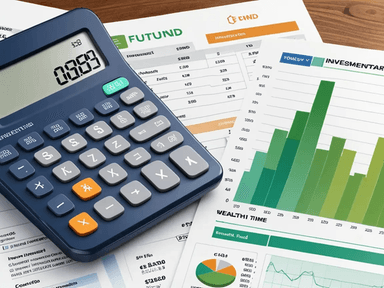
People rarely start investing with numbers alone. More often, the starting point is a thought about the future. A retirement many years away. A financial cushion that gradually takes shape. Sometimes it is simply curiosity — what might today’s savings become after a long stretch of time?
That curiosity explains why tools like the mutual fund calculator appear so frequently in discussions around investing. The tool seems simple enough. Enter an amount, choose a time horizon, assume a return, and the calculator produces an estimated figure.
It feels almost like a glimpse into the future.
Yet the moment that projection appears on the screen, another question quietly follows. If a calculator can show what investments might grow into, does that mean it is predicting wealth?
The answer is a little more nuanced.
A mutual fund calculator does not actually forecast the future. What it does instead is something subtler — it illustrates possibilities.
Many investors approach financial planning with a broad objective rather than a precise number. The aim might be long-term wealth creation, retirement security, or simply the gradual accumulation of savings through market investments.
But translating those intentions into numbers is not always straightforward.
If someone invests in a
A mutual fund calculator provides that framework.
It allows a set of assumptions to be applied to an investment scenario. The result is not a prediction but rather a projection — a way of visualising how the investment could grow if those assumptions were to hold.
One of the more interesting moments occurs when someone uses a mutual fund calculator for the first time.
The process usually begins with a simple input: a monthly investment amount, perhaps modest, paired with a ten-year timeline. The calculator produces an estimate. The number appears reasonable but not extraordinary.
Then something changes.
The timeline extends from ten years to twenty. Or perhaps the monthly investment increases slightly. The projected value on the screen shifts — sometimes more dramatically than expected.
That shift often reveals something important about long-term investing.
Small adjustments can influence outcomes more than people initially assume. Time, especially, tends to carry greater weight than anticipated.
The calculator does not explain why in great detail, but the pattern becomes visible nonetheless.
Behind many of these projections lies the concept of compounding.
Compounding rarely feels dramatic at first. During the early years of an investment, growth is driven mostly by new contributions entering the portfolio. The investment base remains relatively small.
Later on, though, something subtle begins to change.
Returns generated by the investment stay within the portfolio. Those returns begin producing additional returns, and the base gradually expands. Over extended periods the accumulation can accelerate.
A mutual fund calculator captures this effect mathematically. When the timeline increases, the compounding process has more room to unfold, and the projection changes accordingly.
The tool does not create compounding. It simply illustrates how the process might appear numerically.
It is tempting to look at the output of a calculator and treat it as a reliable forecast. After all, the numbers look precise.
Yet every projection generated by a mutual fund calculator rests on assumptions.
The assumed rate of return is one example. Financial markets rarely deliver identical returns year after year. Periods of strong growth may be followed by slower phases or temporary declines.
The calculator cannot anticipate these fluctuations.
Instead, it applies a consistent return assumption across the entire investment period. The resulting projection reflects what might happen under those conditions.
In reality, market behaviour tends to be less predictable.
If the tool cannot predict market outcomes, it might seem reasonable to question its usefulness. Yet investors continue to rely on it.
The reason lies in perspective.
A mutual fund calculator translates the mechanics of long-term investing into something visible. Without it, the relationship between time, contributions, and returns can remain theoretical.
With it, patterns begin to emerge.
Extending the investment horizon often changes the projected corpus significantly. Adjusting contributions produces another shift. The interaction between these variables becomes easier to observe.
The calculator, in effect, transforms abstract ideas into tangible scenarios.
Among all the variables within a projection, time often produces the most striking differences.
Many people initially assume that higher contributions will influence the outcome the most. While contributions certainly matter, extending the investment duration frequently produces an even stronger effect.
The explanation returns once again to compounding.
As time passes, the investment base grows. Returns accumulate on previous returns, and the pace of growth can gradually increase. A twenty-year projection often looks very different from a ten-year projection, even when the contribution amount remains unchanged.
The calculator does not guarantee that such growth will occur exactly as shown. It simply demonstrates how time interacts with investment accumulation.
Real investment journeys rarely resemble the smooth curves displayed by calculators.
Markets move in cycles. Economic conditions shift. Investor sentiment changes. At times the value of a mutual fund may rise steadily, while at other times it may experience volatility.
Because of these factors, projections generated by calculators should be interpreted with flexibility.
They show what might happen under stable conditions, not necessarily what will happen in practice.
Understanding this distinction helps place the calculator in its proper role.
Perhaps the most meaningful insight from using a mutual fund calculator is not the projected number itself.
Instead, it is the realisation that wealth accumulation tends to unfold gradually.
Investments build step by step. Contributions add to the portfolio. Returns accumulate quietly over time. Occasionally the growth appears slow, yet across longer periods the progression can become more noticeable.
The calculator simply places numerical markers along that journey.
Rather than predicting a destination, it reveals the possible shape of the path.
In that sense, a mutual fund calculator functions less like a forecasting tool and more like a lens.
Through that lens, investors can observe how different variables interact. Increase the investment duration and the projection changes. Adjust the contribution amount and another scenario appears.
Each projection represents one possible outcome within a much wider range of possibilities.
The calculator does not determine which outcome will occur. Instead, it offers a structured way to explore how wealth accumulation might unfold.
A mutual fund calculator cannot predict wealth in the literal sense. Financial markets evolve through complex forces that no simple tool can fully anticipate.
What the calculator can do is illustrate potential pathways.
By combining assumptions about contributions, time horizons, and returns, it shows how investments in a mutual fund might accumulate under certain conditions. These projections help clarify how long-term investing works, even if the exact outcomes remain uncertain.
In that way, the calculator does not reveal the future. It simply provides a clearer view of how wealth creation may gradually take shape over time.