[caption id="attachment_285251" align="aligncenter" width="500"]
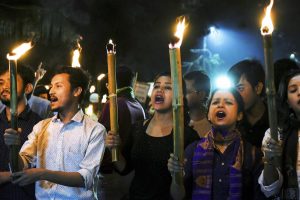 Students of Cotton University along with others participate in a torch rally in protest against the Citizenship Amendment Bill (CAB), in Guwahati on Saturday, November 30
[/caption]
New Delhi, Nov. 30 (PTI): Union Home Minister Amit Shah on Saturday held discussions with leaders of political parties, students bodies and civil society groups of Assam, Arunachal Pradesh and Meghalaya on the contours of the proposed Citizenship Amendment Bill (CAB) and listened to their views, sources said.
Chief Ministers of Assam, Arunachal Pradesh and Meghalaya Sarbananda Sonowal, Pema Khandu and Conrad Sangma respectively, Union minister Kiren Rijiju, several MPs attended the meetings separately.
Sonowal said the consultations carried out by Shah will allay all apprehensions on the CAB.
“This is a very honest and democratic approach of taking along every section of people of the Northeast. I am sure those who have attended the meetings with the home minister felt assured of the central government’s commitments towards the region,” he told PTI.
Most regional parties and civil society groups raised the issue of how CAB could affect the tribals.
Sources said the home minister is learnt to have indicated to them that the CAB may not affect the tribal areas protected by the Inner Line Permit (ILP) regime and those who are governed under the Sixth Schedule of the Constitution.
These areas may be exempted from the ambit of the proposed bill, Shah is believed to have conveyed to the delegations, sources said.
The Bill seeks to remove hurdles in the way of migrants from Bangladesh, Pakistan and Afghanistan from getting the Indian citizenship.
The BJP-led NDA government had introduced the Bill in its previous tenure but could not push it through due to protests by opposition and it lapsed following the dissolution of the last Lok Sabha.
The Bill is expected to be passed in the ongoing winter session.
Later, Assam minister Himanta Biswa Sarma said even though most of the civil society groups have opposed the earlier bill, the new redrafted bill will ensure that the interests of the ILP-regime areas and the Sixth Schedule areas are protected.
Sarma also said a separate legislation may be brought on the recommendations of a committee set up by the home ministry to look into the options of providing constitutional safeguards to the indigenous people of Assam.
The Assam-based political party AIUDF, headed by Maulana Badruddin Ajmal, has opposed the bill, which aims to give citizenship to non-Muslim refugees from three neighbouring countries.
Former Arunachal Pradesh Chief Minister Nabam Tuki said they opposed the 2016 bill but if the new bill excludes the ILP-regime states, it can be considered.
President of the All Bodo Students Union Pramod Boro said they have conveyed to the home minister that they opposed the CAB as it does not provide any safeguard to the tribal areas.
“We want constitutional safeguards to the indigenous people,” he said.
The home minister is holding the meetings on Friday, Saturday and on December 3 in the wake of strong protests in the Northeast against the CAB.
On Friday, Shah held meetings with delegations from Tripura and Mizoram.
The ILP regime is applicable in Arunachal Pradesh, Nagaland and Mizoram under the Bengal Eastern Frontier Regulation, 1873. In terms of Section 2 of the Bengal Eastern Frontier Regulations, 1873, citizens of other states require ILP to visit these three states.
The main objective of the ILP system is to prevent settlement of other Indian nationals in the three states in order to protect the indigenous population.
Under the Sixth Schedule of the Constitution, autonomous councils and districts were created in certain tribal areas in Assam, Meghalaya and Tripura. The autonomous councils and districts enjoy certain executive and legislative powers.
A large section of people and a few organisations in the Northeast have opposed the bill, saying it will nullify the provisions of the Assam Accord of 1985, which fixed March 24, 1971, as the cut-off date for deportation of all illegal immigrants irrespective of religion.
The Congress, Trinamool Congress, Communist Party of India (Marxist) and a few other political parties have been steadfastly opposing the bill, claiming that citizenship can’t be given on the basis of religion.
The Meghalaya government along with various political parties and members of civil society groups here on Saturday submitted joint resolution to Home Minister Amit Shah opposing the Citizenship Amendment Bill (CAB) in the state.
Chief Minister Conrad Sangma submitted the letter to Shah during the consultative meeting with leaders of political parties, students bodies and civil society groups of Meghalaya on the Bill, opposed by cross-sections of the society in the north-eastern region.
In a letter to Shah, Sangma said representatives of the state government, political parties, autonomous district council, civil society groups, met here on Friday and Saturday and resolved to oppose the CAB.
The letter, signed by Sangma, Assembly Speaker Metbah Lyngdoh, Deputy Chief Minister Prestone Tynsong, Agriculture Minister Banteidor Lyngdoh, the Khasi Student’s Union, the Hynniewtrep National Youth Front, among others, also urged the Home Minister to accept the resolution in the interest of the people of Meghalaya.
Meanwhile, the North East Student’s Organisation (NESO), led by chairman Samuel Jyrwa, said the NESO had voiced strong opposition to the proposed Bill.
“We oppose the objective of the Bill and it should not be adopted by Parliament under any circumstances. The Bill is again an attempt to impose the burden of the post-1971 Hindu Bangladeshis in the Northeast region, which is not justified to say the least and Northeast is not a dumping ground for illegal Bangladeshis and to us a foreigner is a foreigner irrespective of his religion,” Jyrwa said.
Arunachal Pradesh Chief Minister Pema Khandu said here on Saturday Home Minister Amit Shah assured him that the proposed Citizenship Amendment Bill (CAB) would have “zero impact on Arunachal Pradesh”.
Khandu, who attended a consultative meeting on the proposed Bill, chaired by Shah, raised the concerns of the indigenous tribal communities and said Arunachal unequivocally opposed the CAB.
During the meeting, the Chief Minister sought special provision to protect the interests of indigenous tribal communities of Arunachal, which should be in accordance with the public sentiments.
Union Sports and Youth Affairs Minister Kiren Rijiju, Deputy Chief Minister Chowna Mein, and leaders of different political parties and civil society groups also attended the meeting.
Khandu said the Home Minister assured that entire inner line permit regime of Arunachal Pradesh, including applicable provisions of the Bengal East Frontier Regulation 1873 and the Chin Hills Regulations 1896, would be suitably incorporated in the CAB.
Shah also assured the Arunachal delegation that there would be “zero impact to Arunachal Pradesh, to ensure the interest of indigenous people of the state.”
“The Home Minister assured that the central government will consider all the concerns raised by them in the CAB to protect the interests of Arunachalees,” Khandu said.


