


Bulging blue veins can be caused by chronic venous insufficiency, or CVI, which is a disease in which the valves within the veins become weakened.
You may have often noticed spider-shaped, blue veins appearing on the skin of the legs or feet. Sometimes, they are more visible on the thighs than on the feet or legs, or near the ankles. Sometimes, these blue veins become quite large on the legs or feet. If these clusters of blue veins appear on the thighs, feet, or legs, do not dismiss them as normal; take them seriously, otherwise negligence can lead to serious consequences. These unusually prominent blue veins on the skin can indicate various diseases developing within the leg. Therefore, take the blue veins on the thighs and legs seriously and consult a vascular surgeon immediately.
Why do these raised veins appear?
These raised blue veins are a network of veins on the upper surface of the leg that are connected to a system of thicker and larger veins located within the leg and thigh. The network of veins located on the upper surface collects impure blood from the surface and transports it to the system of large veins located deep in the leg, from where all the impure blood is collected and transported to the heart and lungs for purification. If for some reason the system of thick veins located deep within the leg becomes obstructed, this impure blood accumulates in the surface of the skin instead of flowing inward. Due to the increased amount of impure blood in the venous system located beneath the skin, these blue veins become visible and appear larger above the skin.
CVI is a major cause of bulging blue veins in the thighs or legs
If you notice blue veins appearing in places like a spider web on your thigh, do not consider this normal; consult a vascular or cardiovascular surgeon and seek their advice. There are two causes of such blue veins. One is chronic venous insufficiency, or CVI. Varicose veins is a disease in which the valves within the veins become weakened. Due to the weakening of these valves, some or most of the ascending blood flows back down. When this backward flow continues, impure blood begins to accumulate in the veins beneath the skin, causing the appearance of blue veins on the skin. This is called primary varicose veins.
Blockage in the veins is also an important cause of bulging blue veins
Another important cause of varicose veins on the thighs is deep vein thrombosis (DVT), in which blood clots suddenly accumulate in deep veins of the legs. If not treated promptly, these blood clots will become permanently lodged in the veins of the legs, blocking the passage of impure blood upward through the veins. This causes the impure blood to accumulate in the veins beneath the skin, leading to the appearance of bulging blue veins on the legs and thighs. Sometimes, when excessive amounts of impure blood accumulate in the bulging blue veins, the veins become larger than spider webs, resembling earthworms on the skin of the patient's legs and thighs. These are medically known as "secondary" varicose veins. If the bulging blue veins on the legs and thighs are not treated properly, they can lead to dark marks, eczema, and large wounds, causing severe pain for the patient.
Bulging Blue Veins on the Legs of Pregnant Women
If spider-like blue veins appear on the legs and thighs during pregnancy, women should be cautious, as this can be due to two factors: excessive pressure from the uterus on the veins, and DVT (DVT), a condition in pregnant women, which is the accumulation of blood clots in the veins in the legs. In such a situation, consult a vascular surgeon and seek advice on preventing DVT in the leg. Don't take the accumulation of these blood clots lightly. If the entire leg suddenly swells, begin treatment immediately, otherwise these clots
can move up the leg and block the large lung vein, causing shortness of breath and increasing the risk of death.
What to do if you have bulging blue veins on your leg?
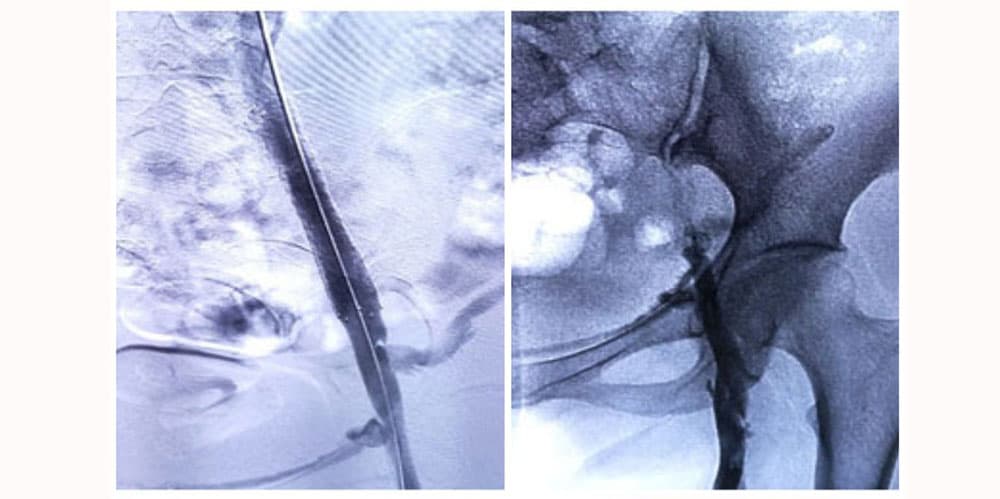
If you notice spider-like or scissor-like blue veins in any part of your thigh, leg, or foot, don't sit idle; consult a vascular surgeon immediately. It's important to understand the cause of these bulging blue veins, only then can proper treatment be possible. This requires a Doppler study, CT venogram, and digital subtraction venography. Therefore, always go to a hospital that offers these advanced testing facilities easily. Before entering the hospital, make sure that a vascular and cardiovascular surgeon is available.
Modern treatment for bulging veins
If the cause of bulging veins in the leg is a permanent blockage in the veins located inside the leg or thigh, venous angioplasty and stenting are performed. If venous angioplasty is not possible, venous bypass surgery is required. If the cause of bulging veins in the leg or thigh is not a blockage but CVI, then the latest technology called laser technology or RFA is used in such patients. This does not require any cutting or surgery on the skin of the leg. Discharge from the hospital occurs within 24 hours.
Dr. K.K. Pandey,
Senior Vascular & Endovascular Surgeon,
Indraprastha Apollo Hospital,
Sarita Vihar, New Delhi.