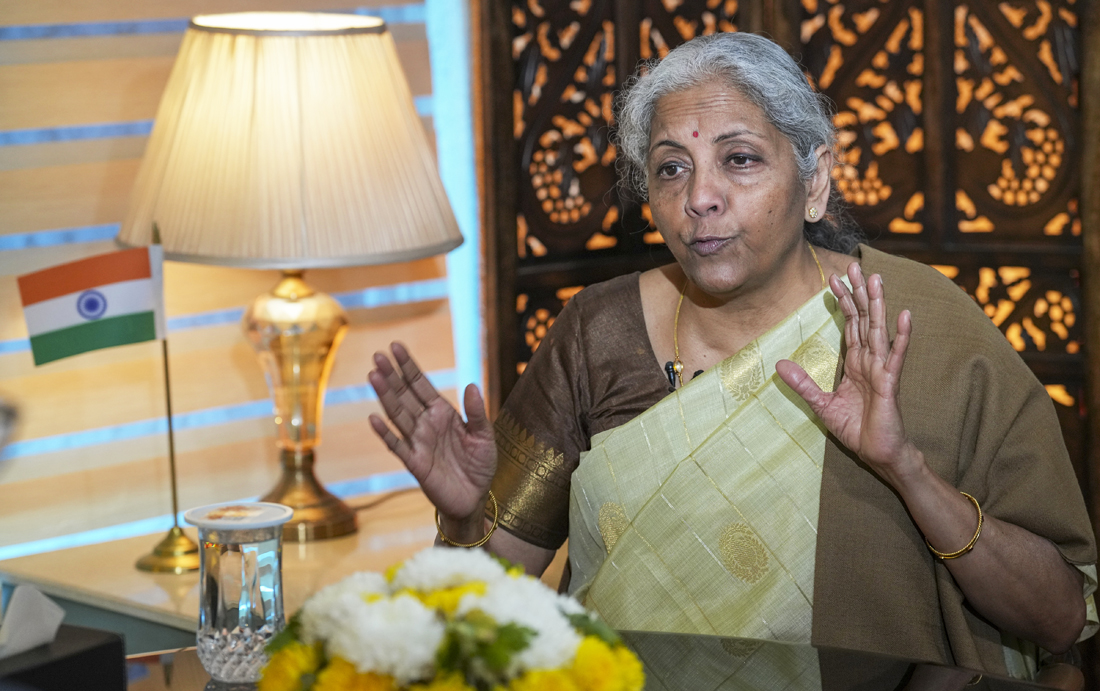
Union Finance Minister Nirmala Sitharaman during an
interview with PTI Editor-in-Chief Vijay Joshi, in New Delhi, Sunday, Feb. 2,
2025. (PTI Photo/Surendra Manral)
NEW DELHI — Paraphrasing Abraham Lincoln, Finance Minister Nirmala Sitharaman
on Sunday described the Union Budget as "by the people, for the people, of
the people", and said Prime Minister Narendra Modi was fully behind the
idea to cut taxes for middle class but it took time to convince the
bureaucrats.
"We have heard the voice of the middle class" who
had been complaining about their aspirations not being met despite being honest
taxpayers, she told PTI in an interview.
With the honest and proud taxpayers wanting the government
to do more to limit the impact of factors like inflation, the prime minister
was quick to task Sitharaman to look at ways to give relief.
While Modi was quick to agree to tax relief, it took a bit
of convincing to get on board the officials in the finance ministry and the
Central Board of Direct Taxes (CBDT) - who are tasked to ensure revenue
collection to meet welfare and other schemes, she said.
Presenting her eighth straight budget, Sitharaman on
Saturday announced an increase in the personal income tax threshold below which
taxpayers owe no tax to Rs 12 lakh, up from Rs 7 lakh, as well as a regij in
tax brackets that would help those earning higher than that save up to Rs 1.1
lakh.
The Rs 5 lakh hike in exemption limit is the biggest-ever
and equals all the reliefs that were given between 2005 and 2023.
"I think the prime minister put it succinctly, he said
it's the people's Budget, it is the Budget which the people wanted."
Asked to describe the ethos of the budget in her own words,
she said, "as they say in democracy in Abraham Lincoln's words, it is
Budget by the people, of the people for the people."
Sitharaman said the new rates would "substantially
reduce the taxes of the middle class and leave more money in their hands,
boosting household consumption, savings and investment".
Explaining the thought that went behind the big
announcement, Sitharaman said the tax cuts were in the works for sometime.
One of the ideas was to make the direct tax simpler and easier
to comply with. Work on this started in the July 2024 Budget and now a new law
is on the anvil, which will simplify the language, reduce compliance burden and
be a bit more user-friendly.
"It wasn't talking about rate restructuring, although
for several years now, we have been looking at ways in which the rates can be a
lot more reasonably taxpayer friendly. And therefore that work was also going
on," she said. "Equally, after the July budget, there was this voice
of the middle class, which felt that they were paying tax... but also felt they
don't seem to have much in the way of redressing their problems."
There was also this feeling that the government was very
inclusive in taking care of the very poor and the vulnerable sections.
"So the voice which came wherever I travelled was we
are proud taxpayers. We are honest taxpayers. We want to continue to serve the
country by being good taxpayers. But what do you think about what kind of
things you can do for us?," she said. "And so I had this discussion also
with the prime minister who put me on the specific assignment to see what is it
that you can come up with."
Numbers were worked and presented to the prime minister who
gave guidance for what was presented in the FY26 Budget on Saturday, she said.
Asked how much persuasion did it take to get the prime
minister on board, Sitharaman said, "No, I think your question should be,
how much did it take for me to convince the ministry (and) the board
(CBDT)."
"So, it is not so much the PM, the PM was very clear
that he wants to do something. It is for the ministry to have had the comfort
level and then go with the proposal," she said. "So, the more work
that was needed, was needed for convincing the Board that efficiency in
collection and honest taxpayers' voice" needs to be heard.
The ministry and CBDT needed convincing because they have to
be sure of revenue generation. "So, they were not wrong in reminding me
periodically, saying what would it mean? But ultimately, everybody came
around," she added.
The finance minister said the prime minister meets and
listens to the voice of people from different sectors and industry leaders and
responds to their needs.
"I'm very happy to be a part of this government, which
literally hears the voice and responds," she said.
Stating that an attempt has always been to widen the tax
net, Sitharaman said efforts are to get more Indians, who are in a position to
pay, come on board and pay.
"That attempt of widening the tax net is a continuous,
ongoing exercise," she said.
India currently has about 8.65 crore income tax return
filer. The number swells to over 10 crore after people with TDS liability but
not filing returns are included.
"I think many people who are just outside of the fringe
should be nudged to come in who have never been taxpayers or who have now
reached that level of income, or even those who have avoided tax, will all have
to be brought on," she said. "So, that is certainly a task before us.
We have to make sure that people are understanding the role of paying tax and
bring them on board."
Sitharaman defended the modest increase in capital spending
at Rs 11.21 lakh crore in the next financial year starting April compared to a
lowered Rs 10.18 lakh crore in current fiscal, saying the quality of spending
has also to be seen.
"If we are looking at the numbers, because we've got
used to 16 per cent, 17 per cent increase (in capital spending) every year from
2020, and saying you have not increased it by that number (in the Budget for
2025-26), I would equally want to ask you to please look at the way in which
the quality of spending has happened, particularly capital expenditure,"
she said.
She was also appreciative of the states which received the
50-year interest-free share of the money which went from the central
government's side as capital expenditure for them.
"They have also shown very great interest in capital
expenditure and the quality of expenditure, therefore has been very good. At
the same time, last year we touched Rs 11.11 lakh crore and this year building
on it, it is about Rs 10.1 lakh crore over the revised estimate (RE) which is
far more realistic," she said.
The spending in the 2024-25 fiscal was lower than the
budgeted Rs 11.11 lakh crore as four months were lost when the general
elections were being held in the country.
"But during that year, the election year, which we've
just completed, the capital expenditure did go a bit slow. Otherwise my RE
would have also been closer to the budget estimate (BE) number again," she
added.