[caption id="attachment_218195" align="alignnone" width="550"]
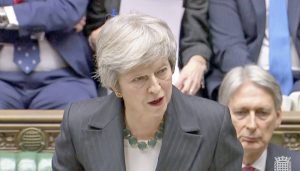 In this grab taken from video, Britain’s Prime Minister Theresa May makes a statement on the draft Brexit withdrawal agreement, in the House of Commons in London on Thursday Nov. 15.
[/caption]
London, Nov. 15 (IANS): Brexit Secretary Dominic Raab and another senior UK minister resigned on Thursday, just hours after Prime Minister Theresa May secured her Cabinet’s backing on a draft EU withdrawal deal following lengthy and tense meetings with her government.
Raab, who only took office in July when his predecessor David Davis quit due to his conflicting views with May, said that he “cannot in good conscience support” the UK’s draft Brexit agreement with the EU, the BBC reported.
His resignation, just as the Brexit negotiations appeared to be entering their twilight stages, came as a huge blow to May amid growing calls among hardline Tories for a vote of no confidence against their leader.
May was set to speak in the Parliament later in the day to sell the new “divorce deal”.
“I regret to say that following the Cabinet meeting yesterday on the Brexit deal, I must resign,” the Conservative Party politician said in his resignation letter to May.
Raab said he could not back the proposed measures of keeping Northern Ireland in regulatory alignment with the EU as a way to avoid a hard border with the Republic of Ireland and nor could he support an indefinite backstop arrangement, whereby the UK would remain in a customs union until a future deal with the bloc is fully thrashed out.
“Above all, I cannot reconcile with the terms of the proposed deal with the promises we made to the country in our manifesto at the last election,” he said.
Pound sterling dropped one per cent against the euro and the dollar upon Raab’s announcement.
Following Raab’s move, British Work and Pensions Secretary Esther McVey announced his resignation and said the withdrawal deal “did not honour the result of the referendum.”
“This is a matter of trust,” she said in her resignation letter. “It is about the future of our country and the integrity of our democracy.”
Earlier in the day, Shailesh Vara, Minister of Northern Ireland state, also quit over the deal. Vara, who backed to remain in EU in the 2016 referendum, said he feared the UK would stay in limbo for years while a permanent deal with the EU was negotiated. UK Opposition Labour Party leader Jeremy Corbyn called it a “botched deal”.
“After two years of bungled negotiations, from what we know of the government’s deal, it’s a failure in its own terms.” It seems highly unlikely that his party would support May’s deal when it comes to a vote.
On Wednesday, May after a five-hour Cabinet meeting on the draft deal, cleared the first hurdle when the ministers finally approved the draft terms of her EU withdrawal agreement, which needs to be ratified by the British Parliament and the remaining 27 EU countries.
At present, she is facing a battle to get it through Parliament as Brexiteer Conservative member of the Parliament -- as well as some Remainers -- condemned the plan, accusing her of breaking promises and handing control back to Brussels.
“The draft agreement is the best that could be negotiated,” May said after the Cabinet meeting on Wednesday. “The deal enables us to take back control.”
Prime Minister Theresa May will face a major showdown with her Cabinet ministers as the UK’s withdrawal agreement with the European Union enters a crucial stage.
Downing Street has said that the UK and the EU have agreed an initial draft agreement on the negotiating terms for Britain’s exit, the so-called divorce settlement, from the economic bloc by March next year. Theresa May now has the tough task of convincing her deeply divided Cabinet that the agreement is the best possible outcome for Britain.
“The negotiations for our departure are now in the endgame. And we are working extremely hard, through the night, to make progress on the remaining issues in the withdrawal agreement, which are significant,” May had said in a speech earlier this week.
“Both sides want to reach an agreement. But what we are negotiating is immensely difficult. I do not shy away from that,” she said, hours before it emerged that Brussels was ready to publish a 500-page document of the withdrawal agreement once May is able to get her Cabinet on board.
On one of the most contentious aspects of the negotiations, the EU has reportedly dropped its demand for Northern Ireland to remain in the economic bloc’s Customs Union as a “back stop” until a future trade deal is signed.
However, Prime Minister May is believed to have agreed that the region can remain more closely aligned to the EU regulations in some areas than the rest of the UK.
The deal will involve a two-year transition until 2021, followed by a UK-wide Customs Union “backstop” in the event that the Irish border issue cannot be resolved during that period.
While the full details of the agreement are yet to be published, leading Brexiteers and even some pro-Remain MPs of the ruling Conservative Party have called on ministers to reject the deal as unacceptable.
Northern Ireland’s Democratic Unionist Party (DUP), on whom May relies for her majority in the House of Commons, has warned that the agreement could lead to the break-up of the United Kingdom.
An embattled May hosted one-on-one briefings with her ministers in Downing Street on Tuesday ahead of the full Cabinet meeting expected to last around three hours later on Wednesday.
Some key pro-Brexit ministers, including international development secretary Penny Mordaunt and work and pensions secretary Esther McVey, are being named as possible members of her Cabinet who might resign in protest and possibly even pave the way for a leadership challenge against May.
But May is thought to have won the support of five key ministers foreign secretary Jeremy Hunt, home secretary Sajid Javid, Brexit secretary Dominic Raab, environment secretary Michael Gove, and Attorney General Geoffrey Cox.
Ambassadors from the remaining 27 EU member states will then discuss the possibility of organising an emergency summit later this month, earmarked for November 25, to sign off on it.
However, then the UK government faces a battle to win Parliament’s backing on the divorce agreement, with some Tories already vowing to vote against it and the Democratic Unionist Party DUP’s support being uncertain.


