


A book on Lotha-Naga electoral politics by Dr. E Benrithung Patton was launched at Fazl Ali College.
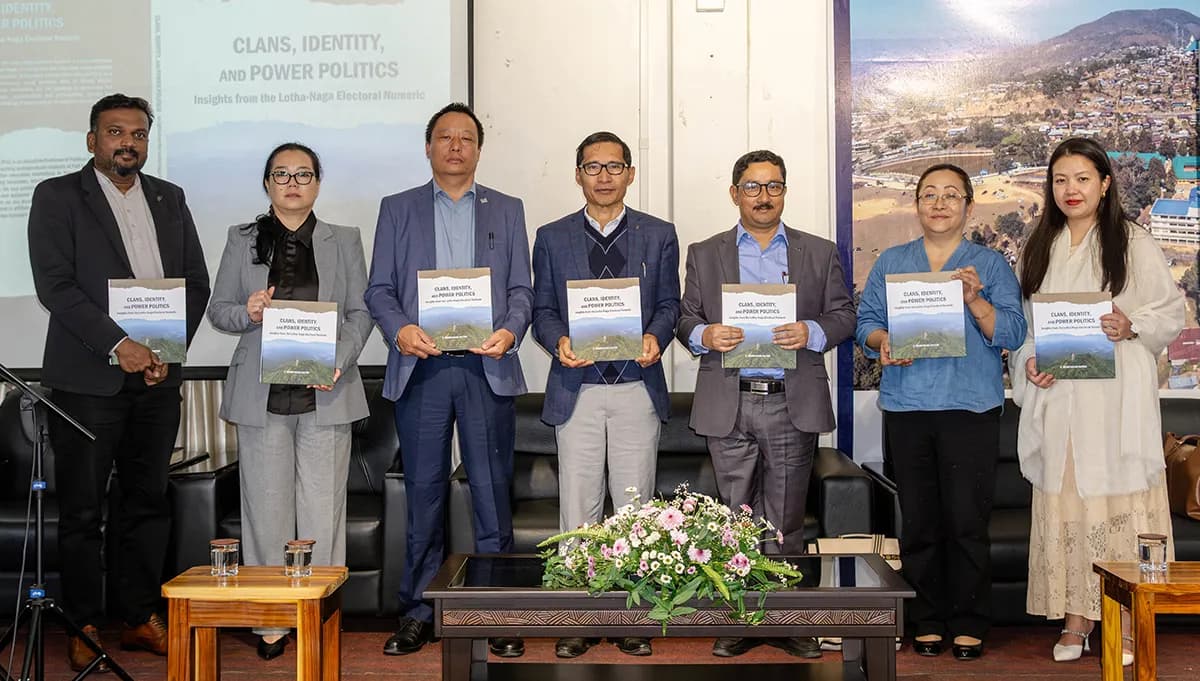
DIMAPUR — A book titled “Clans, Identity, and Power Politics: Insights from the Lotha-Naga Electoral Numeric”, written by Dr. E Benrithung Patton, Associate Professor of Political Science at Fazl Ali College (FAC), Mokokchung, was launched at the college conference hall on Friday.
According to a press release, the book was released by special guest Akhil Ranjan Dutta, Professor and former Head of the Political Science Department, Head of the Sociology Department, and Director of the Gauhati University Institute of North East India Studies (GUINEIS), Gauhati University, in the presence of the college fraternity, special guests, and well-wishers.
The book is a comprehensive study of the socio-political landscape of the Lotha-Naga, revealing how clan structures shape electoral behaviour, leadership patterns, and democratic practice. It theorises pfűchipolitics (clan politics) as a framework for understanding indigenous governance using electoral data of Wokha district (1964-2023).
The book demonstrates that clan institutions are not opposed to democracy but culturally embedded systems of representation, accountability, and participation. Beyond the Lotha-Naga experience, the book advances a rethinking of democracy as an adaptive and contextually grounded process in plural societies.
Principal Dr. I Wati Imchen, in his welcome address, encouraged academicians in the pursuit of academic nourishment, considering this milestone of the college and Dr. Patton in particular as a springboard for more research writings.
Dutta called the book a great contribution to the discourse on democracy in India, describing it as a work based on empirical grounding with theoretical insights providing statistics of the last six decades of elections in Wokha district.
Author Dr. E Benrithung Patton called the book "a part of lived experience", growing up in a time when the election process involved election funding, feasting, and distribution of resources.
He added that the book is intended not only for the younger generation but particularly for the elderly who were actively involved in politics three to four decades back. He welcomed critical opinions from readers, stating that this will add more value to his work, as it will open doors for more meaningful and insightful conversations on the subject.
Moamenla Amer, Professor of Political Science at Nagaland University, delivered the book review, calling it an empirical and ethnographic study that is a major academic contribution, while Sentinaro Longkumer, Editor-in-Chief of 6th Finger Publishers, Kohima, shared the publisher’s note.