[caption id="attachment_250132" align="aligncenter" width="500"]
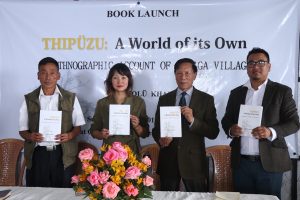 From left: Village Council Chairman Chorhitso Khamo; and Dr. Sezolü Khamu, Hüsaü Epao; and Dr. Mechüselie Kehie.
[/caption]
Dimapur, May 20 (EMN): A book, ‘Thipüzu: A world of its own, an ethnographic account of a Naga village,’ was released by the principal of Patkai Christian College, Hüsaü Epao, on Sunday, at Thipüzu village.
The book was authored by Dr. Sezolü Khamu and published by Whetstone Publication, a press release from the organisers on Monday stated. The book was dedicated to 'all the generations of Thipüzumi,' updates informed.
"As such finding a solid place among the people of the village, the book is an attempt to cover in brief as many instances that speaks of the life in and about Thipüzu," the press release stated.
Speaking during the occasion, Dr. Khamu informed that the journey to document the life of the village in the form of a monograph was started way back in July 2016.
Reminiscing over the journey, the author credited the elders of the village who had helped her with unique narratives of the past; which otherwise would have been impossible to find, the updates stated.
The author spoke about the importance of village ethnographies considering the uniqueness of each village. She said, “It is in taking pleasure in the fascination of the past and the concern for the fast fleeting culture that have inspired me to come up with this monograph.”
Further, Khamu spoke about how anthropologists started to shift their attention from typical monographic study of tribes and concentrated on villages when the Second World War came to a close.
Speaking about the core theme of the book, she said, “Each village has its own distinctive cultural heritage as such it is important to document each village as a distinctive entity.”
A special guest of the programme, Hüsazü Epao congratulated the author. The college principal said that the book was a ‘must read’ book for students, scholars and others 'who wish to know about a Naga village.'
Stating that the book was a well researched piece, Epao urged people to 'have a copy of the book in order to show it to guests from outside visiting their village.'
Stating to have been impressed by the author’s effort, Epao said that the decision to release the book in the village about which the book was, reflected the author’s genuine acknowledgement of the villagers and the village itself.
Founder-director of the Sustainable Development Research Centre of Rüzaphema village, Dr Mechüselie Kehie gave the introductory and publisher’s note. He "underscored the significance of documenting the fast eroding cultural heritage of the Naga people."
Kehie was stated to have told the gathering that the book can be a strong 'medium to pass on the oral tradition.' It can act as a historical account of the traditions followed by generations, he said.
Adding that the 'richness' of a cultural heritage cannot be limited to one book, he encouraged writers and authors to come forward to add to the value of documentation.
Further, Kehie informed that a meeting was held with the village's council and research committee of the village after the primary collections of the data. It was then approved and authenticated by both, the updates stated.
"It is pertinent to mention here that the village has a research committee where the villagers can volunteer to share distinct narratives in order to be documented," the press release informed.
Leaders of the village council also spoke during the occasion, the updates stated.


