[caption id="attachment_197334" align="alignleft" width="320"]
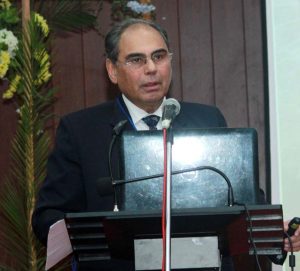 Pramod Tandon, CEO of Biotech Park, delivering the keynote address at the capacity-building programme at Nagaland University, at Lumami, on July 25.
[/caption]
Mokokchung, July 25 (EMN): Bio-economy is economic activities relating to invention, development, production and use of biological products and processes for people’s use. This economy is the next big thing in the business-of-all-things, students and youths attending a skill development programme in Mokokchung were told recently.
The chief executive officer of Biotech Park, Professor Pramod Tandon said on Wednesday during the programme that 40% of the world’s economy is based on biological products. Bio-economy is expected to be the next economic wave after the fossil economy, he said.
Professor Tandon was delivering the keynote address of the inaugural programme of a four-day workshop, ‘skill and entrepreneurial development of the tribal youth.” The topical theme of the event was value-additions to rich bio-resources with special reference to medicinal and aromatic plants. The event was conducted at Nagaland University at Lumami.
Eminent scientists, scholars, and degree students; members of self help groups and entrepreneurs from Zunheboto and Mokokchung are attending the event, organized by Biotech Hub, of the univ. department of Botany, in collaboration with Biotech Park of Lucknow. The workshop will conclude on July 28.
The professor said bio-economy was born from necessity as ‘people are forced to find alternatives because of Climate Change and scarcity of non-renewable raw materials,’ etc. He defined bio-economy as a set of economic activities relating to invention, development, production and use of biological products and processes.
Tandon informed the participants that there was a rapid increase in the world’s population, which is at an alarming rate, with the estimate of the current about 7 billion to increase to 9 billion by 2050. He cautioned that a large number of areas that are useable for agricultural process will be lost. This will put a lot of pressure on biodiversity and vital services. Besides, about 60 % of the Earth’s ecosystem will be in trouble if the population increases without check.
The professor warned that there would be 50 % more of requirement for food, 4.5 % more for energy and a 30 % increase in demand for water by 2030.
It is going to be a herculean task unless steps are taken right away, he said. Mankind will not be able to meet the challenges ahead, the gathering was told.
On the Northeast region, the professor observed that cultural diversity was the reason behind the region’s rich biodiversity. “It all starts from respect for biological diversity, which implies respect for human diversity,” Tandon said. However, he lamented that the Northeast region was lagging behind the rest of the country even though the region contributes ‘50 percent of the country’s fauna and flora.’
In this regard, he asserted that biological resources are going to be the future welfare and security of the country. Therefore, the entire ecosystem of the Northeast region provided by its rich biodiversity should be explored and exploited for economic gain in sustainable ways, the gathering was told.
Further, the speaker talked about the potential of floriculture, herbal products and bamboo, and the importance of documenting traditional knowledge through scientific means in the Northeast states. He urged the people to conserve crop genetic diversity for the reason that biodiversity generates economic values.


