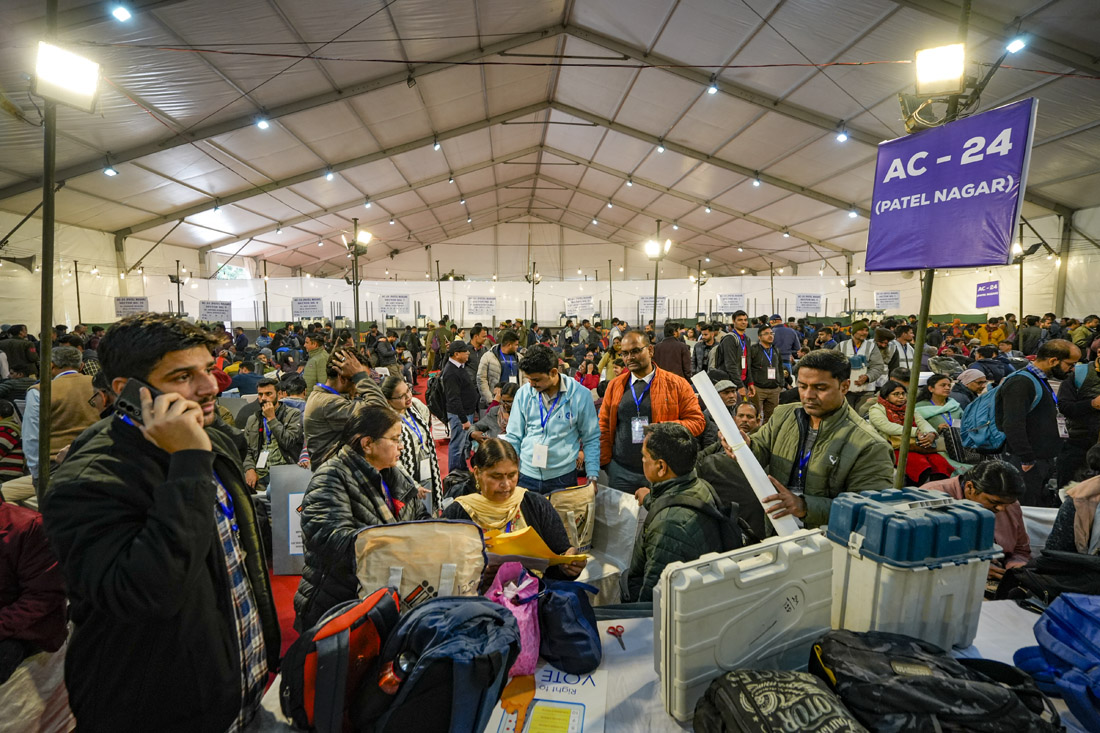
Polling officials leave after collecting election material
from a distribution center on the eve of the Delhi Assembly elections, at Gole
Market in New Delhi, Tuesday, Feb. 4, 2025. (PTI Photo/Shahbaz Khan)
NEW DELHI — The stage is set for the high-stakes Assembly elections in Delhi,
with over 1.56 crore voters eligible to cast their ballots from 7 am onwards on
Wednesday.
Voting will take place across 13,766 polling stations in
all the 70 Assembly constituencies to decide the fates of 699 candidates in a
contest that could reshape the political landscape of the capital.
Led by Arvind Kejriwal, the Aam Aadmi Party (AAP) is
seeking a third straight term, banking on its governance record and welfare
schemes.
On the other hand, the Bharatiya Janata Party (BJP) is
making a determined push to reclaim the capital after more than 25 years.
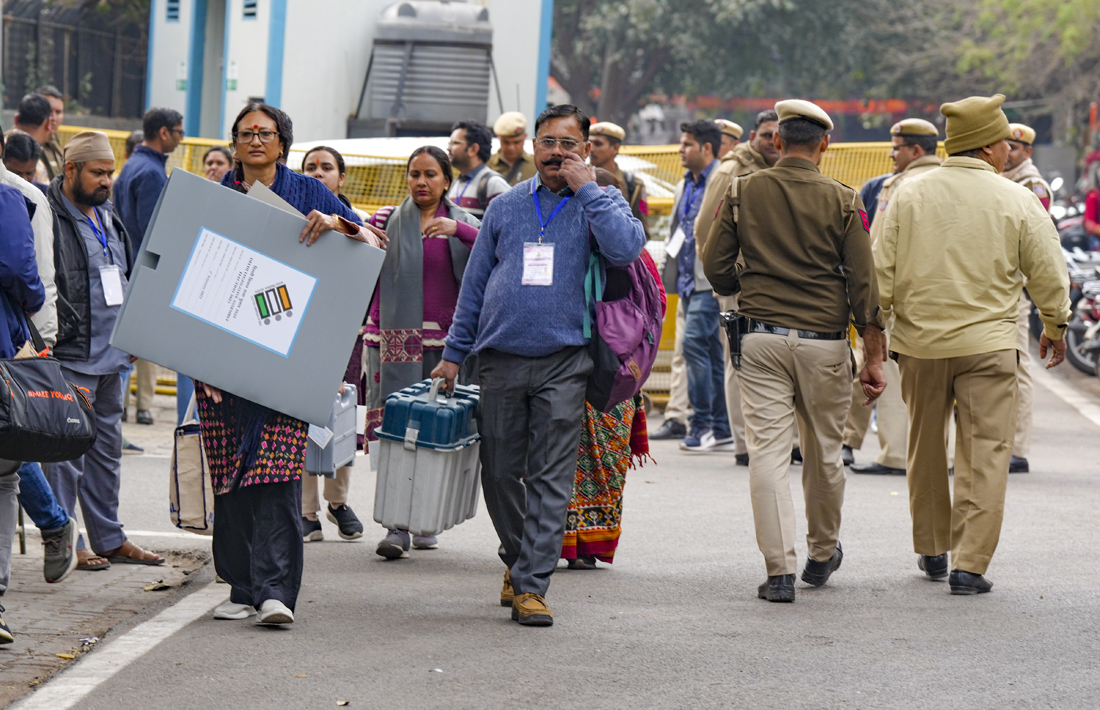
Polling officials leave after collecting election material
from a distribution center on the eve of the Delhi Assembly elections, at Gole
Market in New Delhi, Tuesday, Feb. 4, 2025. (PTI Photo/Shahbaz Khan)
The Congress, which ruled Delhi for 15 years till 2013,
is striving to stage a comeback after failing to win a single seat in the
previous two elections.
Polling will begin at 7 am on Wednesday and continue
until 6 pm under tight security arrangements.
The Election Commission has deployed 220 companies of
paramilitary forces, 35,626 Delhi Police personnel, and 19,000 home guards to
ensure peaceful voting.
Nearly 3,000 polling booths have been identified as
sensitive, and special security arrangements, including drone surveillance,
have been made at some of these locations.
According to Delhi Police, additional police forces will
be deployed for the sensitive booths where Quick Reaction Teams (QRTs) will
also be stationed to maintain law and order.
Special provisions have been made for senior citizens and
persons with disabilities, with 733 polling stations designated for their
accessibility.
In an effort to streamline the process, the Election
Commission has introduced a Queue Management System (QMS) app, which will
enable the voters to check crowd levels in real time.
Additionally, 6,980 out of 7,553 eligible voters under
the home voting facility have already cast their ballots.
The campaigning, which officially ended at 6 pm on
Monday, saw a high-voltage battle between the three main contenders.
The AAP focused on its governance model, with Kejriwal
and Chief Minister Atishi leading rallies across the city.
Led by heavyweights like Prime Minister Narendra Modi,
Home Minister Amit Shah and party president JP Nadda, the BJP intensified its
attack on the AAP over corruption allegations and law and order issues.
The Congress, led by Rahul Gandhi and Priyanka Gandhi,
too put up a spirited campaign, targeting both the AAP and the BJP on various
issues.
The discourse was marked by aggressive name-calling,
AI-generated spoofs, and debates over issues such as the "Sheesh
Mahal" controversy, Yamuna's water quality, and allegations of voter list
tampering.
While governance, law and order, and women's welfare were
the focal points, freebies dominated the pre-poll promises.
The AAP has pledged free bus rides for students,
insurance for auto and taxi drivers, and financial aid of Rs 18,000 for temple
priests and gurdwara granthis.
The BJP, on the other hand, has promised financial
assistance of Rs 21,000 for pregnant women and subsidised cooking gas cylinders
at Rs 500, while the Congress has vowed to provide a monthly unemployment
benefit of Rs 8,500.
The poll outcome on February 8 will determine whether AAP
retains its stronghold, the BJP breaks its losing streak, or the Congress
springs a surprise.
With voter turnout likely to play a decisive role, all
eyes are now on Delhi's electorate as they hit the polling booths on Wednesday.