


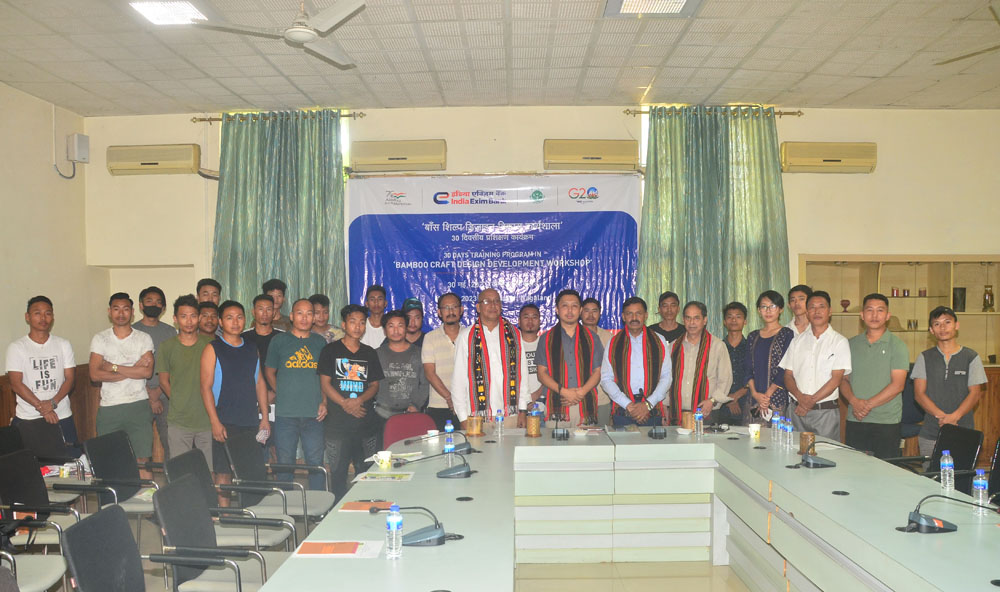
DIMAPUR — A 30-day training-cum-workshop for 25 bamboo handicraft artisans got underway at the Bamboo Resource Centre, 7th Mile under Chümoukedima district on May 30 with Nukzo Phesao, proprietor of Warehouse 103 and founder of Nature Fuel India and co-founder of Pristine Food India, as the chief guest.
The training-cum-workshop was organised by Rashtriya Gramin Vikas Nidhi, Guwahati, and supported by EXIM Bank, Mumbai.
An update from EXIM Bank informed that the programme was aimed at imparting training to develop new products with modern techniques and improve the quality of products through product diversification. Its objective was to help artisans understand and comply with international quality and safety standards for bamboo products and to ensure that Indian bamboo products meet international buyers' requirements and are competitive in the global market.
Speaking at the opening ceremony, EXIM Bank general manager, Dharmendra Sachan stated that Nagaland, a landlocked state in the north eastern region of India, is known for its bamboo handicrafts. He added that bamboo artisanal activities have been an integral part of Indian culture and heritage for centuries. Sachan stated that support to bamboo handicraft artisans of Nagaland was a step towards skill development with product diversification.
“This is a step towards creating employment opportunities for local communities and enhancing the income of artisans engaged in the bamboo sector,” he said.
He pointed out that bamboo has a wide range of applications and could be used to develop innovative and high-quality products including furniture, handicrafts, textiles and construction materials. He opined that supporting bamboo handicraft artisans could foster product innovation and design and create new market opportunities for Indian products in domestic and international markets.
[bsa_pro_ad_space id=1]Sachan informed that Exim Bank assists artisans, master craftsmen, weavers, clusters, self-help groups, and grassroots and micro enterprises through capacity building and sourcing overseas buyers/ distributors under its grassroots initiatives and development (GRID) and marketing advisory services (MAS) programmes.
He stated that the bank extends support and promote grassroots enterprises by providing specific interventions such as skill development, product development, and export readiness. He added that the assistance under those programmes have enabled financial empowerment, employment generation, promotion of entrepreneurship among individual artisans and ensured the survival and sustenance of centuries-old traditional handicraft and handloom products.
Also speaking at the inaugural programme, Nukzo Phesao, has shared about his personal journey as an entrepreneur especially in food processing domain. In his exhortation, he explained how different products are interconnected and has common use in the supply chain.
He also cited an example where bamboo craft products are used for serving and storing of food processed items etc. He further stressed on the need to maintain product quality at competitive price, besides giving special attention to business networking and about product promotional and marketing strategy.
Jaideep Das, deputy director of RGVN, while delivering the welcome address, gave a brief introduction on the purpose of the training and its relevance in skilling bamboo craft artisan. He encouraged the artisans to draw out maximum benefit from the training.
Utpal Dutta, deputy director of RGVN (HR), presented a brief account of RGVN as a national-level organisation and highlighted its various development programmes being undertaken by the organisation across the country.
K Heshu Henry, training coordinator, proposed the vote of thanks.