


Nagaland University and ICAR National Bureau of Fish Genetic Resources held awareness programme on aquaculture under NEH Component.
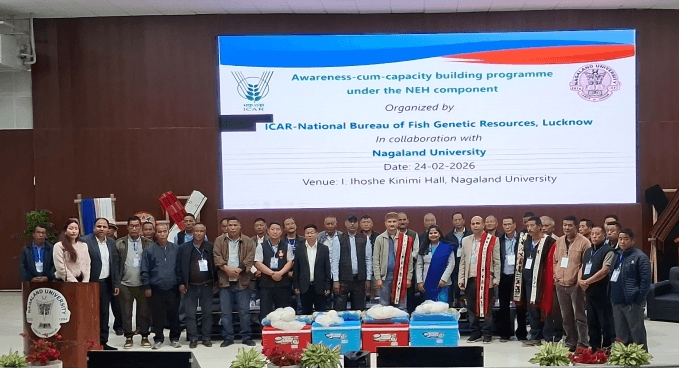
DIMAPUR — An awareness-cum-capacity building programme under the NEH Component was organised at I Ihoshe Kinimi Hall, Nagaland University, Lumami, on Tuesday.
The programme was organised by the Indian Council of Agricultural Research (ICAR)-National Bureau of Fish Genetic Resources (NBFGR), Lucknow, in collaboration with Nagaland University, with the objective of strengthening sustainable aquaculture practices and promoting scientific fisheries development in the North Eastern Hill region.
According to an update, the programme was convened by Dr. Kajal Chakraborty, Director, ICAR–NBFGR, Lucknow, who addressed the gathering virtually and presented an overview of the Bureau’s initiatives in the NEH region.
He highlighted fish germplasm conservation, brood bank development, biosecurity measures, and farmer-orientated capacity-building interventions aimed at enhancing regional fisheries productivity.
Also read: NEISSR commemorates World Peace and Understanding Day in Chümoukedima
The inaugural session included the release of farmers’ extension booklets in the Nagamese and Ao languages to support scientific fish farming practices at the grassroots level.
Chief guest B Kilangla Jamir, Vice-Chancellor (In-Charge), underscored the vast fisheries potential of Nagaland, noting the state’s abundant streams, ponds, springs, and terrace-based water systems.
She observed that despite these natural resources, dependence on imported fish remains high, reflecting a production gap as well as a significant opportunity for achieving self-reliance through scientific pond management, quality seed use, balanced feeding, and systematic water-quality monitoring.
Dr. Abemo, Registrar of Nagaland University, emphasised the university’s commitment to providing strong administrative support for community-orientated research and extension initiatives. Bendang Ao, Director of the Research & Development Cell, highlighted the importance of translating academic research into measurable field-level outcomes that directly benefit rural communities.
The programme witnessed participation of nearly 250 attendees, including progressive Ao tribal fish farmers, village council members from Mangmetong Village, faculty members, university staff, research scholars, students, and media representatives.
Technical sessions covered scientific pond preparation, optimal stocking density, feed and health management, water-quality assessment, and post-harvest handling practices. An interactive scientist–farmer session enabled participants to discuss field-level constraints and identify locally adaptable solutions.
Conference on intelligent systems
Meanwhile, the 6th International Conference on Intelligent Systems and Machine Learning commenced at the Kohima Campus, Meriema, Nagaland University, on Tuesday and will continue till February 25.
The conference is being organised by the School of Engineering and Technology, Nagaland University.
Jagadish K Patnaik, Vice-Chancellor of Nagaland University, who was the chief guest, delivered a recorded video message.
Sachinandan Mohanty, General Co-chair, stated that more than 1,000 papers were received, out of which 249 papers were accepted and will be published in SCI- and Scopus-indexed JOVE and PES journals, as well as in Scopus-indexed AIP proceedings.