


Nagaland University and ICS host the 19th All India Conference of Chinese Studies focusing on research and AI
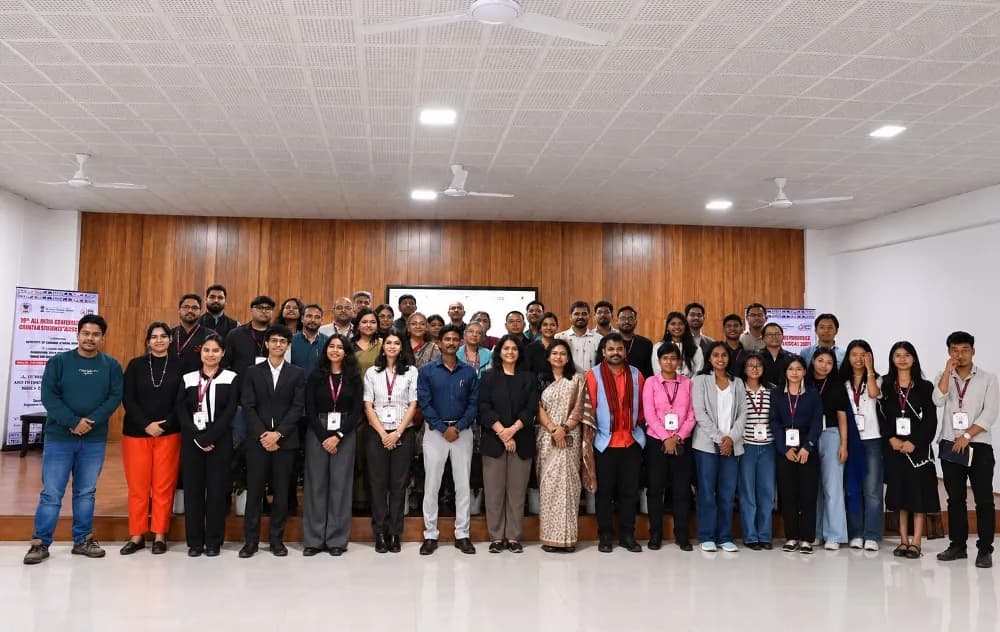
DIMAPUR — The 19th All India Conference of Chinese Studies (AICCS), jointly organised by the Institute of Chinese Studies (ICS), New Delhi, and the Department of Political Science, Nagaland University, concluded on October 30.
The conference was held from October 28 to 30. According to an update, the valedictory session on October 30 emphasised the importance of strengthening India’s research ecosystem and developing an independent, evidence-based understanding of China.
Speakers highlighted the need to study China through primary sources, move beyond dominant external narratives, and encourage greater participation of young scholars, particularly from the Northeast, in China Studies. The discussions also drew attention to the challenges posed by AI, including digital inequality, employment displacement, ethical concerns, and dependence on foreign technologies.
The conference received 90 abstracts, of which 54 papers were selected for presentation across 11 thematic panels and two special panels over three days, with participation from scholars representing more than 27 institutions across India.
Also read: AI to aid preservation of India’s cultural heritage
Discussions on the first day examined the institutional, linguistic, and epistemic challenges facing China Studies in India, alongside China’s political economy, governance, and society. Presentations addressed the need for epistemic sovereignty, the evolution of China Studies, Chinese language education under NEP 2020, and the shortage of programmes and faculty in Northeast India.
Speakers also examined China’s energy transition, digital governance, ethnic cultural industries, environmental risks in technology infrastructure, youth disengagement, state feminism, and women’s movements in China and India. The panels highlighted the importance of stronger research infrastructure, ethical and inclusive governance, independent scholarship, and human expertise in an age increasingly shaped by AI.
Discussions on the second day explored the role of emerging technologies in strategic competition, historical interactions between India and China, and the growing influence of AI on global power dynamics. Presentations examined critical mineral supply chains in Central Asia, the use of AI in contemporary Chinese literature, digital nationalism, and the implications of technological rivalry for national security.
A special panel on strategic autonomy and techno-geopolitics highlighted the importance of developing indigenous AI capabilities, strengthening semiconductor infrastructure, fostering public-private partnerships, and balancing technological self-reliance with international cooperation.
The third day focused on China’s role in shaping global technological norms, AI governance in the Global South, high-tech security architecture, digital infrastructure, and regional relations.
Researchers examined China’s influence on international technology standards, India’s pursuit of digital sovereignty, cybersecurity risks associated with smart-city infrastructure, and India’s dependence on Chinese battery technologies and electronic components.
Discussions also explored the strategic implications of undersea cables, digital connectivity, and technological dependencies for national security and international relations.
The conference concluded with three key priorities for advancing China Studies: deepening empirical research, strengthening interdisciplinary and comparative approaches, and building India’s institutional capacity for research on China.
The next edition, the 20th AICCS, is scheduled to be hosted by Chanakya University, Bengaluru, in 2027.