[caption id="attachment_224660" align="alignnone" width="550"]
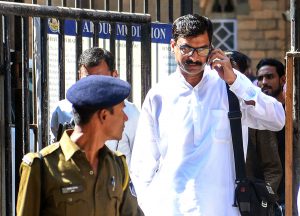 Rubabuddin, brother of Sohrabuddin Shaikh, leaves the special CBI court, in Mumbai, Friday, Dec. 21, 2018. The court has acquitted all 22 accused in the alleged fake encounter case of gangster Sohrabuddin Shaikh. (PTI)
[/caption]
Mumbai, Dec. 21 (PTI): All 22 accused in the alleged fake encounter killings of gangster Sohrabuddin Shaikh, his wife Kausar Bi and his aide Tulsi Prajapati were acquitted Friday by a special CBI court because of insufficient evidence, even as it expressed sorrow over the loss of "three lives."
Special CBI Judge S J Sharma said in his ruling that the court feels sorry for the families of Shaikh and Prajapati as "three lives were lost", but the system demands that the court go solely by evidence. "....I am helpless," the judge said.
The court noted that the prosecution could not have done much to salvage its case as key witnesses turned hostile.
"There is no substantial evidence on record. The evidence submitted does not conclusively show that these 22 accused were the authors of this crime," it said.
All the accused, who were mostly police officials from Gujarat and Rajasthan, were out on bail during the year-long trial.
The 13-year-old case saw several twists and turns, including 92 prosecution witnesses turning hostile. At one point, BJP president Amit Shah was also arrested briefly in 2010 in the case before being discharged in December 2014.
The court's verdict drew mixed responses in the court room. While the accused, all of whom were present in court, broke into tears of joy, congratulated and hugged each other, Shaikh's brother Rubabuddin looked visibly upset.
Sharma said the prosecution failed to establish a cogent case to suggest there was a conspiracy to kill the three people, or the accused had any role in it.
He said while there was no denying that Shaikh and others were killed, "going by the evidence on record, the court could not conclude that the present accused persons could be questioned, or, held accountable for those deaths."
The three victims, who were returning to Sangli in Maharashtra from Hyderabad in a bus, were taken into custody by a police team on November 22-23, 2005 night. The couple were taken in one vehicle and Prajapati in another.
CBI, the prosecuting agency, said Shaikh was killed on November 26, 2005, allegedly by a joint team comprising Gujarat and Rajasthan police, and Kausar Bi three days later. Prajapati, who was lodged in an Udaipur central jail, was killed in an encounter on the Gujarat-Rajasthan border on December 27, 2006.
Of the 22 accused, 21 are junior police officers from Gujarat and Rajasthan, who the CBI said were part of the teams that abducted the three and later killed them in staged encounters.
The remaining accused was owner of the farm house in Gujarat where Shaikh and Kausar Bi were illegally detained before being killed.
"The prosecution has failed to put forth any documentary or substantive evidence to suggest or establish the conspiracy theory against the 22 accused. It has failed to establish all charges levelled against them. Hence all the accused stand acquitted," the judge said.
The court cannot rely solely on "circumstantial and hearsay evidence", he said.
Police said Sohrabuddin was linked to terror groups like Lashkar-e-Taiba and allegedly conspired to assassinate Prime Minister Narendra Modi, who was then Gujarat chief minister.
Despite sincere efforts made by the prosecution, a cogent case could not be established since CBI lacked documentary evidence and reliable witnesses, Sharma said.
"Two main prosecution witnesses turned hostile. What could the prosecution have done? It couldn't have forced them not to turn hostile," he said.
The court was apparently referring to police drivers Nathuba Jadeja and Gurudayal Singh, eye-witnesses to the killings, as per CBI, who did not support the prosecution case in the witness box.
"Therefore, when this court ultimately went through all the evidence and testimonies on record, it concluded that no case of conspiracy could be established. Also, no link between these 22 persons and the three deaths could be established," Sharma said.
The court said there was nothing to show if service weapons of any of the accused policemen were used in the killings.
The CBI had charged 38 persons, including Amit Shah, who was then Gujarat home minister, Gulabchand Kataria, the then Rajasthan home minister, and senior IPS officers like D G Vanzara and P C Pande. The prosecution had examined 210 witnesses, of which 92 turned hostile.
Shah was arrested in the case in July 2010, but released on bail by Gujarat High Court in October 2010. He was discharged by CBI court in December 2014.
Sixteen people, including Shah, Kataria, Vanzara and Pande, were earlier discharged by the CBI court due to lack of evidence.
The case evoked controversy when judge B H Loya, who was presiding over the CBI court, died three years ago after a heart attack. His family made unsubstantiated allegations that the judge was offered a huge bribe to rule in favour of the prime accused.
The case was initially probed by Gujarat CID before CBI took over in 2010. The SC in 2013 directed the trial be shifted to Mumbai from Gujarat on CBI's request to ensure a fair trial.
CBI had claimed Vanzara summoned Gujarat IPS Ashish Pandya while the latter was on leave, to be part of Prajapati's alleged encounter.
"CBI failed to produce any substantial evidence, phone records to prove Vanzara called Pandya for this specific purpose. There is nothing to conclude Vanzara had any knowledge of the alleged conspiracy," the court said.
Rubabuddin said he was disappointed with the verdict and would appeal in the SC.
The court Friday also dismissed applications by two prosecution witnesses seeking re-examination.


