


AISA activists staged a protest for the second consecutive day against Chief Election Commissioner Gyanesh Kumar, with around 150 protesters, including AISA national president Neha Bora, activist Yogendra Yadav and senior advocate Prashant Bhushan, detained as they marched towards Jantar Mantar amid heavy police deployment on Saturday.
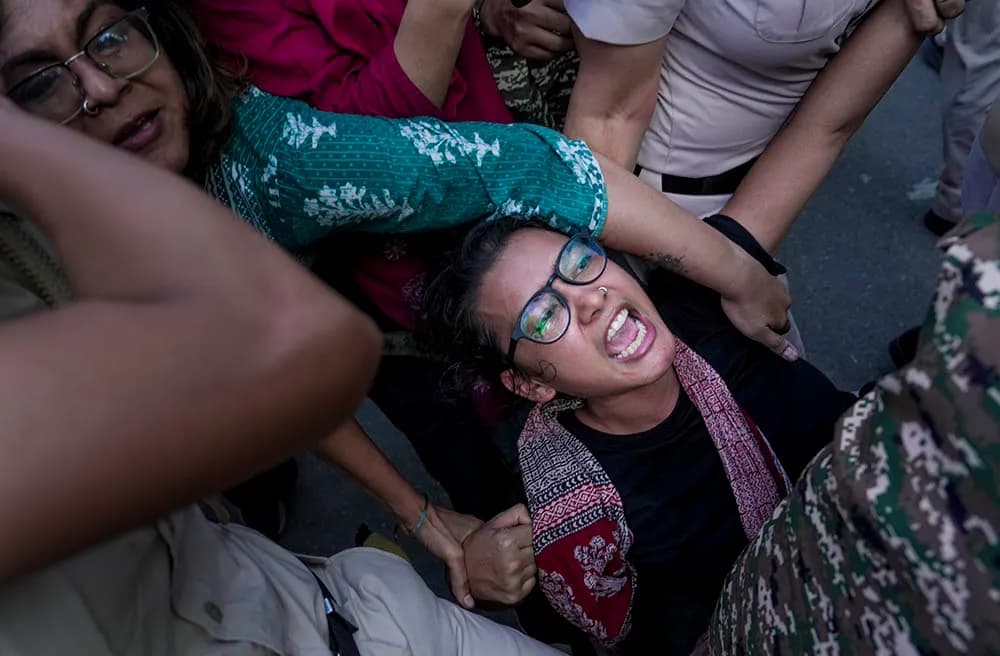
NEW DELHI — AISA activists staged a protest for the second consecutive day against Chief Election Commissioner Gyanesh Kumar, with around 150 protesters, including AISA national president Neha Bora, activist Yogendra Yadav and senior advocate Prashant Bhushan, detained as they marched towards Jantar Mantar amid heavy police deployment on Saturday.
The protesters began marching from Patel Chowk towards Jantar Mantar, where security personnel had erected barricades and deployed additional forces to prevent the demonstrators from reaching the designated protest area, according to an official.
AISA members said senior advocates Kapil Sibal, Nitya Ramakrishnan and Pallav Sisodia, along with Bhushan and Yadav, joined Bora and other students during the march.
Police began detaining protesters as they gathered near the protest site, with several of them taken to police stations, officials said.
"Women protesters, journalists, and lawyers were manhandled by male police. Several women have complained of being groped by male police personnel," AISA said in a statement.
"A police force that claims to ensure justice to women cannot maintain basic protocols of crowd management. Male police officers openly abused women protesters and behaved in the most unprofessional way," they said.
AISA claimed that Neha, along with 10 others, were taken to Kotwali police station, while DU AISA secretary Anjali, activist Anjali Bharadwaj, Yadav and Bhushan were taken to Badarpur police station.
The organisation alleged that more than 500 people who had marched towards Jantar Mantar on Saturday were met with force by Delhi Police while demanding what it described as integrity and transparency in the electoral process.
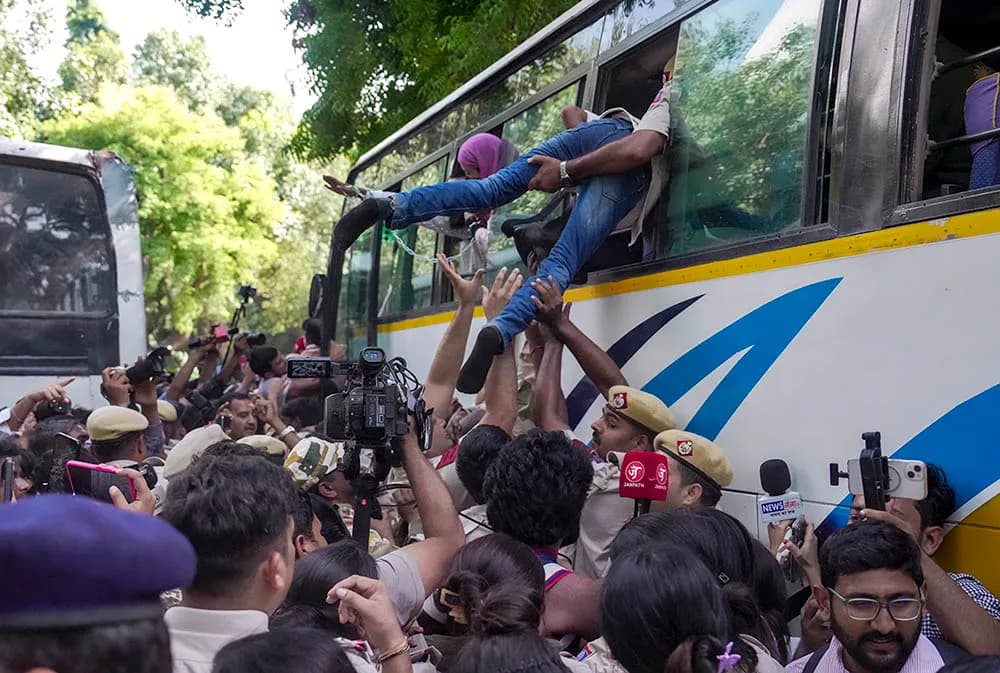
The fresh mobilisation followed Bora's call on Friday evening for activists to return to Jantar Mantar and continue the protest demanding Kumar's resignation and raising concerns over the Special Intensive Revision (SIR) of electoral rolls.
The development came a day after nearly 1,000 protesters were detained from Jantar Mantar and surrounding areas as police and paramilitary personnel prevented large groups from reaching the protest site. Many of those detained were subsequently released.
Delhi Police has registered at least three FIRs in connection with Friday's protests, two at Parliament Street police station and one at Connaught Place police station, under Section 223 of the Bharatiya Nyaya Sanhita for alleged disobedience of an order duly promulgated by a public servant.
A senior police officer said no individual or organisation had been named as an accused in the FIRs, though details of organisers and organisations that proposed or participated in the demonstrations were mentioned in their contents.
The FIRs relate to alleged violations of prohibitory orders imposed across the New Delhi district under Section 163 of the Bharatiya Nagarik Suraksha Sanhita, which restrict gatherings of five or more people, processions, demonstrations, picketing, dharnas and slogan shouting without prior written permission.
The protesters are opposing the SIR exercise and alleging irregularities in the revision of electoral rolls.
Delhi Police had denied permission for the Friday gathering and imposed heightened security measures in central Delhi. Several roads were barricaded and entry and exit at a number of Metro stations near Jantar Mantar were temporarily restricted.
The demonstration comes days after The Indian Express reported that Election Commissioners Sukhbir Singh Sandhu and Vivek Joshi objected on record at least 14 times over the last 10 months to decisions and orders on the SIR that they said were issued without their knowledge or recommendation.
Under fire over the red flags raised by two of its commissioners over the SIR process, the EC has asserted that differing views and observations are a normal part of deliberations in any institution and that all its orders carry full legal sanction and follow established statutory procedures.