


AIM, NITI Aayog, proposes 93 new Atal Tinkering Labs and two incubation centres for Nagaland under the AIM 2.0 Frontier Region Programme.
From agriculture to disaster preparedness, schools urged to tackle local challenges
DIMAPUR — The Atal Innovation Mission (AIM), NITI Aayog, has proposed 93 additional Atal Tinkering Labs (ATLs) and two Atal Incubation Centres for Nagaland under the AIM 2.0 Frontier Region Programme.
The proposals are currently at the consultation stage, with inputs from a two-day engagement involving the Department of School Education, government departments, educational institutions, industry, start-ups and civil-society organisations.
The engagement, held in Kohima on September 16 and the 17th, comprised a state-level consultation on innovation and entrepreneurship and visits to two existing ATLs.
Lend A Hand India supported the programme as its implementation partner.
The state-level consultation at De Oriental, Kohima, brought together more than 70 participants. Discussions focused on developing an innovation ecosystem suited to Nagaland’s geography, schools, local knowledge and emerging entrepreneurial opportunities. The consultation was chaired by L Jamithung Lotha, State Mission Director, Samagra Shiksha, Nagaland.
In his opening remarks, Lotha encouraged participants to provide practical inputs based on the needs and operating conditions of schools in the state.
Asangla Imti, Commissioner and Secretary, Department of School Education and SCERT, delivered the keynote address. She highlighted the importance of developing curiosity, practical skills and problem-solving abilities among students, and connecting Nagaland’s existing knowledge in agriculture, bamboo, crafts and community life with scientific thinking and modern tools.
Shubham Gupta, Innovation Lead, AIM, NITI Aayog, presented the context and objectives of the Frontier Region Programme, while Prateek Deshmukh, Programme Director, AIM, spoke about the mission’s vision for strengthening innovation and entrepreneurship in frontier regions.
Vineet Kumar, Additional Secretary, Finance and IDAN, emphasised credit-linkage awareness and the need for a supportive ecosystem for young entrepreneurs.
He also highlighted the increasing number of approvals being extended to young entrepreneurs under the Chief Minister’s Micro Finance Initiative.
Lend A Hand India representatives Richard Asoso, Programme Lead, and Arundhati Jadhav, ATL Programme Lead, presented the organisation’s work in school-based skill education and its experience supporting ATLs across the country.
Participants discussed infrastructure, teacher capacity, locally relevant innovation and the wider ecosystem required to sustain innovation in schools.
They stressed the importance of regular mentorship, internships and stronger linkages among schools, higher education institutions and industry.
The discussions also explored pathways for promising student innovators to progress from school-level tinkering to existing and proposed incubation centres.
Suggestions included establishing a technical consortium of institutions and experts, strengthening mentorship networks and organising a Nagaland Innovation Hackathon focused on challenges relevant to the state.
Representatives from Industries and Commerce, Startup Nagaland, Science and Technology, Information Technology and Communication, IDAN, Agriculture, Planning, Higher Education and Technical Education contributed to the discussions. Incubation centres, technical institutions and start-ups also shared perspectives on strengthening the innovation ecosystem.
Speakers emphasised that innovation in schools should extend beyond infrastructure and equipment. Students should be encouraged to identify and address local challenges involving agriculture, disaster preparedness, water, waste, energy, livelihoods and other community needs.
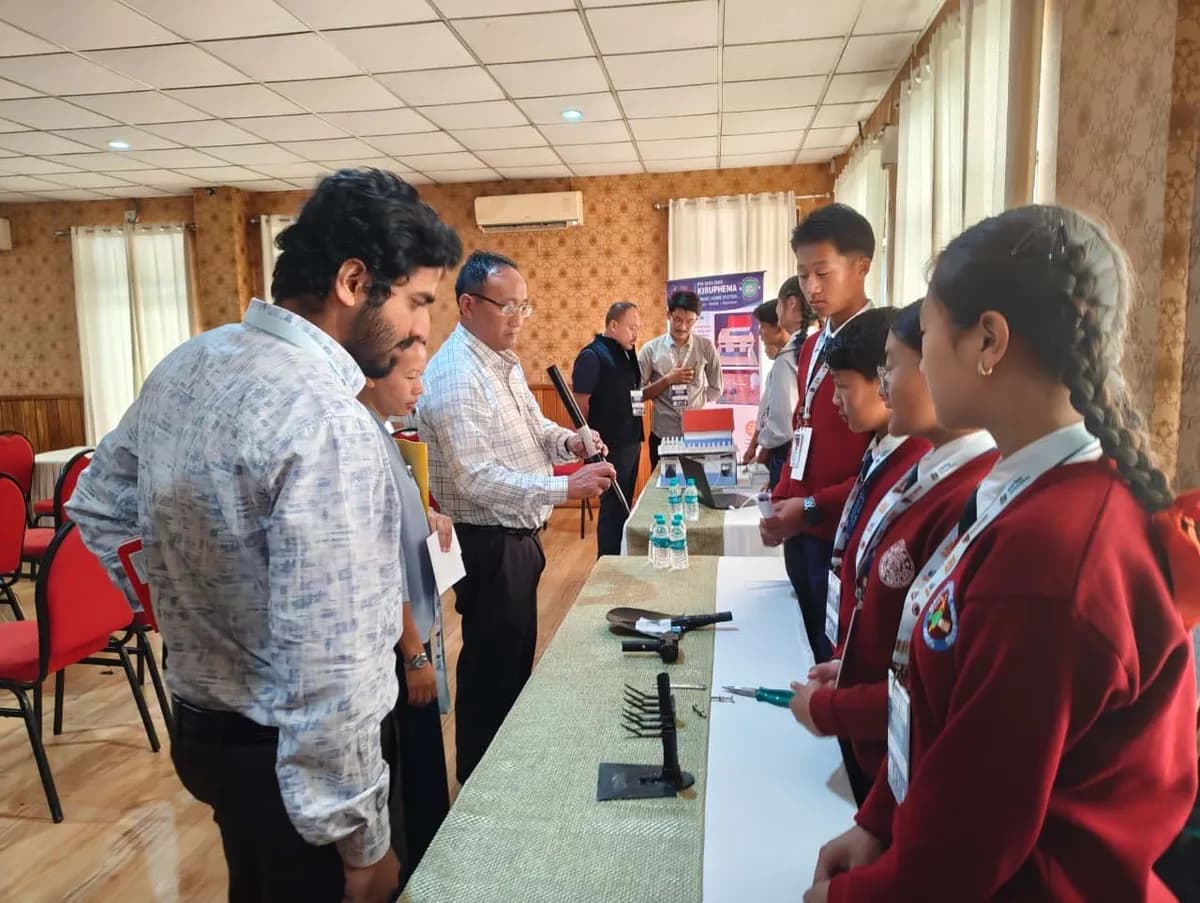
Student exhibits at the venue showcased work already being undertaken in Nagaland’s schools, including a multipurpose agricultural tool developed by students of Loyola Higher Secondary School, Jakhama, and a smart-home system developed by students of PM SHRI Government High School, Kiruphema.
In his closing remarks, Shashank Pratap Singh, Principal Director, Directorate of School Education, urged participants to look beyond the establishment of infrastructure.
He called for stronger convergence between innovation activities, curriculum and pedagogy, and emphasised linking practical activities with post-learning assessments.
The AIM team subsequently met the Advisor for School Education to discuss opportunities presented by the Frontier Region Programme for Nagaland.
On September 17, the team visited existing ATLs at PM SHRI Government High School, Kiruphema, Kohima, and Hollotoli School, Dimapur.
The visits aimed to assess the functioning of the laboratories and gather feedback from school leaders, teachers and students on equipment use, mentoring, training and participation.
The Frontier Region Programme seeks to strengthen innovation and entrepreneurship in border, remote and aspirational regions across the country.
Nationally, it proposes the establishment of 2,500 new ATLs. Inputs from the Nagaland consultation and school visits will contribute to developing an approach suited to the state’s needs and emerging innovation ecosystem.