


AFI mandates SRY testing, introduces DNA profiling and structural reforms to boost athletics and expand grassroots participation nationwide
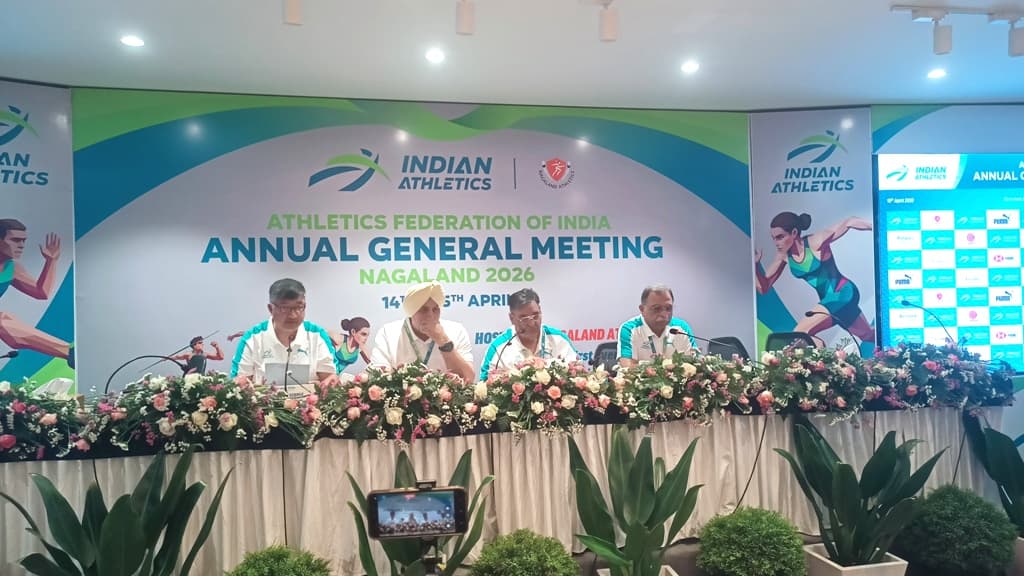
KOHIMA — The Athletics Federation of India (AFI) annual general meeting concluded in Kohima on Wednesday with a series of key decisions, including mandatory SRY gene testing for national participation, DNA profiling of athletes, restructuring of district bodies, and a nationwide push to popularise athletics.
The decisions were announced at a press conference held in Kohima, addressed by Dr. Lalit K Bhanot, President of the South Asian Athletics Federation; Dr. Adille J Sumariwalla, Vice President of World Athletics; Bahadur Singh Sahoo, President of the Athletics Federation of India; and Abu Metha, President of the Nagaland Athletics Association and Vice President of AFI.
Abu Metha described the two-day AGM as “successful and historic.” He added that delegates were hosted by the governor at Lok Bhavan and that AFI leadership would meet the chief minister to discuss sports development.
AFI President Bahadur Singh Sahoo said that all agenda items were discussed in detail with participation from representatives of states and districts.
Dr. Bhanot appreciated the government of Nagaland for hosting the meeting and said the decisions taken would help further develop athletics in the country.
Also read: AGM 2026 of Athletics Federation of India begins in Kohima
Among the key decisions, AFI has made the SRY gene test mandatory for participation in national competitions, with the cost to be borne by the federation through government support. He noted that while the test is expensive, it is necessary at the national level.
He also informed that AFI will begin DNA profiling of athletes for development purposes, starting with around 100 athletes this year to build a performance database.
To promote athletics at the grassroots level, AFI decided to reconstitute district bodies. Each district executive committee will have 15 members, with only four from headquarters and the rest representing villages, blocks, or mandals.
The federation also decided to organise a 2-km race across 700 districts every year on August 30 to popularise athletics nationwide, marking the day India won its first World Championships gold medal.
The AGM also adopted the “Kohima Declaration,” committing to nation-building through sports, promoting athletics across the country, strengthening institutional collaboration, and creating opportunities for youth to represent India.
The declaration further emphasises focused development of athletics in Nagaland and the Northeast through infrastructure, capacity building, and positioning the region as a hub of athletic excellence.
The AFI placed on record its appreciation to the government and people of Nagaland for their hospitality, noting that this was the first time a national sports federation held its AGM in the state. It also highlighted Kohima’s historical significance as the site of the Battle of Kohima during World War II.
Dr. Sumariwalla stressed decentralisation to take athletics to the grassroots, including villages and small towns.
He informed that the executive boards of Chhattisgarh and Arunachal Pradesh have been suspended, with ad-hoc committees to be formed, while Tripura and Manipur have been placed on a watch list and downgraded to associate members without voting rights.
He also said Karl Gunter Lange (Germany) and Michael (UK) have been appointed as High Performance Directors for seniors and juniors, respectively.
Discussions on athlete sponsorship agreements have been kept on hold for further consultation to safeguard both athletes and sponsors.
Responding to queries, Dr. Bhanot said AFI will provide technical support, coaching education, and guidance for academies in the Northeast, while infrastructure development will remain the responsibility of the government.
He noted that the region has strong potential in middle- and long-distance running as well as race walking.
On athlete selection, he clarified that it is purely performance-based and not region-specific, and assured that more national-level competitions would be organised in Nagaland.
Metha added that, apart from infrastructure, developing human resources such as coaches, athletes, and technical officials is crucial. He noted that Nagaland has already developed over 100 technical officials with support from AFI.
The federation reiterated its commitment to strengthening athletics across the country in collaboration with all stakeholders.