


Temjenmenba inaugurates District Transport Office in Dimapur, highlights revenue role and future transport system plans in Nagaland.
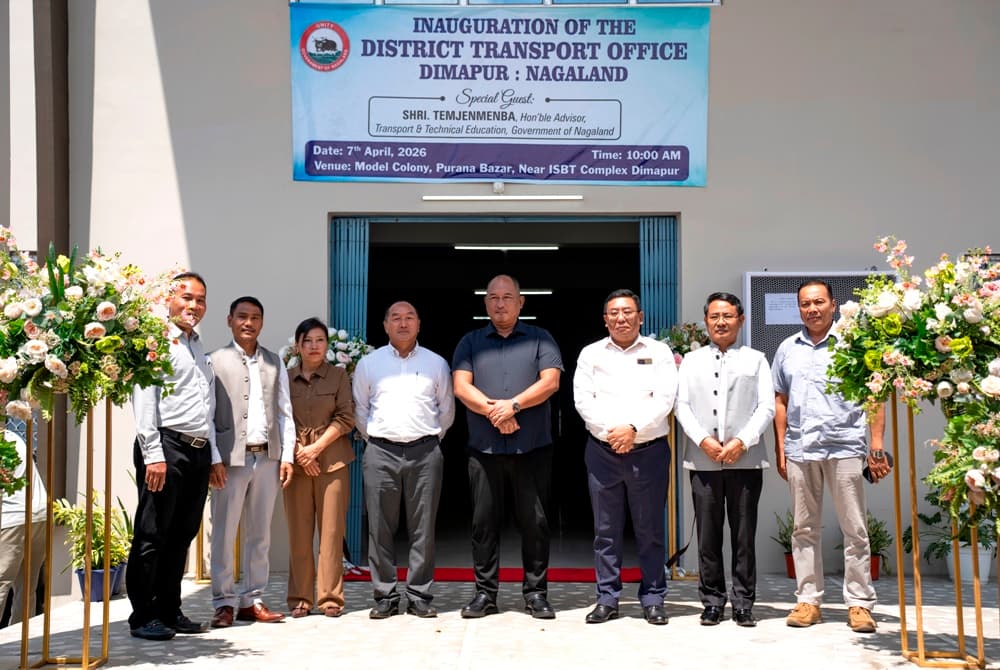
DIMAPUR — Advisor of Transport and Technical Education, Temjenmenba inaugurated the District Transport Office, Dimapur, at Model colony, Purana Bazar, near ISBT Complex, on Tuesday.
Addressing the gathering, the advisor said that the Transport Department is unlike many others department, as it serves as a key revenue generating arm of the state government.
Temjenmenba stressed that the manner in which officials deal with the public is of utmost importance, noting that many citizens visiting transport offices may not be familiar with procedures related to documentation and services and it is the responsibility of the department’s staff to guide such individuals with patience and professionalism, ensuring that their work is completed.
Dimapur being the state’s main commercial hub, he urged the officials to work with diligence, a strong sense of duty, and professionalism to meet their targets.
He added that the role of the department extends beyond issuing driving licences and registration certificates, encouraging innovation and expansion of services.
Also read: DC Dimapur office to remain shut April 6–9 for relocation
District Transport Office Dimapur to operate from Purana Bazaar starting April 1
The advisor informed that the department is actively pursuing the implementation of an Intelligent Transport Management System with the Government of India, which would improve traffic management, enhance revenue collection, and help reduce road fatalities.
Describing the Transport Department as the second-highest revenue-generating department in the state, Temjenmenba said that the officials should take pride in their contribution and remain motivated.
He also stated that the department has every right to seek necessary support and infrastructure from the state government to further boost revenue.
Pointing out the state’s financial constraints, he noted that with the 16th Finance Commission discontinuing the revenue deficit grant, the department’s role has become even more critical in bridging the gap.
WATCH MORE:
The advisor further called for greater coordination among sister departments and urged all stakeholders to work collectively towards strengthening the department and achieving its objectives.
Executive Engineer, NST Dimapur, Renben Kikon, who presented the technical report, informed that a total land area of 19,200 sq. ft. has been transferred for the department.
He stated that the project was sanctioned in 2022–23 under the State Plan (Development) with a total cost of INR 499.86 lakh and was awarded to M/s Niholu Ayemi, a Class-I contractor, with a stipulated completion period of 36 months.
The work commenced on July 3, 2023, and was completed in October 2025 within 28 months.
The infrastructure includes a two-storey RCC building, a canteen with kitchen (450 sq. ft.), and two rooms for a pollution testing unit (250 sq. ft.), along with a paved parking area of about 1,000 sq. m.
It is also equipped with a sand filtration tank and underground reservoir of 30,000-litre capacity, a 63 KVA electrical substation, and a firefighting system.
The ground floor (4,275 sq. ft.) houses the Vahan section for vehicle registration and the Sarathi section for driving licences, along with a public lobby, inquiry/help desk with form-filling facilities, rooms for field officers including enforcement staff, and separate public washrooms.
The first floor (3,690 sq. ft.) comprises five rooms for officers and staff, a conference room, a record storage hall, and separate washroom facilities for office personnel.
A brief report on the project was presented by Transport Commissioner of Nagaland, Elias T Lotha, while the Commissioner & Secretary for Transport, Robert Longchari, in his short address, stated that the office of the Transport Commissioner is the second-highest revenue-generating in the state after the Taxes department, and thus plays a crucial role not only in public service delivery but also revenue generation for the government.