


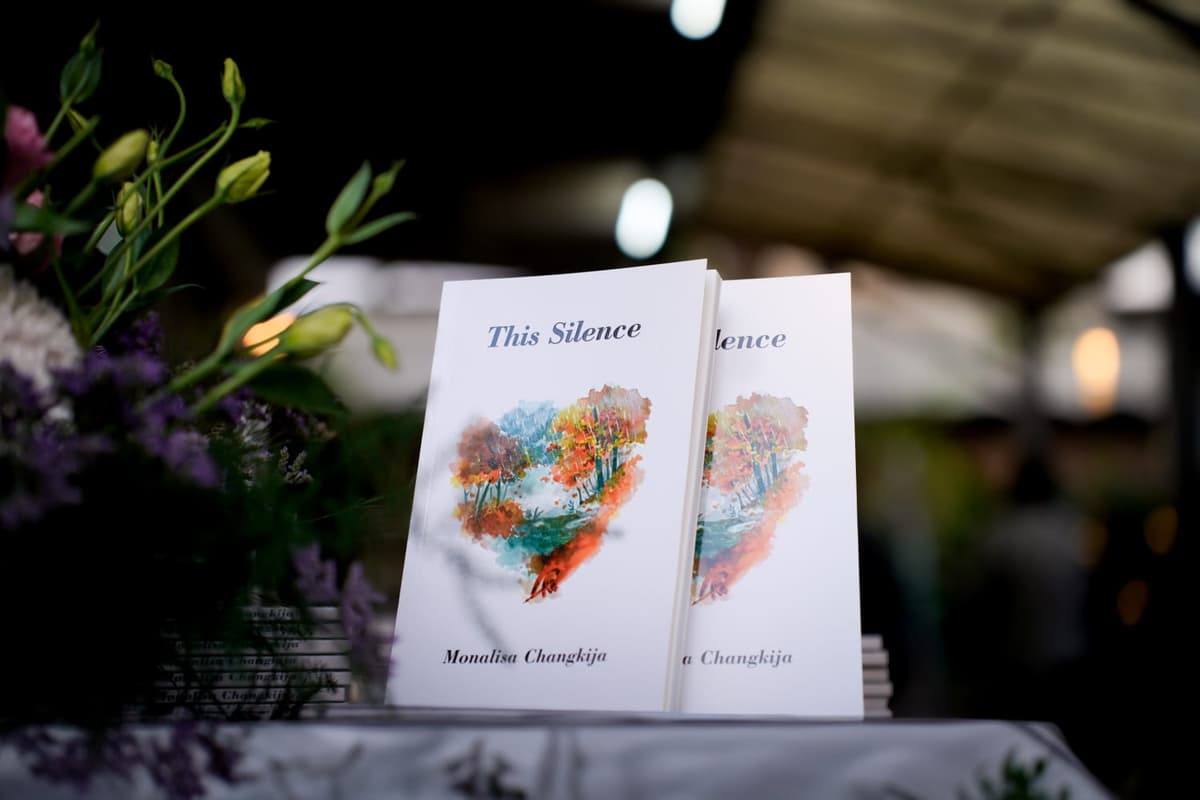
Here is book review of Monalisa Changkija’s third and latest collection of poetry, compellingly titled This Silence.
Share


‘For what is a poem but a hazardous attempt at self-understanding- it is the deepest part of autobiography’
This quote from Pulitzer Prize winning Poet, Robert Penn Warren, comes to mind while reading Monalisa Changkija’s third and latest collection of poetry, compellingly titled This Silence. The poems, varied in theme, fluid and evocative in her signature free verse style reads like the memoir of a woman looking back, contemplating her life. This woman is bold, unfiltered and unapologetic. Profound.
The anthology opens with In My Mind, a melancholic poem on grief and loss, on living with the pain of missing someone dear. The final stanza expresses frustration as well as acceptance, in coming to terms with loss.
In my mind, I’m constantly conversing with you
about my relationships with my mother,
mother-in-law and daughter,
my fears and phobias, my joys and laughter,
my anxieties about my sagging body,
thinning hair, tiny wrinkles around my eyes,
and my graying mind,
about my success with alcohol,
defeat with cigarettes, my impatience
and my inability to cry out loud
and call you.
Poems that follow, such as Illusion/ Reality, Confession, Moments of Truth, amongst others, continue to explore the many layered complexities of grief with raw honesty and an open vulnerability. When I Weep does away with keeping up appearances and poignantly embraces grief with the verses;
I am done with facades,
my lips hurt from decades
I am done with definitions,
descriptions, images and adulations
of the hyped, the hyperboled
‘strong woman’ ~
inevitably perceived as high-strung and hyper-sensitive
Now I will be human
and weep when it hurts,
A bit of brokenness is necessary to create art. And so, brokenness here finds its release in poetry, as attested through these lines from the poem Because;
It is because I’m lost
I can find my poetry and music within me
to guide me to where
I can be found.
Vernal Showers is a particular favorite, emotively weaving verses on finding healing in nature, in springtime showers;
These vernal showers
that lash against
my window panes
or pour gently
on my roof top
cleansing and renewing
my entire being
But grief is a relentless companion, stubbornly persisting. In the same poem, the poet masterfully navigates joy alongside heartache with the following lines;
These days
I take
what I can
giving what
I have
knowing these
vernal showers
gently pouring outside
no longer hold
dreams of passion
or promises
for one steriled,
and exiled
by advancing years
……….
What a shame
these vernal showers
cannot wash away the stains
nor put out the fires.
As with Grief, Youth and Age are also recurring themes, beautifully juxtaposed with poems like Sunset, Marks of Time, Age Related & Age Defying and At my Age. They say is a lovely little poem which instills courage to just be, to speak up and not be confined or restricted by societal norms.
Must I know how to sing, to sing?, the poet challenges.
For students of literature, Changkija’s writings are often associated, if not synonymous, with themes pertaining to gender, protest/resistance, and culture. In this regard, the poet does not disappoint with Take this Name a thought-provoking poem which takes on the Ao Naga custom which stipulates that only the name of a married woman may be returned after her death, if she was married into another village. The poet urges that her name to be taken now, on her own volition, and asks;
Why wait for death to take
what must anyway be returned?
Themes on mortality and death pervade throughout the collection with powerful poems like When I die, The Hours say, Is it Time Already? and When I Died. Changjika has the ability to treat seemingly grave themes with a lightness which is familiar, while still deep and contemplative. Skillfully employing sparse language, the two-line poem You said, I
replied elucidates how there are greater fears than physical death.
“People die, you know”, you said
“Yes, I know. But only if we forget they lived”, I replied.
At times, the reader might feel like he or she is in intimate conversation with the Poet, other times, there is a quality of listening into a private conversation or an inner monologue. That many of the poems are dated lends a touching intimacy to the entire collection and forges a familiarity between the poet and reader.
Don’t bank on me is written with refreshing directness as evidenced by these candid excerpts from the poem
I really don’t know what tomorrow would bring
I’m only a journalist, and a human to boot
Not a soothsayer.
…...
And who am I to challenge
the tenets of democracy,
and the role of the Fourth Estate
I vowed to uphold, on my own volition,
which wasn’t anyone’s bone of contention,
when I made my decision.
Be all that as they may,
go ahead, and do your thing.
I just want you to know
Don’t bank on me.
…..
I’ve never been a good shoulder to cry on,
I’ve never pretended otherwise.
And I’m not about to change my ways.
Poems like Moments of Truth, Empowerment, Irrelevant, Master Suckers and Miasma continue in the same autobiographical vein which is resilient and uncompromising, with a touch of irreverence. Unfinished Business is delightfully unabashed with its acceptance of an unfinished business between two friends which might always remain unfinished.
The title poem This Silence and Conversation with Silence personify silence in a way that is discomfiting while deeply heartfelt.
The poem Music in the bathroom, effectively ties the spirit of the entire collection- which is indisputably indomitable. The poet writes;
I resolved ~ from today I quit
cigarettes, all toxicities ~ people and non-people,
exercise, lose weight, stuff myself with fruits and veggies,
generally do what Doctors say I must.
And all this I resolved after lighting another cigarette,
while pouring myself a Brandy
~ what’s a girl to do when it’s a dark cloudy day, freezing?
And our Power Department decides to take a break,
maybe it’s worked for the best ~
I discovered I am a great bathroom singer
I could sing all the notes, you know.
With 2020 starting with a freezing water bath.
I think the message is clear
~ I must now consider a career in music in the bathroom.
In light of the range and nature of themes, this specific choice of poem seems intentional and movingly symbolic. The struggles and aches remain, and yet, in the new year, the poet chooses to shift focus on music in the bathroom. This is Monalisa Changkija.
Dr. Avinuo Kire
(The writer is a noted poet and author)