


Here is review of Monalisa Changkija’s latest book This Silence, a collection of poems.
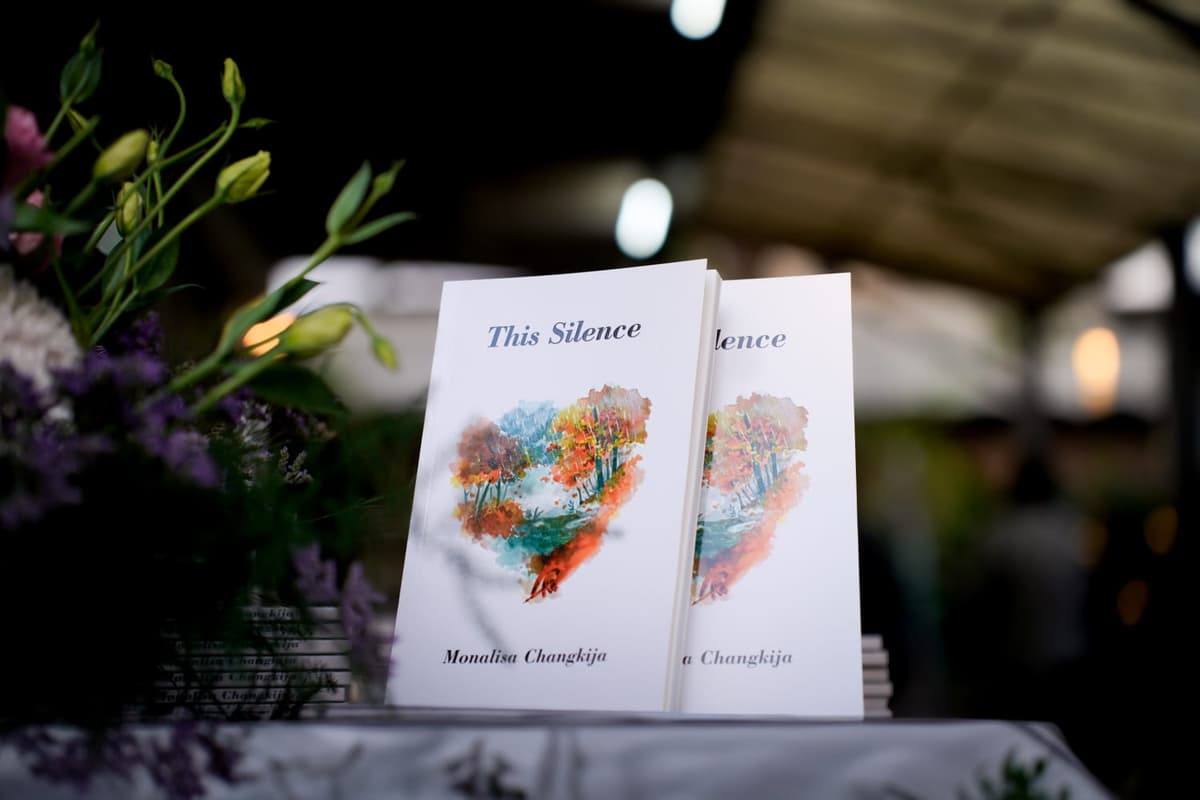
There are some women who appear to the world as strong, courageous and bold, but who occasionally bare the secret sufferings of their souls through poetry.
Because poetry is the medium through which a poet may act as the “unacknowledged” legislator of mankind; it can also provide the path of escape to souls immersed in pain.
Monalisa Changkija is known to the world as someone who upholds the civil rights of the indigenous people of her community not only through her journalistic writings but also through participation in long-drawn litigations to restore constitutional rights of the people. She has also been the most outspoken spokesperson for gender rights at home and outside. In one of her earliest publications, a book of verses called Weapons of Words on Pages of Pain (1993) Monalisa has reflected deeply on domestic violence which exists in most societies including that of the Nagas, and asserts that the problem is personal as well as political for her. Against the weapons of violence which the patriarchal society wields in order to silence women, she triumphantly holds up her weapons of words which have the power to sensitize the society about an inhuman system where men assume the role of God: “If God made man/in his own image,/where shall the battered seek Justice?” In her rich array of journalistic pieces and middle-liners too, Monalisa boldly comments on the political and social problems confronting the Naga society which has just crossed the threshold of a new millennium.
On a personal note, I have been reading Monalisa’s poems eagerly for more than a decade and a half now. To be more specific, I chanced upon her poems at the time when I was collecting pieces of writing from the North-eastern region of the country for an anthology which was published by the Oxford University Press in 2011. I was immediately captivated by her forceful, yet sensitive, expression of concern for the wounds inflicted by insensitive people on nature as well as human beings and her bold protest against the gun-culture which has been destroying the lives of people of the Northeastern region. In some of her poems collected in Monsoon Mourning, I have discovered qualities which can move the readers to reflect deeply on life, death and the mysteries of nature. These poems also hold out hopes for a better future for humanity:
Become as real as the nightmare now
We will gather around the fire
On moonlit nights as did our forefathers
And silence the gunfire with our songs…
When such a woman bares her secret sufferings through poetry, one is awestruck by these unseen dimensions to her personality. The poems which find a place in the present volume seem to be resurrecting some thoughts which had been pushed to the secret chambers of the poet’s heart during her tumultuous career as a successful journalist and social rights activist. These poems are genuine songs springing from a suffering heart: as she abandons all facades and cries out in
When I weep:
I am done with facades,
my lips hurt from decades
of keeping them stiff.
I am done with definitions,
descriptions, images and adulations
of the hyped, the hyperboled
‘strong woman’ ~
inevitably perceived as high-strung and hyper-sensitive
Now I will be human
and weep when it hurts,
smile otherwise
and confess all fears,
frustrations and failures
that come with the living,
the aging and the diseased.
Now I will heed to
the human me
and revel in
solitude’s offerings.
The reader will at once discover another kind of boldness in this volume called This Silence. In the poet’s silent communion with her heart, she redefines the meaning of concepts like ‘empowerment’ and ‘liberation’ which are used so casually in everyday parlance or in public speech: “If my personal, private, professional and public life/must adapt and suit to yours/I am a long way from empowerment”, says the poet . Such realisations are a sign of maturity for a writer and the sensitive reader can only celebrate this necessary transition in her career.
Dr. Tilottoma Misra
(The writer is an author and former Professor of English, Dibrugarh University)