[caption id="attachment_191499" align="alignnone" width="550"]
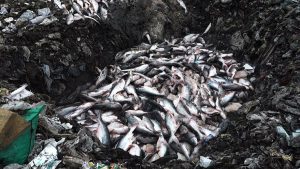 The seized fish in Kohima. (EM Images)
[/caption]
Our Correspondent
Kohima, June 25 (EMN): In a major haul, authorities on Monday seized 5280 kg of fish treated with formalin being transported in four mini-trucks at the by-pass area in Kohima. Three of the vehicles were bound for the capital town while one was on way to Pfutsero in Phek district.
The seizure was made barely three days after the Food Safety cell of the department of Health and Family Welfare issued a notification prohibiting storage, distribution or sale of fresh fish products. The products include crustaceans treated with formalin or other forms of preservatives. The notice was for a period of three months or until corrective measures are taken. The authorities discovered that several fish vendors were selling fresh fish products treated with formalin, a highly toxic chemical injurious to health.
Food safety officer for Kohima Kezhangulie Yimchunger said a tip-off was received about fish products being transported. In coordination with the Kohima Municipal Council (KMC), district administration and volunteers from Kohima Village Youth Organization (KVYO), the department’s personnel intercepted four vehicles during the early hours of Monday. The shipment was found to have been treated with formalin when tested in the mobile food testing laboratory (Food Safety on Wheels) stationed at the spot by the authorities. The fish that were tested include ‘pankaj,’ ‘rohu,’ and ‘katla,’ some of the commonest choice of fish for the local population.
Formalin, which is used to preserve dead bodies, is said to be a toxic chemical and can cause serious health problems even if consumed in small quantities. The most common ailments it can cause include damage to kidney and long-term use can be carcinogenic i.e., having the potential to cause cancer, Yimchunger said.
The officer informed that the contaminated fish were disposed off at the KMC garbage dumping site near Meriema, in the presence of the state’s Food Safety Commissioner Himato Zhimomi and other officials from the Health department, and the police, KMC, and district administration.
It was learnt that the owners/dealers of the seized products were yet to be identified, but the authorities informed that investigation and legal course of action would be carried out.
The Food Safety and Standard Authority of India (FSSAI) has recently created a new scheme and along with it, the Food Safety on Wheels, to strengthen the food testing system to create a network of modern food testing laboratories in the state. The main aim of the scheme is to educate vendors and consumers food safety norms and practices. Besides, it aims to ensure that nutritious food is sold and consumed by the public.
The health department’s order prohibiting sale of fish products containing toxic chemicals stated: “in pursuance of Regulations 9.1 of Food Safety Standards (Food Products Standards & Food Addictives) Regulation 2011, the term “fresh” refers to fish and fish products including crustaceans that are untreated except for refrigeration, storage on ice, or freezing upon catching at sea or in lakes or other bodies of water in order to prevent decomposition and spoilage.
“And whereas, distribution, storage and sale of fresh fish products treated with formalin or other forms of preservatives render the article of “unsafe” under Section 3(1)(zz)(v) of Food Safety and Standards Act, 2006. Therefore, in exercise of the power conferred ... under clause (a) of sub-section (2) of section 30 of Food Safety and Standards Act, 2006, do hereby prohibit storage, distribution or sale of fresh fish products including Crustaceans treated with formalin or other forms of preservatives in the State of Nagaland for a period of three months or till corrective measures are taken with immediate effect from the date of issue of this notification.
“Failure to comply with the provision of the Food Safety and Standards Act, 2006 and the Notification will attract penalties up to INR 10,00,000 with imprisonment under section 59 of the Food Safety and Standards Act, 2006.”


