


Around 5,000 Nagaland Police personnel are battling drug and alcohol addiction, prompting calls for prevention and rehabilitation.
Share


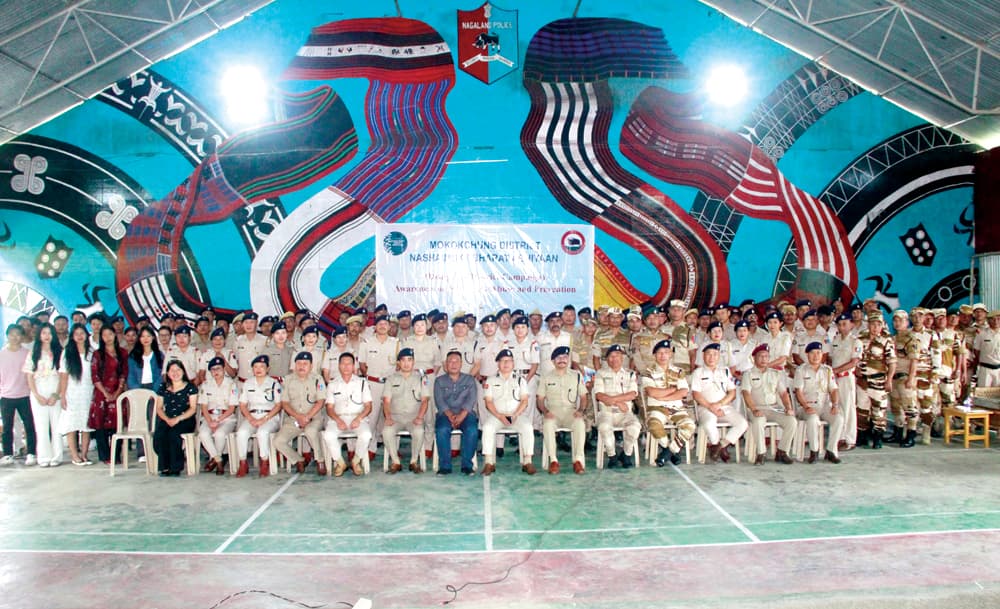
CHUCHUYIMPANG — Around 5,000 police personnel in Nagaland are battling addiction to drugs and alcohol, a senior officer revealed, terming it a major concern for the department.
Senior Superintendent of Police (SP) Mokokchung, Vesupura Kezo, disclosed the alarming figure while addressing an awareness programme on substance abuse and prevention organised by the District Executive Force (DEF) Mokokchung under the Nasha Mukt Bharat Abhiyaan (Drug-Free India Campaign) at New Reserve, Mokokchung, on June 19.
Kezo stated that police personnel who fall into substance abuse become liabilities to the department and called for collective efforts from all quarters to eradicate the menace of drugs and alcohol.
“The first step towards wiping out this problem is prevention,” he asserted, noting that once addiction takes hold, withdrawal becomes extremely difficult.
He lauded Director General of Police (DGP) Rupin Sharma for leading a strong campaign against narcotics in the state.
“The department under DGP leadership is waging a determined war against drugs. While the fight is far from over, the results so far have been commendable, with significant seizures and arrests,” Kezo said.
Also read: Promises vs. Reality: Inside Nagaland’s war on drugs
However, he cautioned that arrests and seizures alone would not win the battle.
“We need the support of all stakeholders through sustained awareness drives, outreach programmes, and rehabilitation efforts to effectively tackle substance abuse in our society,” he added.
Kilang Imsong, director of Life Anew Foundation and a recovering drug addict with over 20 years of experience, shared sobering insights drawn from his personal journey.
He revealed that his rehabilitation centre currently has 98 clients, including six serving police personnel.
Imsong highlighted the widespread nature of the problem in Nagaland, which has an estimated population of around 20 lakh.
“Roughly 30 percent of the population is directly or indirectly involved in drug abuse. If the trend continues, the number of addicts is likely to double in the coming years,” he warned.
He clarified that alcoholism should not be viewed separately from drug addiction. “Alcohol is the oldest drug and it is equally addictive,” he said.
Describing addiction as a “progressive disease” that is incurable but can be arrested, Imsong stressed that recovery is a lifelong journey. He explained that without intervention, the condition worsens over time, leading to severe consequences.
He added that addicts often become selfish and self-centred, thinking only of their next fix, which leads to financial ruin, criminal behaviour to sustain their habit, and eventual deterioration of physical and mental health, sometimes progressing to self-harm, suicidal thoughts, and death.
The programme also featured legal awareness sessions on the Narcotic Drugs and Psychotropic Substances (NDPS) Act 1985 by SDPO Mokokchung headquarters Aekant Jain, and on government employees’ conduct rules by Additional SP Mokokchung, Y Tumchobemo Yanthan.