


Nagaland Forest Department admits poor public awareness of the Wildlife (Protection) Act, 45 years after its adoption.
DIMAPUR — More than four decades after the Wildlife (Protection) Act was adopted in Nagaland, public awareness of the legislation remains poor, with the Forest department admitting that efforts to educate communities about wildlife protection and conservation have fallen short.
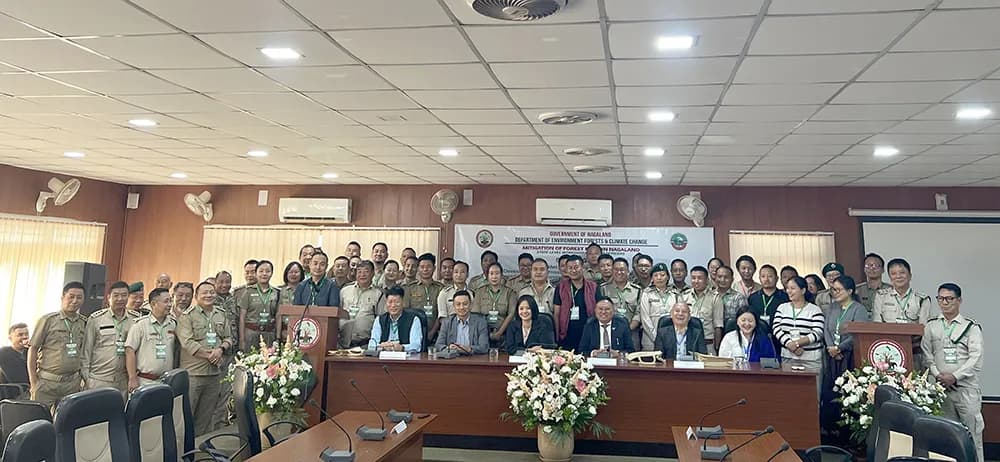
Principal Secretary and Development Commissioner Y Kikheto Sema acknowledged the failure while addressing a workshop on mitigation of forest fires in Nagaland, organised by the State Environment & Forestry Training Institute (SEFTI) and the Department of Environment, Forests & Climate Change in Dimapur on Friday.
He pointed out that although the Wildlife (Protection) Act was enacted nationally in 1972 and adopted in Nagaland in 1981, people continued to lack awareness of the provisions, including what was permitted and prohibited under the law.
Acknowledging that the department had failed to adequately educate the public, Sema directed the principal chief conservator of forests (PCCF) and senior officers to publish the dos and don'ts under the Act in all Naga languages and distribute them across the state.
He also urged the Education department to incorporate biodiversity and wildlife-related topics into the elementary school curriculum, while asking churches to include environmental awareness in their pulpit teachings.
The emphasis on public awareness and community participation comes amid concerns over the state's declining forest cover and the challenges of protecting natural resources under Nagaland's unique landownership system.
Nagaland lost 795 square kilometres of forest cover between 2013 and 2023, accounting for about 5% of its total geographical area. The figure was highlighted by Sema at the workshop, where he stressed that conservation could not be left to the Forest department alone.
He pointed out that unlike most other states, land in Nagaland was predominantly owned by individuals and communities under the protection of Article 371A of the Constitution. The government and Forest department, he said, owned less than 5% of the state's land and forests.
Sema called for a shift from a department-centric approach to community-based conservation, urging Forest officials to work closely with village councils, village development boards, youth organisations and women's groups.
Identifying jhum cultivation as the primary cause of forest fires in Nagaland, Sema acknowledged that the practice could not simply be stopped, given its importance to rural livelihoods and traditional practices.

With around 70% of the state's population living in rural areas and depending on agriculture and allied activities, he said jhum cultivation remained closely connected to the social and cultural life of communities. Traditional songs and festivals, he observed, were also intertwined with the cultivation system.
However, he cautioned against unscientific burning, warning that it damaged not only forests and biodiversity but also soil and water resources. Such practices, he said, had wider implications for climate change, food security, livelihoods and the long-term economy.
The other major cause of forest fires identified by Sema was hunting and the collection of forest produce, during which fires were sometimes lit carelessly. He urged communities to exercise greater caution and adopt practices that would minimise damage to surrounding forests.
Calling for a more preventive approach to forest fire management, Sema outlined the need to move away from reactive firefighting towards early intervention and preparedness.
He directed Forest officers to identify and map fire-prone areas in their respective jurisdictions and coordinate with district administrations and local institutions. He also called for greater use of Forest Survey of India satellite alerts, Geographic Information Systems and remote sensing to monitor vulnerable areas and improve preparedness.
Meanwhile, Lhinghoikim Touthang, IFS, Conservator of Forests (RPU), in her keynote address, stressed that prevention should remain the foremost priority in forest fire management.
She said that once a fire started and spread, even if it was eventually contained, the damage to life, property, biodiversity and infrastructure could not be undone. The extent of damage and the measures required to contain a fire also varied according to terrain, slope, environmental conditions and available resources, she said.
Recounting her experience during the Dzukou Valley forest fire in 2014-15, when she was a probationer, Touthang said the incident had taught her the importance of community participation and inter-departmental coordination in protecting natural resources.
She recalled that the valley, which she had previously known only through photographs, appeared completely blackened when she first encountered it during the fire.
Touthang said that accurate vulnerability mapping, early warning systems, appropriate firefighting equipment and community participation were essential to prevent forest fires from causing widespread destruction.