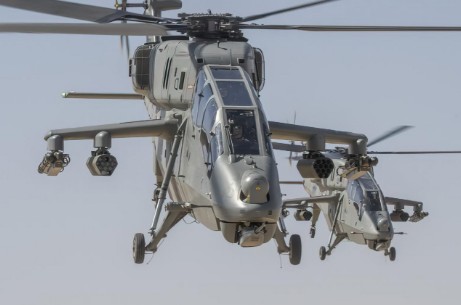
Representational
image of Light Combat Helicopter (LCH) Prachand.
NEW DELHI — The
year 2024 was marked by transformative achievements, with numerous
path-breaking advancements and strategic milestones in the defence sector. The
Ministry of Defence (MoD) and the Indian Armed Forces made significant strides
in enhancing national security, technological capabilities, and defence
exports.
In a major breakthrough, India and China arrived at a broad
consensus this year aimed at restoring the ground situation along the Line of
Actual Control (LAC). Both sides held massive diplomatic and military dialogues
to resolve the deadlock. The breakthrough was achieved based on the principles
of mutual and equal security.
Defence Minister Rajnath Singh, during the Chanakya Defence
Dialogue on October 24, affirmed that the consensus showed how sustained
dialogue can bring about solutions.
Record budget and indigenous production
In the Union Budget for FY 2024-25, the MoD was allocated a
historic INR 6.22 lakh crore, the largest among all ministries. To bolster
India’s self-reliance in defence, the Ministry introduced the fifth Positive
Indigenisation List (PIL), which includes 346 strategically important items
such as Line Replacement Units, spares, and raw materials.
The Ministry also achieved a record growth in indigenous
defence production, which surged to INR 1,26,887 crore in FY 2023-24,
reflecting a 16.7 per cent increase from the previous year.
Defence exports hit a record INR 21,083 crore in FY 2023-24,
marking a 32.5 per cent rise over the previous fiscal. Over the past decade,
Indian defence exports have grown 31 times since FY 2013-14, driven by the
concerted efforts of both the private sector and Defence Public Sector
Undertakings (DPSUs).
Major defence projects and collaborations
In October 2024, Prime Minister Narendra Modi and Spanish
President Pedro Sanchez jointly inaugurated the TATA Aircraft Complex in
Vadodara, Gujarat, for the manufacturing of C-295 transport aircraft.
This complex is part of a INR 21,935-crore contract signed
with Airbus Defence and Space in September 2021 for 56 aircraft, with 40 to be
built in India by TATA Advanced Systems Limited (TASL). Six of the 16 aircraft
have already been inducted into the Indian Air Force (IAF).
Several key indigenous defence systems made significant
progress this year.
The Indian Light Tank (ILT) 'Zorawar' successfully completed
trials in high-altitude regions, demonstrating its operational effectiveness in
challenging terrains.
The INS Arighaat, the second Arihant-class submarine, was
commissioned into the Indian Navy on August 29, 2024.
INS Tushil, a multi-role stealth-guided missile frigate, was
commissioned on December 9, 2024, in Russia, further strengthening India’s
naval capabilities.
The Light Combat Helicopter (LCH) Prachand was fully
inducted by the IAF in February 2024, marking a significant addition to India’s
defence arsenal.
Significant defence contracts
Several strategic defence contracts were signed in 2024.
A contract for 240 AL-31FP Aero Engines for the Su-30MKI
aircraft fleet was signed in September 2024 for over INR 26,000 crore.
A procurement agreement for 12 Su-30MKI aircraft worth INR
13,500 crore was inked in December 2024.
Two contracts for 34 Advanced Light Helicopters (ALH) Dhruv
Mk III for the Indian Army and Indian Coast Guard were signed in March 2024 at
a total value of INR 8,073.17 crore.
Other major contracts include the acquisition of BrahMos
missiles worth INR 19,518 crore and the short refit and dry docking of INS
Vikramaditya for INR 1,207.5 crore.
Gaganyaan programme
In a landmark achievement, the Gaganyaan Programme, aimed at
India’s first human spaceflight mission, made significant progress. Four Indian
Air Force (IAF) astronauts were selected for training at NASA for the Axiom-4
mission to the International Space Station in 2025. The astronauts were awarded
the ‘Space Wings’ by Prime Minister Modi in February 2024.
Operational preparedness and security
The Indian Army maintained a high state of operational
preparedness, ensuring dominance along critical frontiers, including the LAC
and Line of Control (LC). It also continued counter-terrorism operations and
prioritised infrastructure development in border areas. The security situation
in Jammu and Kashmir remained stable, with improvements despite occasional
security challenges.
India also advanced its technological capabilities with the
Unexploded Ordnance Handling Robot (UXOR), developed by the R&DE (Engr) in
Pune. The robot, which can handle unexploded ordnance up to 1,000 kg, was
inducted into service in August 2024. The Indian Air Force (IAF) also inducted
indigenous Counter Unmanned Aerial Systems to neutralise aerial threats.



 Representational
image of Light Combat Helicopter (LCH) Prachand.
Representational
image of Light Combat Helicopter (LCH) Prachand.