


A five-day workshop at Tetso College developed a working prototype of the Nagaland Language Digital Hub featuring 13 interactive learning activities for 12 Naga languages.
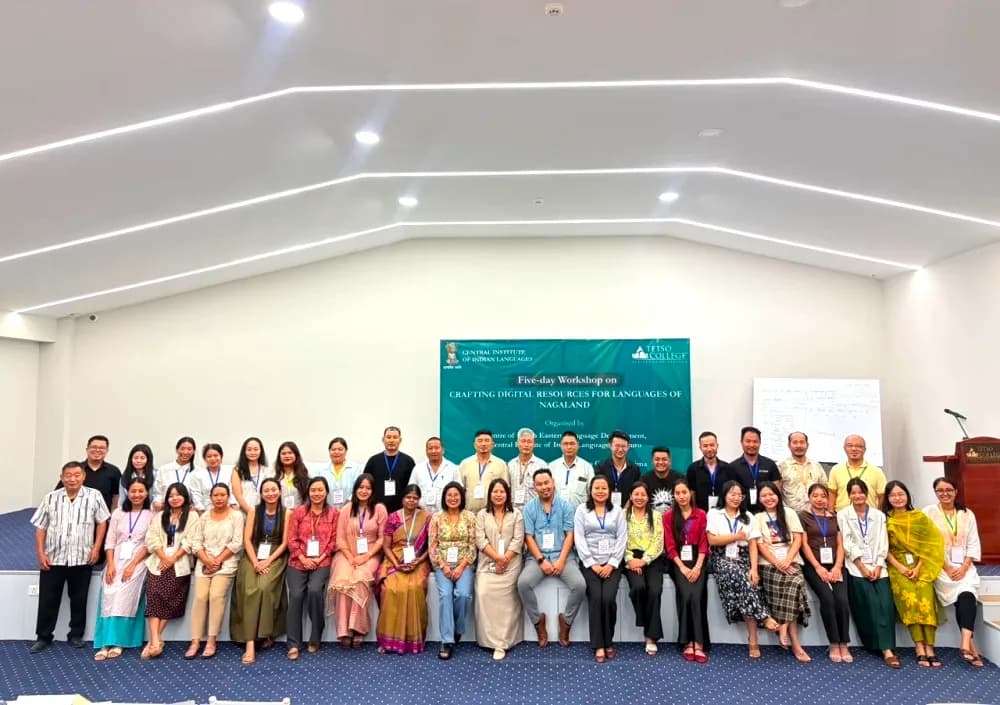
DIMAPUR — A five-day workshop aimed at developing digital resources for the indigenous languages of Nagaland concluded at Tetso College, Sovima, Chümoukedima district, on August 22, with a working prototype of the Nagaland Language Digital Hub emerging as a key outcome.
The workshop, titled “Crafting Digital Resources for the Languages of Nagaland”, was organised by the Central Institute of Indian Languages (CIIL), Mysuru, in collaboration with the Department of Linguistics, Tetso College.
According to a press release issued by Tetso College, the workshop brought together linguists, language experts, community resource persons and native speakers to work on language-data collection and the development of digital learning resources.
Twelve Naga languages—Angami, Ao, Khezha, Khiamniungan, Konyak, Lotha, Phom, Rengma, Sangtam, Sumi, Tikhir and Zeme—were selected as the preliminary batch for the workshop.
Representatives of the participating languages worked with linguists and technical resource persons on language-data collection, audio recording, transcription, verification and the development of prototype digital resources.
A major outcome of the workshop was the development of a working prototype of the Nagaland Language Digital Hub using language data collected from the participating communities.
The prototype demonstrates how community language materials can be transformed into interactive digital learning activities instead of remaining limited to static wordlists or recordings.
It currently features 13 language-learning games and activities, including picture match, word match, listen and choose, listen and spell, word weave, spell it, spot the spelling, counting, memory cards, sentence builder, body map, family tree and crossword.
The activities are designed for learners at different levels, including children, teenagers, adults and heritage-language learners.
The working prototype was formally demonstrated during the valedictory programme on August 22 in the presence of Dr. Hewasa L Khing, Principal of Tetso College, workshop participants, resource persons and members of the organising team.
The demonstration highlighted how language data collected from participating communities could be integrated into interactive digital tools for language learning.
The organisers said the prototype is intended to serve as a model for developing digital resources for other indigenous languages of Northeast India.
The prototype will be further reviewed, tested and refined before the methodology and digital activities are adapted and extended to other languages.
Community participation remained central to the initiative, with native speakers and community resource persons contributing to the provision, recording and verification of language data used in developing the prototype.
The workshop brought together community knowledge, linguistic expertise and digital technology to create resources aimed at supporting language learning and community engagement.
The next phase of the initiative is planned for February 2027, when the prototype and resources developed during the preliminary phase will be further reviewed, refined and developed.
The organisers said the initiative marks a step towards language documentation, digital inclusion and language learning, while exploring the use of digital technology to support indigenous languages in contemporary educational and community contexts.