


The 10th Walu Aten of the Khensa Students’ Union commences at local ground, Khensa village.
Share


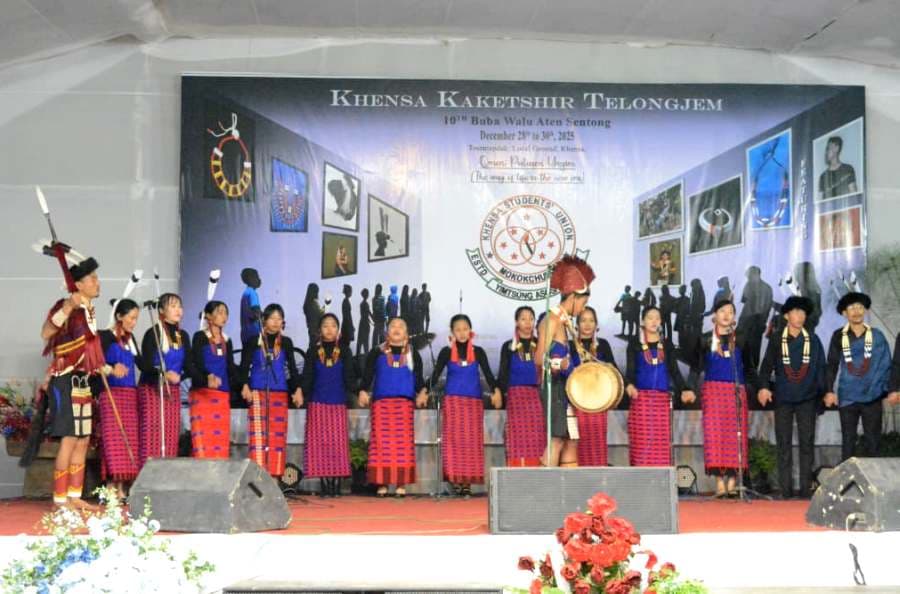
MOKOKCHUNG — The 10th Walu Aten of the Khensa Kaketshir Telongjem (Khensa Students’ Union) commenced at local ground, Khensa village, Mokokchung district, on December 28.
The three-day event is being held on the theme ‘Putusen yayim’ (The way of life in the new era).
A total of 387 delegates from seven units are participating in this year’s event — 35 from Amenyong, 26 from Mokokchung town, 48 from Dimapur, 46 from Kohima, 100 from Yimyu Ward, 67 from Yimtsüng (village), and 65 from Kongrokong.
On the opening night, Temjenzulu from the Economic and Statistical Organisation (ESO), Kohima, delivered an exhortation on the theme.
He urged the Khensa community, particularly students and youths, to reflect deeply on the present state of the village and respond with concrete and collective action.
Expressing concern over social challenges, Temjenzulu noted that Khensa is gradually turning into a “village of widows,” revealing that around 40 widows reside in the village, with nearly 80 percent of such cases linked to substance abuse.
Sharing his personal testimony, he recounted his own past struggles with alcoholism and warned about the destructive consequences of substance addiction. He called upon the students and youth to shoulder moral responsibility in addressing the issue.
He lamented that despite Khensa being an agrarian village, locals depend heavily on outside labourers, attributing the trend to growing idleness and the erosion of the dignity of labour.
He cautioned that this dependence might cause social and demographic issues in the future, stressing that one can work with dignity and earn within the village itself.
On education and economic discipline, Temjenzulu observed that while Khensa has skilled teachers and functioning government institutions, many families still prefer sending their children to private schools.
He questioned this practice and challenged the community to take ownership of its educational future, reduce unnecessary expenses, and build confidence in local institutions.
Turning to governance, he criticised the general tolerance of corruption within the community, stating that funds meant for public welfare are sometimes misused while citizens remain silent.
He urged students to raise questions and promote transparency in public affairs.
Highlighting the disconnect between discussion and practice, he remarked that although wisdom is often emphasised, it is rarely applied. He argued that the community underutilises its elders’ knowledge and experience, which could serve as valuable guidance for future generations.
Temjenzulu also linked the lack of political justice and economic progress to disunity among villagers, noting that Khensa has yet to produce an MLA.
He urged the youth to strengthen their social, emotional, and intellectual capacities to overcome divisions and work for collective advancement.
Calling for genuine reformation, he said transformation must begin at individual, family, and societal levels.
Challenging the Khensa Students’ Union to evaluate its past programmes, he asked, “Beyond social gatherings, what tangible reforms have we achieved?”
He proposed several initiatives, including educational reforms through coordination between local schools, the village education trust, village council, and students’ union; restoration of the dignity of labour; promotion of Sunday School and home evangelism; the institution of a Khensa Reformation Day; and creation of professional networking groups for knowledge exchange.
He concluded by urging self-reflection, forgiveness, and acceptance as the foundation for a truly progressive Khensa society.
The programme also marked the release of the second edition of Khensa Mongsen Yusa (Khensa Mongsen language) book by Alemyapang Longchar, ADC, Chiephobozou.
Earlier, the event was chaired by Nokrangtsüng, assistant general secretary of KKT. The invocation was pronounced by Imlilemba, home evangelist, KBA, followed by a welcome address from Walunir Tatong Tir, vice president of KKT.
The Kohima unit presented a special number, and the first round of the Walu Aten talent show competition was also held. The programme concluded with a closing prayer by Tiakokla, president of Khensa Sensotsür Telongjem.