


Share


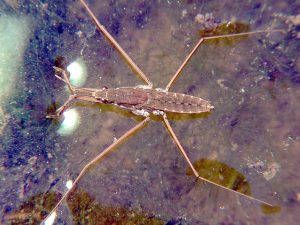 An adult water strider (Wikipedia)[/caption]
Dimapur, March 17 (EMN): Scientists from the Zoological Survey of India (ZSI) have discovered a new species of water strider (also known as water skippers or pond skaters) from Nagaland, The Hindu reported on Saturday.
According to the report, the new species named Ptilomera nagalanda Jehamalar and Chandra was found in Intangki River in Peren district.
Water striders are a group of insects adapted to life on the surface of water. Scientists working on the water striders say that their presence serves as an indicator of water quality.
“Orange with black stripes on the dorsal side and a pale yellowish brown ventral part of the body, this particular species has long slender legs and measures about 11.79 mm,” scientist Eyarin Jehamalar told The Hindu of the kind discovered in Intangki.
The presence of black stripes on the dorsal side differentiates this species from other known species of the subgenus Ptilomera. The discovery was published in the science journal Zootaxa, according to the report.
So far, only five species of water striders under the subgenus Ptilomera were known in India.
These includes Ptilomera agriodes found in peninsular India, Ptilomera assamensis found in northeastern India, Ptilomera laticaudata in northern and northeastern India, Pltilomera occidentalis from Uttarakhand and Ptilomera tigrina found in the Andaman islands.
With the discovery of Ptilomera nagalanda the number of species of water striders belonging to the subgenus has increased to six.
Other than being a good indicator of water quality, water striders also play an important role in the food chain by feeding on mosquito larvae.
There are nearly 100 species of water striders found in India across different water bodies such as open ocean, ponds, pools, lakes, rivers, streams etc.
What is unique about Ptilomera is that they are only found in rocky, fast flowing streams and rivers that are not exposed to a lot of sunlight.
Ptilomera has hair on the middle legs that help the insects resist the strong current of streams. Water striders have three pairs of legs.
The front legs are relatively shorter than the mid and hind legs and used to catch and hold prey. The striders possess needle-like mouth parts that are used for sucking the juice of prey.
Walking on water
Water striders skim across ponds and streams as if skating on ice. How do they ‘walk on water’ while staying completely dry?
Many other bugs stick like glue when they touch water, but the water strider’s feet are covered with thousands of fuzzy little hairs, called microsetae, that trap air and create a floating cushion.
These needle-shaped strands are dozens of times narrower than a human hair and coated with a special wax. Each strand also is covered with an orderly arrangement of microscopic channels, or nanogrooves. When wet, the grooves trap tiny air bubbles. The result is an effective water-repellent, or hydrophobic, barrier. Taking advantage of the natural surface tension or ‘stickiness’ of water itself, the airborne strider remains high and dry.
An adult water strider (Wikipedia)[/caption]
Dimapur, March 17 (EMN): Scientists from the Zoological Survey of India (ZSI) have discovered a new species of water strider (also known as water skippers or pond skaters) from Nagaland, The Hindu reported on Saturday.
According to the report, the new species named Ptilomera nagalanda Jehamalar and Chandra was found in Intangki River in Peren district.
Water striders are a group of insects adapted to life on the surface of water. Scientists working on the water striders say that their presence serves as an indicator of water quality.
“Orange with black stripes on the dorsal side and a pale yellowish brown ventral part of the body, this particular species has long slender legs and measures about 11.79 mm,” scientist Eyarin Jehamalar told The Hindu of the kind discovered in Intangki.
The presence of black stripes on the dorsal side differentiates this species from other known species of the subgenus Ptilomera. The discovery was published in the science journal Zootaxa, according to the report.
So far, only five species of water striders under the subgenus Ptilomera were known in India.
These includes Ptilomera agriodes found in peninsular India, Ptilomera assamensis found in northeastern India, Ptilomera laticaudata in northern and northeastern India, Pltilomera occidentalis from Uttarakhand and Ptilomera tigrina found in the Andaman islands.
With the discovery of Ptilomera nagalanda the number of species of water striders belonging to the subgenus has increased to six.
Other than being a good indicator of water quality, water striders also play an important role in the food chain by feeding on mosquito larvae.
There are nearly 100 species of water striders found in India across different water bodies such as open ocean, ponds, pools, lakes, rivers, streams etc.
What is unique about Ptilomera is that they are only found in rocky, fast flowing streams and rivers that are not exposed to a lot of sunlight.
Ptilomera has hair on the middle legs that help the insects resist the strong current of streams. Water striders have three pairs of legs.
The front legs are relatively shorter than the mid and hind legs and used to catch and hold prey. The striders possess needle-like mouth parts that are used for sucking the juice of prey.
Walking on water
Water striders skim across ponds and streams as if skating on ice. How do they ‘walk on water’ while staying completely dry?
Many other bugs stick like glue when they touch water, but the water strider’s feet are covered with thousands of fuzzy little hairs, called microsetae, that trap air and create a floating cushion.
These needle-shaped strands are dozens of times narrower than a human hair and coated with a special wax. Each strand also is covered with an orderly arrangement of microscopic channels, or nanogrooves. When wet, the grooves trap tiny air bubbles. The result is an effective water-repellent, or hydrophobic, barrier. Taking advantage of the natural surface tension or ‘stickiness’ of water itself, the airborne strider remains high and dry.